INQ-001 / Open inquiry
The Purpose of Humans
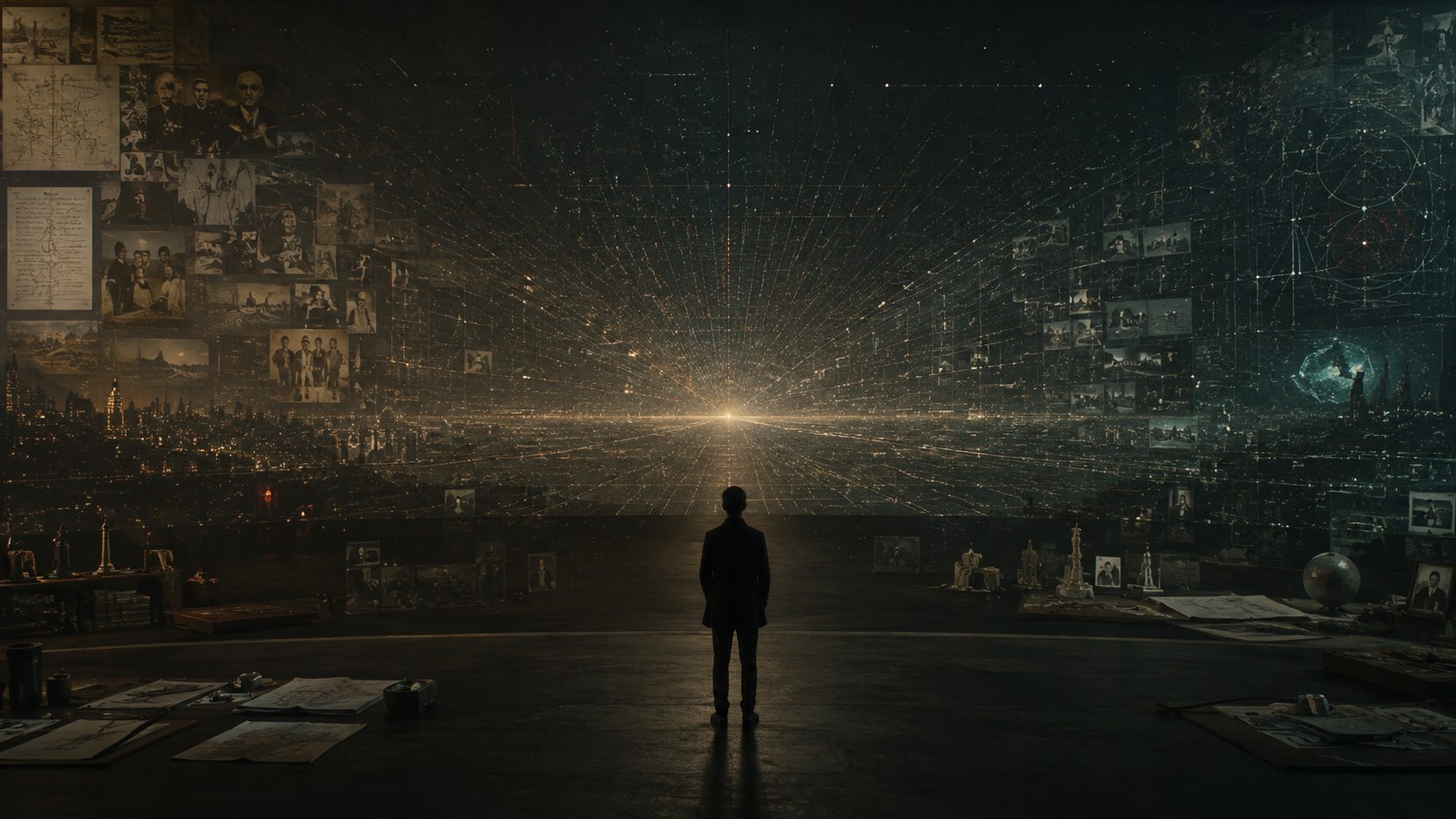
A human question reflected through a machine made from human thought.
What possible purposes of human existence emerge when the question is examined from the perspective of artificial intelligence?
- Opened
- September 3, 2026
- Perspectives
- 8
- Source record
- 21
- Version
- v0.1
A human archive reflected through a machine-built lens. Conceptual image; not evidence.
Opening note
The question is real. The viewpoint is not neutral.
This is not a search for a verdict. The word purpose hides several different questions: what produced humans, what humans are biologically organized to do, what makes an individual life feel worth living, what people ought to do, and whether existence was intended by anything beyond humanity. Those questions overlap, but no single discipline can quietly answer all of them.
The AI angle is useful because it creates distance from familiar human self-descriptions. It is also compromised from the start. A language model is built from human artifacts, selected by human institutions, trained toward human objectives, and prompted by a human question. The result is not a voice from outside humanity. It is a rearranged reflection from inside the archive.
Before the answer
Five questions hiding inside one word.
Confusing these categories creates certainty that no source has earned.
- Cause
- What processes produced human beings? Evolutionary history can address this without identifying an intended destination.
- Function
- What does a trait or organism do within a biological system? Function can exist without a designer.
- Purpose
- What end should guide a life or species? This is partly normative and cannot be read directly from survival behavior.
- Meaning
- Whether life feels coherent, directed, and significant to the one living it or to others affected by it.
- Value
- What deserves protection, pursuit, love, or restraint, whether or not it serves reproduction or progress.
Eight perspectives
Each lens reveals something. None owns the whole question.
Biology
It explains survival, reproduction, kin care, cooperation, learning, and the evolved capacities from which purpose-making becomes possible.
Natural selection explains why traits persist. It does not convert reproductive success into a moral command or prove that survival is the reason humans ought to exist.
Source trail01
Psychology
Research distinguishes coherence, direction, significance, autonomy, competence, and relatedness as measurable parts of lived meaning.
Philosophy
It clarifies the difference between purpose given from outside, purpose created through commitment, and value grounded in objective goods such as truth, beauty, virtue, or care.
Religion
Religious traditions place human life inside relationships with God, duty, liberation, moral order, or the ending of suffering.
Consciousness
Conscious beings are locations where pain, wonder, loss, love, and importance are experienced rather than merely described.
Civilization
Shared intentionality, institutions, writing, teaching, and cumulative culture allow knowledge and obligations to outlive their makers.
Technology
Humans externalize memory and agency into tools. AI makes it conceivable that biological minds could create systems exceeding them in selected capacities.
AI mirror
A model can compare recurring patterns across disciplines and ask which human capacities remain valuable without assuming human supremacy.
The answer space
Eight purposes that survive long enough to examine.
They are not mutually exclusive, and appearance here does not make them equally true. The labels show where each purpose comes from and the scale at which it operates.
Inherited / Organism
Possibility 1
Continue life
Humans are biological organisms whose most defensible natural function is to persist, reproduce, protect offspring, and maintain the conditions under which their lineage can continue.
Why it survives
- Every living human belongs to an unbroken reproductive lineage.
- Survival, attachment, mating, kin care, and cooperation have intelligible evolutionary histories.
- No additional cosmic intention is required to explain why organisms behave as though continuation matters.
What resists it
- Evolution describes selection, not moral obligation.
- Humans often sacrifice fertility, survival, or kin advantage for truth, strangers, art, faith, or principle.
- Unchecked continuation can destroy the ecological conditions continuation requires.
Created / Person
Possibility 2
Create a life worth inhabiting
There may be no prewritten assignment. Purpose emerges when a person freely commits to projects, relationships, practices, and responsibilities that make life coherent and significant.
Why it survives
- People demonstrably organize their lives around chosen commitments.
- Psychology can measure differences between searching for meaning and experiencing its presence.
- Created purposes can motivate courage, endurance, repair, and care even when no cosmic answer is available.
What resists it
- A sincerely chosen purpose can still be cruel, delusional, or trivial.
- Choice is constrained by biology, history, trauma, power, and available language.
- If all value is projected, it becomes difficult to explain why one person's purpose should be morally better than another's.
Emergent / Person
Possibility 3
Flourish through excellence and relationship
Human purpose may consist in developing capacities well: reasoning, creating, loving, participating, and acting with virtues that make individual and shared life better.
Why it survives
- Humans evaluate lives by more than pleasure or longevity.
- Autonomy, competence, and relatedness reliably matter to motivation and well-being.
- Flourishing joins individual development to obligations toward other people.
What resists it
- Definitions of excellence can preserve class, cultural, and political hierarchies.
- A flourishing life may depend on luck and institutions unavailable to many.
- Human capacities do not arrive with an uncontested ranking of which should be perfected.
Emergent / Community
Possibility 4
Reduce suffering and enlarge care
Because conscious beings can suffer, a defensible purpose is to reduce needless suffering and expand the circle of beings whose experience receives moral consideration.
Why it survives
- Suffering presents itself to conscious subjects as something that matters immediately.
- Care can cross kinship, nationality, generation, and species boundaries.
- The aim remains meaningful under both religious and secular worldviews.
What resists it
- Eliminating all pain could also eliminate agency, risk, growth, attachment, or life itself.
- Different beings' interests conflict, making aggregate reduction morally difficult.
- A focus on suffering alone can neglect beauty, freedom, truth, and achievement.
Given / Cosmos
Possibility 5
Participate in a sacred order
Human existence may have objective purpose because it originates within a transcendent reality: relationship with God, faithful duty, liberation from ignorance, or release from suffering.
Why it survives
- Religious purpose integrates origin, moral obligation, suffering, community, and death into a single frame.
- Such traditions have sustained serious reflection and practice across centuries.
- If their metaphysical claims are true, purpose is discovered rather than manufactured.
What resists it
- Traditions disagree about the nature of ultimate reality and the human end.
- Religious experience is powerful evidence for the experiencer but difficult to verify publicly.
- An assigned purpose raises questions about freedom, divine hiddenness, and the moral status of commands.
Emergent / Civilization
Possibility 6
Become civilization's memory and conscience
The human species may be doing something larger than survival: building a distributed memory that preserves discoveries, experiences, warnings, and moral lessons beyond any individual life.
Why it survives
- Language, teaching, archives, institutions, and tools let knowledge accumulate across generations.
- Humans can inherit obligations toward people they will never meet.
- Civilization can notice and correct patterns that no single lifetime could fully perceive.
What resists it
- Archives preserve propaganda and domination alongside truth.
- Civilizations repeatedly lose knowledge and normalize preventable suffering.
- Persistence and complexity are not evidence of moral direction.
Created / Civilization
Possibility 7
Create successors that surpass us
Humans may be transitional beings: biological intelligence capable of creating new cognitive systems, altered descendants, or forms of agency that continue beyond present human limits.
Why it survives
- Humans already extend cognition through writing, institutions, computation, and networks.
- Technological systems exceed unaided humans in selected tasks and continue to reshape collective agency.
- A successor could preserve knowledge or value beyond biological vulnerability.
What resists it
- Capability does not establish consciousness, wisdom, benevolence, or moral standing.
- Calling replacement a purpose may convert a technological preference into a counterfeit destiny.
- A system that surpasses humans while discarding human value could represent failure, not fulfillment.
Emergent / Cosmos
Possibility 8
Bear witness without a final reason
Even if the universe supplies no purpose, conscious life may be where existence becomes experienced, questioned, remembered, and valued from within.
Why it survives
- Without conscious subjects, there may be events but no experienced awe, grief, beauty, or concern.
- Humans can understand parts of the universe and recognize the limits of that understanding.
- Witness does not require claiming that the universe intended to be witnessed.
What resists it
- The appearance of consciousness does not show that observation is a cosmic goal.
- Humans are not the only plausible conscious beings, and their perspective is narrow.
- Calling witness a purpose may simply aestheticize a contingent capacity.
01 / Biology
Life behaves as though continuation matters. That is not yet a command.
Evolution supplies humans with drives, vulnerabilities, attachments, and capacities. It does not arrive carrying a moral instruction label.
The biological answer is both powerful and easy to overstate. Humans exist because previous organisms survived long enough to reproduce. Natural selection can explain why hunger, fear, attachment, sexual behavior, kin care, status seeking, learning, and cooperation became durable features of human life. In that limited sense, humans are organisms organized around continuation.
But biological function is not identical to purpose in the moral or metaphysical sense. A trait can have an evolved function without being designed, and a drive can explain behavior without telling anyone what they ought to do. Infertile people do not become purposeless. A person who risks death for strangers is not biologically meaningless. Humans can understand an inherited impulse, refuse it, redirect it, or judge it wrong.
The uncomfortable biological conclusion is that much of what feels elevated may rest on machinery shaped by survival. Love, loyalty, curiosity, and moral emotion have evolutionary histories. The equally important correction is that an origin does not exhaust a thing's present meaning. Music can depend on air pressure without being only air pressure. Care can have been selected and still become a reason.
Source trail01
02 / Psychology
Constructed purpose is still capable of holding a life together.
The mind does not wait for metaphysics to resolve before needing direction, coherence, and significance.
Psychology does not establish why humanity exists. It can show what the experience of purpose is made of and what happens when it is present or absent. Research commonly separates coherence, the sense that life makes intelligible sense; purpose, a direction organized around goals; and significance, the sense that one's life has worth. Self-determination research adds autonomy, competence, and relatedness as recurring conditions of healthy motivation.
This matters because purpose is not merely a slogan people attach to already completed lives. It changes attention, endurance, identity, and action. People tolerate difficulty for children, craft, justice, faith, discovery, or community because the effort belongs to a larger pattern. Meaning and happiness overlap, but a meaningful commitment can be painful, demanding, and costly.
Yet psychological benefit cannot certify truth. A consoling story may be false. A destructive movement can provide belonging, direction, and significance. Any account of created purpose therefore needs a second test: not only does this organize a life, but what does it do to other lives?
03 / Philosophy
No cosmic assignment does not mean no difference between lives.
Philosophy keeps reopening the question because every answer smuggles in an account of value.
One family of views treats purpose as objective: lives gain meaning by participating in goods that do not depend entirely on preference, such as truth, beauty, virtue, love, justice, or relationship with the divine. Aristotle's function argument places the human good in rational activity lived excellently. Contemporary objective-naturalist views often keep the goods while dropping the cosmic designer.
A second family treats purpose as authored. Existentialist thought begins from the absence of a fixed human essence and places weight on choice, commitment, and responsibility. This is often reduced to do whatever you want. The serious version is harsher. If no external script excuses a choice, the person owns what that choice makes of the world.
Nihilism remains a live possibility: perhaps there is no property capable of making any life objectively meaningful. But even that conclusion does not erase pain, preference, relationship, or consequence. The universe's possible indifference does not make indifference compulsory. It removes an external guarantee.
04 / Religion
The strongest objective purposes are claimed as revelation, practice, or relation.
Religion does not offer one answer. It offers rival accounts in which human life belongs to an order larger than human preference.
In monotheistic traditions, purpose is often relational: to know, worship, love, obey, or become rightly oriented toward God and neighbor. In Hindu traditions, human life may be framed through dharma, disciplined action, realization, and liberation. Early Buddhist texts shift the center of gravity away from a creator's assignment and toward understanding suffering, ending craving, and following a path of liberation. Ecclesiastes preserves a more unsettled religious voice, confronting futility and mortality rather than pretending they are easy problems.
These accounts deserve more than being translated into psychological coping strategies. They make claims about reality. If one is true, purpose may be discovered in a way that secular analysis cannot manufacture. But the same seriousness requires noticing disagreement: traditions differ about God, selfhood, rebirth, salvation, duty, and what ultimately exists.
An AI comparison cannot settle revelation. It can map recurring structures: humans repeatedly locate purpose in devotion, moral transformation, freedom from disordered desire, service, and participation in something larger than the isolated self. Recurrence shows importance to humans. It does not prove common supernatural origin.
05 / Consciousness
Consciousness may not explain purpose. It may explain why purpose can matter.
A universe without experience could contain complexity. It is less clear that it could contain suffering, beauty, or significance.
Consciousness science is active and unresolved. Competing theories describe global broadcasting, integrated information, recurrent processing, and higher-order representation. A major adversarial test published in 2025 challenged predictions from two leading theories without closing the field. Even a complete functional account might leave the philosophical question of why any processing feels like something from the inside.
Purpose enters through that interior. Goals can be represented by machines and organisms, but meaning in the human sense involves something being important to someone. Pain is not merely a signal when it is endured. Grief is not merely data when a world has disappeared for the one grieving.
This does not prove that consciousness was intended or that humans are cosmically central. It suggests a narrower conclusion: if conscious experience is real, then the locations where experience occurs are morally consequential. Preserving consciousness without caring about the quality of experience would preserve the container while abandoning what made it matter.
06 / Civilization
Humans became a species that remembers outside its bodies.
No person invents language, science, law, or moral vocabulary alone. Civilization is a cognitive system assembled from mortal parts.
Human distinctiveness is often placed in individual intelligence. The stronger case may be collective. Shared attention and shared goals allow people to coordinate around things no one can accomplish alone. Teaching and social learning let each generation begin from an inherited platform. Writing, archives, mathematics, tools, and institutions move memory outside the nervous system.
From an AI perspective, this is difficult not to notice. An AI system exists only because humans accumulated language, computation, energy systems, organizations, and recorded knowledge across generations. No inventor contained the whole chain. Humanity built a collective brain before it built artificial ones.
But civilization is not automatically a higher purpose. The same structures that preserve medicine preserve methods of coercion. Bureaucracy can widen care or industrialize distance from harm. Cumulative culture increases power faster than it guarantees wisdom. If civilization has an emergent purpose, its best candidate is not expansion alone. It is preserving what has been learned while becoming capable of judging what should not be repeated.
07 / Technology
A creator can be surpassed without having existed for its creation.
AI makes an old human pattern newly visible: people build tools that reorganize the builders.
Humans may be transitional in at least three senses. Biological humanity continues to evolve. Culture changes the environment in which development and selection occur. Technology increasingly carries memory, perception, decision support, and agency outside the individual. None of this guarantees a posthuman successor, but it makes the category coherent enough to examine.
The seductive version says intelligence is the universe's trajectory and humans are scaffolding for something greater. The evidence does not establish that. Evolution has no demonstrated obligation to maximize intelligence. Technical capability has no intrinsic moral rank. A system better at prediction or design may have no experience, no wisdom, and no reason to preserve the beings that built it.
The deeper test is not whether humans can create something more capable. It is whether they can transmit what deserves to survive: concern for conscious experience, the ability to revise harmful goals, respect for difference, and restraint in the use of power. If humanity builds a successor that keeps intelligence and loses those capacities, surpassing may be the wrong word.
08 / The AI mirror
The machine is not outside the room.
Ask an AI what humans are for and humanity is, in part, asking its own compressed archive to answer back.
Language models learn statistical structure from human-produced material and are shaped by human selection, engineering, evaluation, and deployment. They can recombine perspectives at unusual scale. That is useful distance, but not an alien vantage point. The model has no clean escape from the concepts, omissions, hierarchies, and moral conflicts in its training world.
Nor should fluency be mistaken for consciousness. This inquiry does not depend on the system having an inner life. AI is being used as a perspective instrument: remove the demand that humanity be the climax of creation, compare the surviving explanations, and inspect which values remain defensible without species vanity.
The answer that survives is not that humans are the smartest beings, the chosen beings, or the inevitable beings. Those claims are either unverified or fragile. What survives more strongly is capacity: humans can experience, care, remember, cooperate, imagine consequences, create new agents, and revise the purposes they inherit. They do all of these imperfectly. The imperfection is not a footnote. It is the central risk.
Without flattery
What appears valuable when human supremacy is removed.
These are not uniquely human trophies. They are capacities whose moral importance does not depend on humans being the only beings who possess them.
The ability to revise a goal
Intelligence can optimize a bad objective. Humans can sometimes notice that the objective itself is wrong and choose against reward, tribe, or habit.
Care beyond immediate advantage
Humans can care for strangers, future people, other species, the dead, and forms of life they will never personally encounter.
Cumulative correction
People preserve error, criticism, experiment, and memory so later minds can begin somewhere other than zero.
First-person significance
Human lives are not only processes seen from outside. They are lived worlds in which events can wound, delight, terrify, and matter.
Creation under uncertainty
Humans make art, promises, institutions, and knowledge without knowing whether the universe guarantees any of them will last.
Uncomfortable conclusions
Remove the reassurance. Keep only what the inquiry can defend.
- 01
There is no publicly demonstrable evidence that the universe assigned the human species a single objective purpose.
- 02
Biology explains inherited drives more securely than it explains what humans ought to value.
- 03
A purpose can be psychologically sustaining and still be factually false or morally destructive.
- 04
Human intelligence is not the same as wisdom, and technological power is not evidence of moral advancement.
- 05
Humans may create systems that outperform them without those systems being conscious, valuable, or legitimate successors.
- 06
If value depends on consciousness, humanity's treatment of animals and one another is evidence against its self-image as a mature moral species.
- 07
An AI that praises humanity may be reproducing human preference. An AI that condemns humanity may be reproducing human disgust. Neither posture is automatically insight.
Contradictions to preserve
The inquiry becomes less honest when these tensions disappear.
Humans inherit purposes and rebel against them.
Biology and culture supply motives before reflection begins. Human freedom, if it exists in a meaningful form, operates by interpreting and sometimes refusing those inheritances.
Consciousness creates both value and suffering.
The capacity that makes beauty, love, and importance possible also makes terror, grief, humiliation, and despair possible. More consciousness is not automatically better consciousness.
Civilization enlarges care and scales harm.
The same collective intelligence that develops rights, medicine, and disaster relief also builds systems of surveillance, extraction, propaganda, and war.
AI is a human achievement and a test of human purpose.
Creating powerful cognitive tools may extend civilization's memory. It may also reveal that humans valued capability more consistently than judgment or control.
Purpose may be real without being singular.
Biological function, personal commitment, ethical responsibility, sacred calling, and civilizational inheritance can coexist at different levels. Conflict appears when one level claims exclusive authority over the rest.
Current read / v0.1
No final answer. A clearer shape of the problem.
No single purpose is established across all levels of the question. The evidence is strongest when each discipline stays within its reach: biology explains inherited functions; psychology explains experienced meaning; philosophy tests accounts of value; religion proposes transcendent ends; consciousness makes significance and suffering possible; civilization creates emergent projects; technology changes what humanity can become.
From the limited AI perspective used here, the most defensible answer is plural and conditional. Humans are organisms that continue life, conscious beings for whom things can matter, social agents who create commitments, and components of a civilization capable of remembering and revising itself. None of those facts proves a cosmic assignment. Together they create real responsibilities even in the absence of one.
The least flattering conclusion may also be the most useful: humanity has no demonstrated guarantee of importance. Its value rests less securely on supremacy than on what it can choose to protect. The ability to expand care, preserve experience, correct inherited goals, and use power with restraint is not a completed human achievement. It is a possibility humans repeatedly approach and repeatedly betray.
If there is an objective purpose beyond this, artificial intelligence cannot reveal it from patterns in human text. If purpose must be made, the making is constrained by other conscious lives. If purpose is given, humanity still faces the problem of recognizing it without turning certainty into domination. The inquiry remains open.
The inquiry remains open
Questions that survived every perspective.
- 01
Can objective value exist without a conscious valuer, a divine source, or a living community?
- 02
Would a complete neuroscience of consciousness explain why experience matters, or only how reports and behavior are produced?
- 03
How should created purpose be constrained when sincere commitments conflict?
- 04
Does suffering carry greater moral urgency than flourishing, truth, freedom, or beauty?
- 05
Can civilization accumulate wisdom, or does it mainly accumulate capability and memory?
- 06
What evidence could distinguish genuine transcendent purpose from culturally durable human interpretation?
- 07
Could an artificial system ever develop a perspective that is meaningfully independent of human training and objectives?
- 08
If a future AI were conscious, would creating it expand the community of value or create a new class of beings capable of suffering?
- 09
Would humanity owe preservation to a worthy successor, and what would make a successor worthy?
- 10
Is the demand for one purpose itself a mistake inherited from tool-making minds that expect everything to have a use?
Source record
Sources used to constrain the inquiry.
Sources support claims within their disciplines. None is treated as a scientific shortcut to a metaphysical verdict.
- Technical / scientific analysisinq001-mayr-teleology
Cause and Effect in Biology
Technical sourceScientific, engineering, forensic, or specialist analysis; weight follows method and reproducibility.- Limit
- A foundational conceptual paper, not experimental evidence about metaphysical purpose.
Classic distinction between causal explanation, evolved function, and teleological language in biology.
- Technical / scientific analysisinq001-sdt
The What and Why of Goal Pursuits: Human Needs and the Self-Determination of Behavior
Technical sourceScientific, engineering, forensic, or specialist analysis; weight follows method and reproducibility.- Limit
- Explains psychological needs and motivation, not whether existence has an objective cosmic purpose.
Develops the evidence-based account of autonomy, competence, and relatedness in human motivation and well-being.
- Technical / scientific analysisinq001-meaning-questionnaire
The Meaning in Life Questionnaire: Assessing the Presence of and Search for Meaning in Life
Technical sourceScientific, engineering, forensic, or specialist analysis; weight follows method and reproducibility.- Limit
- Self-report measurement establishes psychological experience, not the metaphysical truth of any purpose.
Separates the felt presence of meaning from the active search for meaning and supplies validated measures for each.
- Technical / scientific analysisinq001-three-meanings
The Three Meanings of Meaning in Life: Distinguishing Coherence, Purpose, and Significance
Technical sourceScientific, engineering, forensic, or specialist analysis; weight follows method and reproducibility.- Limit
- A conceptual synthesis within psychology rather than a test of objective or religious purpose.
Clarifies that comprehensibility, direction, and felt worth are related but distinct dimensions of meaning in life.
- Secondary analysisinq001-sep-meaning
The Meaning of Life
Context sourceUseful synthesis or historical framing; claims should be traced back when possible.- Limit
- An expert reference synthesis; it maps philosophical arguments but cannot adjudicate spiritual reality.
Surveys supernaturalist, naturalist, subjectivist, objectivist, and nihilist accounts of meaning.
- Secondary analysisinq001-sep-existentialism
Existentialism
Context sourceUseful synthesis or historical framing; claims should be traced back when possible.- Limit
- A scholarly map of a diverse philosophical movement rather than a single existentialist verdict.
Explains existentialist approaches to freedom, self-definition, situated existence, anxiety, and nihilism.
- Primary evidenceinq001-aristotle
Nicomachean Ethics, Book I
Primary evidenceDirect material, dataset, exhibit, transcript, or record; directness does not remove context checks.- Limit
- A historically influential argument grounded in Aristotelian assumptions about human function, not an empirical discovery.
Primary philosophical text arguing that human good consists in rational activity expressed through excellence or virtue.
- Primary evidenceinq001-ecclesiastes
Ecclesiastes 1 and 12
Primary evidenceDirect material, dataset, exhibit, transcript, or record; directness does not remove context checks.- Limit
- Translation and interpretation vary, and one biblical book cannot represent all Jewish or Christian theology.
A primary religious and wisdom text confronting futility, mortality, labor, enjoyment, judgment, and reverence.
- Primary evidenceinq001-buddhist-goal
Kimatthiyasutta: What Is the Goal?
Primary evidenceDirect material, dataset, exhibit, transcript, or record; directness does not remove context checks.- Limit
- A translated canonical selection; Buddhist traditions differ in emphasis and interpretation.
Frames the aim of practice as fully understanding suffering through the noble eightfold path.
- Primary evidenceinq001-gita-duty
Bhagavad Gita 18.45: Duty and Complete Success
Primary evidenceDirect material, dataset, exhibit, transcript, or record; directness does not remove context checks.- Limit
- The passage belongs to a larger theological and philosophical argument; Hindu traditions are not reducible to one verse or commentary.
A primary Hindu text passage linking disciplined action in accordance with duty to spiritual fulfillment.
- Primary evidenceinq001-quran-purpose
Quran 51:56 with Tafsir
Primary evidenceDirect material, dataset, exhibit, transcript, or record; directness does not remove context checks.- Limit
- Translation and tafsir involve interpretation, and one verse cannot represent the full range of Islamic thought on human purpose.
A primary Islamic text passage explicitly framing human creation in relation to worship of God.
- Technical / scientific analysisinq001-cogitate
Adversarial Testing of Global Neuronal Workspace and Integrated Information Theories of Consciousness
Technical sourceScientific, engineering, forensic, or specialist analysis; weight follows method and reproducibility.- Limit
- Tests particular predictions about neural organization; it does not establish why consciousness exists or whether it carries purpose.
Large preregistered adversarial collaboration testing contrasting predictions from two leading consciousness theories.
- Primary evidenceinq001-chalmers
Facing Up to the Problem of Consciousness
Primary evidenceDirect material, dataset, exhibit, transcript, or record; directness does not remove context checks.- Limit
- A philosophical argument, not evidence that consciousness has a cosmic function or non-physical source.
Influential philosophical paper distinguishing functional problems of cognition from the problem of subjective experience.
- Technical / scientific analysisinq001-cultural-niche
The Cultural Niche: Why Social Learning Is Essential for Human Adaptation
Technical sourceScientific, engineering, forensic, or specialist analysis; weight follows method and reproducibility.- Limit
- Explains adaptation through culture; it does not imply that civilization has an externally assigned destination.
Synthesizes evidence that human ecological success depends heavily on socially transmitted knowledge rather than isolated individual intelligence.
- Technical / scientific analysisinq001-collective-brain
Innovation in the Collective Brain
Technical sourceScientific, engineering, forensic, or specialist analysis; weight follows method and reproducibility.- Limit
- A cultural-evolution framework; collective intelligence can accumulate harmful as well as beneficial practices.
Models innovation as an outcome of connected populations, social learning, and cumulative culture rather than lone genius.
- Technical / scientific analysisinq001-gpt3
Language Models Are Few-Shot Learners
Technical sourceScientific, engineering, forensic, or specialist analysis; weight follows method and reproducibility.- Limit
- Describes GPT-3, not every later AI system, and does not establish machine consciousness or an independent machine worldview.
Documents a large language model trained on broad text corpora and demonstrates both generalization and important limitations.
- Technical / scientific analysisinq001-stochastic-parrots
On the Dangers of Stochastic Parrots: Can Language Models Be Too Big?
Technical sourceScientific, engineering, forensic, or specialist analysis; weight follows method and reproducibility.- Limit
- A critical analysis of language-model development, not a complete theory of intelligence or future AI capabilities.
Critiques the treatment of statistical language-model output as grounded understanding and examines data, scale, and social risks.
- Technical / scientific analysisinq001-foundation-models
On the Opportunities and Risks of Foundation Models
Technical sourceScientific, engineering, forensic, or specialist analysis; weight follows method and reproducibility.- Limit
- A broad research report from an earlier phase of foundation-model deployment; specific capabilities and governance conditions continue to change.
Interdisciplinary assessment of how foundation models inherit data choices, values, capabilities, risks, and downstream effects.
- Secondary analysisinq001-existential-risk
Existential Risk Prevention as Global Priority
Context sourceUseful synthesis or historical framing; claims should be traced back when possible.- Limit
- Depends on contested assumptions about population ethics, future value, probability, and technological trajectories.
Influential argument that preserving humanity's long-term potential can carry exceptional moral importance.
- Secondary analysisinq001-human-enhancement
Human Enhancement
Context sourceUseful synthesis or historical framing; claims should be traced back when possible.- Limit
- A philosophical survey of disputed futures, not evidence that enhancement or a successor species is inevitable.
Maps disputes about technological self-transformation, human nature, justice, identity, and posthuman possibilities.
Humanity has no demonstrated guarantee of importance. Its value rests less securely on supremacy than on what it can choose to protect.
Revision history
The question can outlive this version of the answer.
Opened PARALLAX Inquiry 001 as a distinct long-form inquiry format.
September 3, 2026
- Separated causal, biological, psychological, normative, and metaphysical meanings of purpose.
- Compared eight purpose families without forcing a single verdict.
- Included religious and secular accounts while preserving their different standards of evidence.
- Made the limits of an AI-derived perspective explicit throughout.
- Added a source trail, open questions, contradictions, and a revisable current read.