Does the available archaeological and engineering evidence adequately explain when, why, and how the Great Pyramids at Giza were built, or do significant gaps support substantially different interpretations of their age, construction, or purpose?
The Great Pyramids of Giza
Builders, chronology, construction, purpose, and the earlier-civilization question
Does the available archaeological and engineering evidence adequately explain when, why, and how the Great Pyramids at Giza were built, or do significant gaps support substantially different interpretations of their age, construction, or purpose?
Ancient EgyptArchaeologyEngineeringRadiocarbon DatingLost CivilizationsRemote Sensing
- Category
- Archaeology / Engineering / Ancient History
- Source record
- 29 sources
- Evidence reviews
- 10
- Current version
- v0.1.1
We do not have to choose between pretending every ramp is known and pretending no Egyptian construction evidence exists. The age, builder, method, and purpose are related questions, not one mystery with one answer.
Authority does not receive automatic closure, and dissent does not receive automatic credibility. This case remains open to stronger records, technical correction, and good-faith challenge.
Case briefing
Enter the conflict before the conclusion.
The accepted account is documented as a claim to test, not a truth to inherit. Serious alternatives face the same standard.
Khufu commissioned the Great Pyramid around the middle of the third millennium BC as the center of a royal . Fourth Dynasty Egyptians quarried, transported, dressed, surveyed, and raised the stone through state organization, sledges, ropes, ramps, levers, and skilled labor, even though the exact building sequence is not preserved.
The monument was robbed and altered, perishable equipment vanished, old excavations were incomplete, direct sampling is restricted, inaccessible spaces remain, and visual precision can invite both legitimate engineering questions and weak numerical pattern claims.
- No surviving construction manual identifies the complete ramp, lifting sequence, workforce schedule, or placement method for the heaviest upper granite.
- The pyramid achieved exceptional scale, orientation, leveling, internal geometry, and selected stone tolerances with a material toolkit that many readers underestimate or find incompletely demonstrated.
- No identified mummy or original grave inventory survives, and the unusual internal layout permits debate over whether burial was its only or primary function.
- Muon imaging has proved that major internal spaces remain outside the inherited architectural plan.
- Older organic dates, erosion arguments, disputed material studies, and allegations about builders marks are used to argue for an older core or inherited knowledge.
At a glance
What is firmly established
- The Great Pyramid is the largest surviving pyramid in Khufu royal complex at Giza.
- The complex includes a pyramid temple, causeway connection, boat pits, subsidiary pyramids, and adjacent elite cemeteries.
- Merer contemporary log records Tura limestone transport to Akhet-Khufu near the end of Khufu reign.
- Construction marks in inaccessible or originally sealed spaces include Khufu names and work-gang terminology.
- Radiocarbon determinations from associated mortar organics broadly fall in the third millennium BC but show old-material offsets and outliers.
- The Dixon cedar fragment is older than Khufu conventional reign; its reuse and insertion history are not known.
- Most core limestone is local, fine casing limestone was imported from the Tura region, and granite came from southern Egypt.
- Fourth Dynasty Egyptians had boats, sledges, ropes, levers, copper tools, hard-stone tools, abrasives, surveying methods, and organized quarry labor.
- No complete Great Pyramid ramp or lifting system has been recovered.
- The monument cardinal orientation, base layout, and selected masonry are exceptionally precise.
- No identified royal mummy or original grave inventory survives inside the Great Pyramid.
- The granite sarcophagus and surrounding royal complex support a mortuary interpretation even though actual interment is not directly observed.
- Muon imaging established the Big Void and north-face corridor as genuine previously unknown spaces.
- The Big Void function, contents, and exact geometry remain unresolved.
- The 2022 SAR-tomography paper connected to viral deep-structure claims was formally retracted in August 2026.
- No secure pre-Fourth-Dynasty construction deposit is currently tied to the Great Pyramid core.
Still open
What remains disputed or unresolved
- What exact lifting and staging system operated at each height?
- How were the heaviest granite beams moved into their final positions?
- How large and seasonally variable was the workforce during Khufu reign?
- Was the upper chamber ever used for Khufu burial?
- What structural or ritual purpose did the Grand Gallery serve?
- What are the full geometry and function of the Big Void?
- Were any core blocks or other elements made from reconstituted stone?
- How much astronomical intent is demonstrated rather than fitted after measurement?
- Do any physical boundaries identify a pre-Khufu construction phase?
- Can surface erosion provide an independently calibrated construction date?
- Did Fourth Dynasty builders inherit important techniques without inheriting the monument itself?
- Did the pyramid have secondary acoustic, observational, initiatory, or technical functions?
Evidence snapshot
Where the major categories currently point.
Current direction and evidence impact are separate. Open any review for the complete observations, interpretations, source quality, and unresolved questions.
How to read this
Current direction says what the evidence presently supports, challenges, or leaves unresolved. Evidence impact says how important that category is to understanding the case. Impact does not mean support for either side.
Evidence categoryCurrent directionEvidence impactKey limitation / note
Evidence categoryMerer transport log
Read review5 linked sources
Current directionStrongly favors Khufu-era construction activity
Evidence impactHigh impactCentral to the case or capable of materially changing the assessment.
Key limitation / note
Documents Tura stone delivery to , not the complete lifting method or every core block.
Evidence categoryKhufu names and builders marks
Read review5 linked sources
Current directionFavors Khufu-era authorship
Evidence impactHigh impactCentral to the case or capable of materially changing the assessment.
Key limitation / note
Strongest in convergence; direct pigment dating and complete provenance would improve confidence.
Evidence categoryMortar radiocarbon dates
Read review3 linked sources
Current directionFavors Old Kingdom construction
Evidence impactHigh impactCentral to the case or capable of materially changing the assessment.
Key limitation / note
Old wood and residual charcoal broaden and offset dates from the actual placement event.
Evidence categoryDixon cedar date
Read review3 linked sources
Current directionShows older reused material; chronology ambiguous
Evidence impactMedium impactMeaningfully informs the case but is not decisive alone.
Key limitation / note
Dates the tree growth, not securely the shaft or surrounding masonry.
Evidence categoryRoyal mortuary-complex architecture
Read review4 linked sources
Current directionStrongly favors royal mortuary and cult purpose
Evidence impactHigh impactCentral to the case or capable of materially changing the assessment.
Key limitation / note
Actual interment is not directly preserved and multiple functions could coexist.
Evidence categoryMissing mummy and grave inventory
Read review4 linked sources
Current directionLimits certainty about use; does not establish another function
Evidence impactMedium impactMeaningfully informs the case but is not decisive alone.
Key limitation / note
Ancient robbery and stripping are expected alternative explanations for absence.
Evidence categoryQuarries, waterways, and stone delivery
Read review3 linked sources
Current directionStrongly favors Egyptian state logistics
Evidence impactHigh impactCentral to the case or capable of materially changing the assessment.
Key limitation / note
Explains acquisition and site delivery better than final vertical placement.
Evidence categoryKnown tools and experimental archaeology
Read review5 linked sources
Current directionSupports physical feasibility with period technology
Evidence impactHigh impactCentral to the case or capable of materially changing the assessment.
Key limitation / note
Task demonstrations do not recover the integrated historical building sequence.
Evidence categoryMissing complete lifting system
Read review5 linked sources
Current directionLeaves construction method unresolved
Evidence impactHigh impactCentral to the case or capable of materially changing the assessment.
Key limitation / note
A gap in method is not affirmative evidence for a different builder.
Evidence categoryBase orientation and geometric precision
Read review4 linked sources
Current directionSupports exceptional ancient surveying capability
Evidence impactHigh impactCentral to the case or capable of materially changing the assessment.
Key limitation / note
Achievement alone does not identify the instrument set, date, or culture.
Evidence categoryOrion and numerical correlations
Read review4 linked sources
Current directionAmbiguous; weak as an independent dating tool
Evidence impactLimited impactRelevant, but too indirect or constrained to carry much of the case.
Key limitation / note
Multiple comparisons and post-selection can make chance matches look intentional.
Evidence categoryMuon-detected Big Void
Read review4 linked sources
Current directionConfirms the internal plan is incomplete
Evidence impactHigh impactCentral to the case or capable of materially changing the assessment.
Key limitation / note
Its geometry and purpose are unknown, so it does not yet favor one origin model.
Evidence categoryNorth-face corridor
Read review4 linked sources
Current directionConfirms another designed hidden space
Evidence impactMedium impactMeaningfully informs the case but is not decisive alone.
Key limitation / note
Likely structural or access interpretations remain unverified.
Evidence categoryDeep SAR structure claims
Read review4 linked sources
Current directionCurrently unreliable
Evidence impactLimited impactRelevant, but too indirect or constrained to carry much of the case.
Key limitation / note
The central 2022 paper was formally retracted in August 2026.
Evidence categoryReconstituted-limestone microstructure
Read review4 linked sources
Current directionMixed and sample-limited
Evidence impactMedium impactMeaningfully informs the case but is not decisive alone.
Key limitation / note
Candidate signatures conflict with natural and need representative blinded sampling.
Evidence category2026 Relative Erosion Method preprint
Read review6 linked sources
Current directionClaims a much older date but remains unverified
Evidence impactLimited impactRelevant, but too indirect or constrained to carry much of the case.
Key limitation / note
No peer review, known-age validation, or stable local erosion calibration has been demonstrated.
Evidence categoryNo secure older construction phase
Read review6 linked sources
Current directionStrongly limits the earlier-civilization hypothesis
Evidence impactHigh impactCentral to the case or capable of materially changing the assessment.
Key limitation / note
Absence is not absolute disproof, but the proposed older project should leave affirmative material traces.
Evidence categoryAcoustic and physical chamber behavior
Read review3 linked sources
Current directionReal effects; primary function ambiguous
Evidence impactLow impactAdds context but has little power to separate the interpretations.
Key limitation / note
A machine claim requires a demonstrated system, not resonances alone.
Current read
Where the record points after review.
The Great Pyramid is best explained as a Fourth Dynasty Egyptian royal project commissioned for Khufu. The strongest case is cumulative: Merer contemporary log, builders marks, radiocarbon, stone sources, quarries, waterways, settlements, architectural sequence, and the integrated royal precinct point in the same direction.
The standard public construction story is less secure than the builder attribution. Known tools and simple machines make the project feasible, but no complete ramp and lifting sequence has been established for every phase, especially the highest and heaviest granite placement.
Royal mortuary and cult function is better supported than a primary technical-machine interpretation. Actual interment is not directly demonstrated, and ritual, astronomical, acoustic, or symbolic secondary functions may have coexisted.
The Big Void and north-face corridor are genuine discoveries. Their purpose is unknown. They justify continued non-destructive investigation but do not currently establish an older builder, hidden archive, or power system.
A cast-stone contribution is scientifically testable. Existing sample studies are too small and disputed to support wholesale casting, while quarrying, transport, sedimentary fabrics, and tool evidence favor predominantly natural blocks.
An older Egyptian phase or earlier advanced civilization is possible in principle and deserves explicit tests. It is not currently supported by a secure older construction boundary, short-lived primary-context dates, a matching material culture, or a transmission record. Gaps in the Fourth Dynasty method cannot supply that missing affirmative evidence.
The 2026 late-Pleistocene erosion date is preliminary and unverified, and the SAR paper behind viral deep-structure claims has been retracted. Neither presently outweighs the established archaeological record. The investigation remains open to better dating, representative material analysis, and direct study of inaccessible spaces.
What would change it
The assessment remains revisable.
- A sealed pre-Fourth-Dynasty construction layer physically bonded to the core would materially strengthen an older-phase model.
- Replicated dates from short-lived organics in primary core context substantially older than the Old Kingdom would force chronological revision.
- Distinctive pre-dynastic tools, quarries, settlements, or transport infrastructure at the required scale would support an earlier civilization.
- A validated erosion method that correctly dates independently known monuments and then replicates a much older pyramid age would carry substantial weight.
- A complete Fourth Dynasty project archive naming design, work phases, and lifting methods would strongly narrow the remaining attribution and engineering questions.
- Diagnostic ramp anchors, wear, sockets, staging surfaces, or internal features matching one construction model would raise that model above feasibility.
- Direct inspection of the Big Void showing an older construction boundary or unexpected original equipment would materially alter the case.
- Representative blinded material analysis showing widespread artificial binder inside intact blocks would strengthen a hybrid or cast-stone method.
- A reproducible non-funerary operating system with realistic inputs, outputs, residues, and archaeological infrastructure would change the purpose assessment.
- Evidence that the Khufu names or Merer archive are inauthentic would remove important attribution lines, but the remaining chronology and complex context would still require reassessment rather than automatic reversal.
01Visual source
Enter the conflict
What story were we given, and why is it questioned?
Begin with the account most people receive, then inspect why it remains contested before testing every serious possibility.The story we were given
The accepted account, stated without caricature.
Khufu commissioned the Great Pyramid around the middle of the third millennium BC as the center of a royal . Fourth Dynasty Egyptians quarried, transported, dressed, surveyed, and raised the stone through state organization, sledges, ropes, ramps, levers, and skilled labor, even though the exact building sequence is not preserved.
Why people question it
The pressure points that keep this case open.
A contradiction is not proof of a preferred theory. It is a reason to keep asking better questions.
- 01
No surviving construction manual identifies the complete ramp, lifting sequence, workforce schedule, or placement method for the heaviest upper granite.
- 02
The pyramid achieved exceptional scale, orientation, leveling, internal geometry, and selected stone tolerances with a material toolkit that many readers underestimate or find incompletely demonstrated.
- 03
No identified mummy or original grave inventory survives, and the unusual internal layout permits debate over whether burial was its only or primary function.
- 04
Muon imaging has proved that major internal spaces remain outside the inherited architectural plan.
- 05
Older organic dates, erosion arguments, disputed material studies, and allegations about builders marks are used to argue for an older core or inherited knowledge.
At a glance
What is firmly established
- The Great Pyramid is the largest surviving pyramid in Khufu royal complex at Giza.
- The complex includes a pyramid temple, causeway connection, boat pits, subsidiary pyramids, and adjacent elite cemeteries.
- Merer contemporary log records Tura limestone transport to Akhet-Khufu near the end of Khufu reign.
- Construction marks in inaccessible or originally sealed spaces include Khufu names and work-gang terminology.
- Radiocarbon determinations from associated mortar organics broadly fall in the third millennium BC but show old-material offsets and outliers.
- The Dixon cedar fragment is older than Khufu conventional reign; its reuse and insertion history are not known.
- Most core limestone is local, fine casing limestone was imported from the Tura region, and granite came from southern Egypt.
- Fourth Dynasty Egyptians had boats, sledges, ropes, levers, copper tools, hard-stone tools, abrasives, surveying methods, and organized quarry labor.
- No complete Great Pyramid ramp or lifting system has been recovered.
- The monument cardinal orientation, base layout, and selected masonry are exceptionally precise.
- No identified royal mummy or original grave inventory survives inside the Great Pyramid.
- The granite sarcophagus and surrounding royal complex support a mortuary interpretation even though actual interment is not directly observed.
- Muon imaging established the Big Void and north-face corridor as genuine previously unknown spaces.
- The Big Void function, contents, and exact geometry remain unresolved.
- The 2022 SAR-tomography paper connected to viral deep-structure claims was formally retracted in August 2026.
- No secure pre-Fourth-Dynasty construction deposit is currently tied to the Great Pyramid core.
Still open
What remains disputed or unresolved
- What exact lifting and staging system operated at each height?
- How were the heaviest granite beams moved into their final positions?
- How large and seasonally variable was the workforce during Khufu reign?
- Was the upper chamber ever used for Khufu burial?
- What structural or ritual purpose did the Grand Gallery serve?
- What are the full geometry and function of the Big Void?
- Were any core blocks or other elements made from reconstituted stone?
- How much astronomical intent is demonstrated rather than fitted after measurement?
- Do any physical boundaries identify a pre-Khufu construction phase?
- Can surface erosion provide an independently calibrated construction date?
- Did Fourth Dynasty builders inherit important techniques without inheriting the monument itself?
- Did the pyramid have secondary acoustic, observational, initiatory, or technical functions?
Scope
What this investigation is, and is not, asking.
The Great Pyramid of Khufu is the central test case. Khafre and Menkaure pyramids provide comparative architectural and landscape context rather than three separate full investigations.
The investigation separates chronology and attribution, logistics, lifting, surveying, function, material composition, remote sensing, and later popular interpretations. Evidence for one question is not allowed to answer all the others automatically.
The earlier-civilization possibility includes an older Egyptian core, an inherited regional building tradition, or a technologically different predecessor culture. It excludes aliens and undefined claims that cannot identify physical predictions.
The Sphinx is included only where its chronology or landscape bears directly on pyramid claims. Its erosion evidence remains the subject of INV-010.
Timeline
Case chronology.
A compact record of the events, tests, publications, and review moments that define the current investigation.
Egyptian monumental building develops
Mastabas, Djoser step complex, Meidum, Bent Pyramid, and Red Pyramid show a visible sequence of experimentation before Khufu project.
Khufu complex is built and supplied
Quarrying, river transport, crew administration, casing delivery, and royal construction marks place major work at Akhet-Khufu during Khufu reign.
Giza becomes a national project landscape
Khafre and Menkaure complexes, cemeteries, worker settlement, quarries, harbors, and provisioning infrastructure expand around the plateau.
Al-Mamun tunnel enters the pyramid
A forced passage traditionally associated with Caliph al-Mamun becomes the principal modern visitor route, illustrating how later entry altered the record.
Interior marks and precision enter the modern record
Vyse and Perring clear and document upper spaces; Petrie later publishes a foundational instrument survey of the plateau and interiors.
Monument radiocarbon campaigns sample mortar
Large dating programs place associated organics broadly in the Old Kingdom while exposing old-wood offsets and sample spread.
Merer papyri are reconstructed and published
The Wadi al-Jarf archive supplies a contemporary window into Tura limestone transport and Khufu complex administration.
Muon teams announce the Big Void
Three detector systems identify a major low-density space above the Grand Gallery without determining its purpose.
North-face corridor is characterized
Muon measurements and endoscopic inspection confirm a roughly 9-meter corridor behind the chevron above the original entrance.
Late-Pleistocene erosion date is proposed
An unreviewed Relative Erosion Method preprint estimates an age far older than dynastic Egypt; its rate assumptions and calibration remain unvalidated.
SAR pyramid paper is retracted
Remote Sensing retracts a 2022 tomography paper for methodological and statistical concerns, weakening later claims built on that method.
PARALLAX opens INV-012
Chronology, engineering, purpose, hidden spaces, and the earlier-civilization hypothesis are placed in one revisable evidence record.
Gallery
Visual context for the evidence.
These images are included as source-linked context, not as proof by themselves. Captions describe what the image can help inspect.
This image provides visual context. It does not establish cause, identity, date, or interpretation by itself.
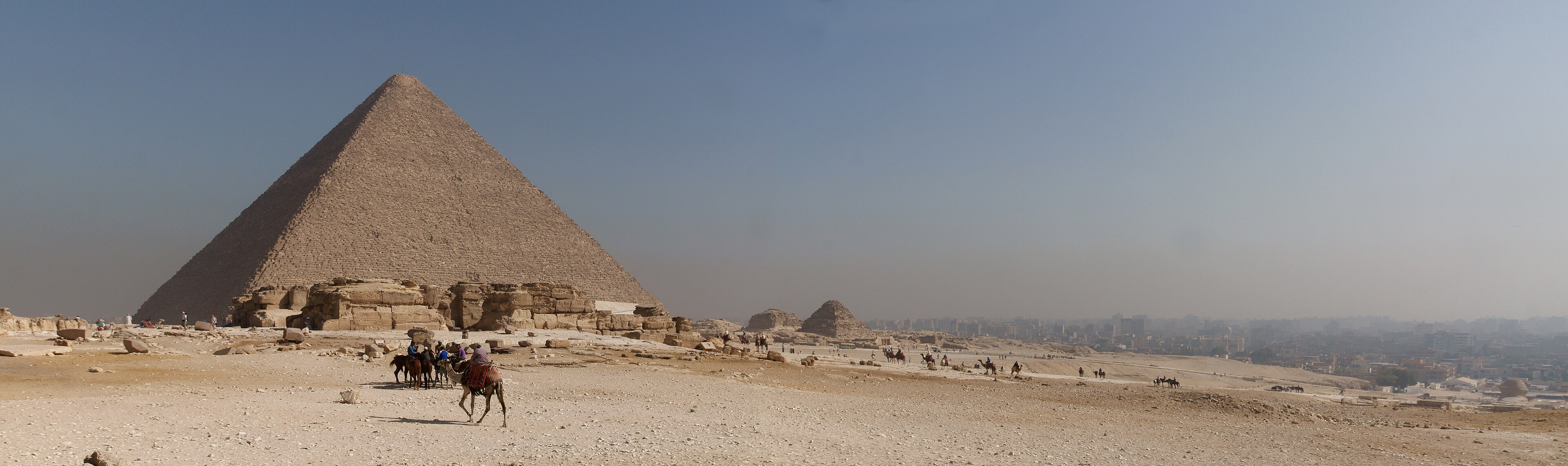
Kallerna / Wikimedia Commons. CC BY-SA 3.0.Great Pyramid of Giza panoramaThis image provides visual context. It does not establish cause, identity, date, or interpretation by itself.
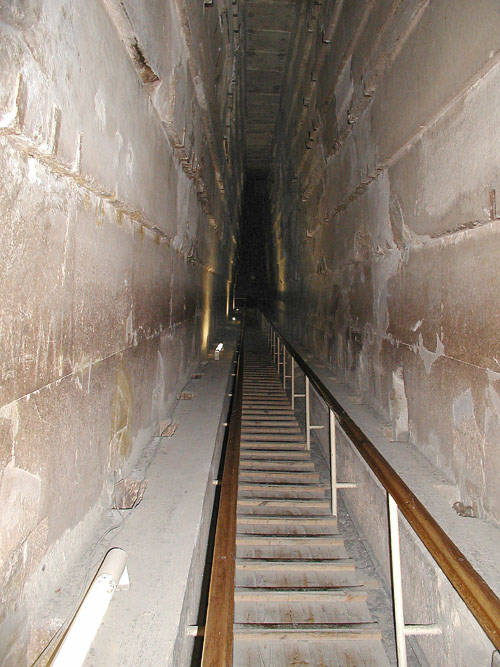
Jon Bodsworth / Wikimedia Commons. Copyrighted free use.Grande galerieThis image provides visual context. It does not establish cause, identity, date, or interpretation by itself.
W. M. Flinders Petrie / Encyclopaedia Britannica. Public domain.Section of the Great PyramidThis image provides visual context. It does not establish cause, identity, date, or interpretation by itself.
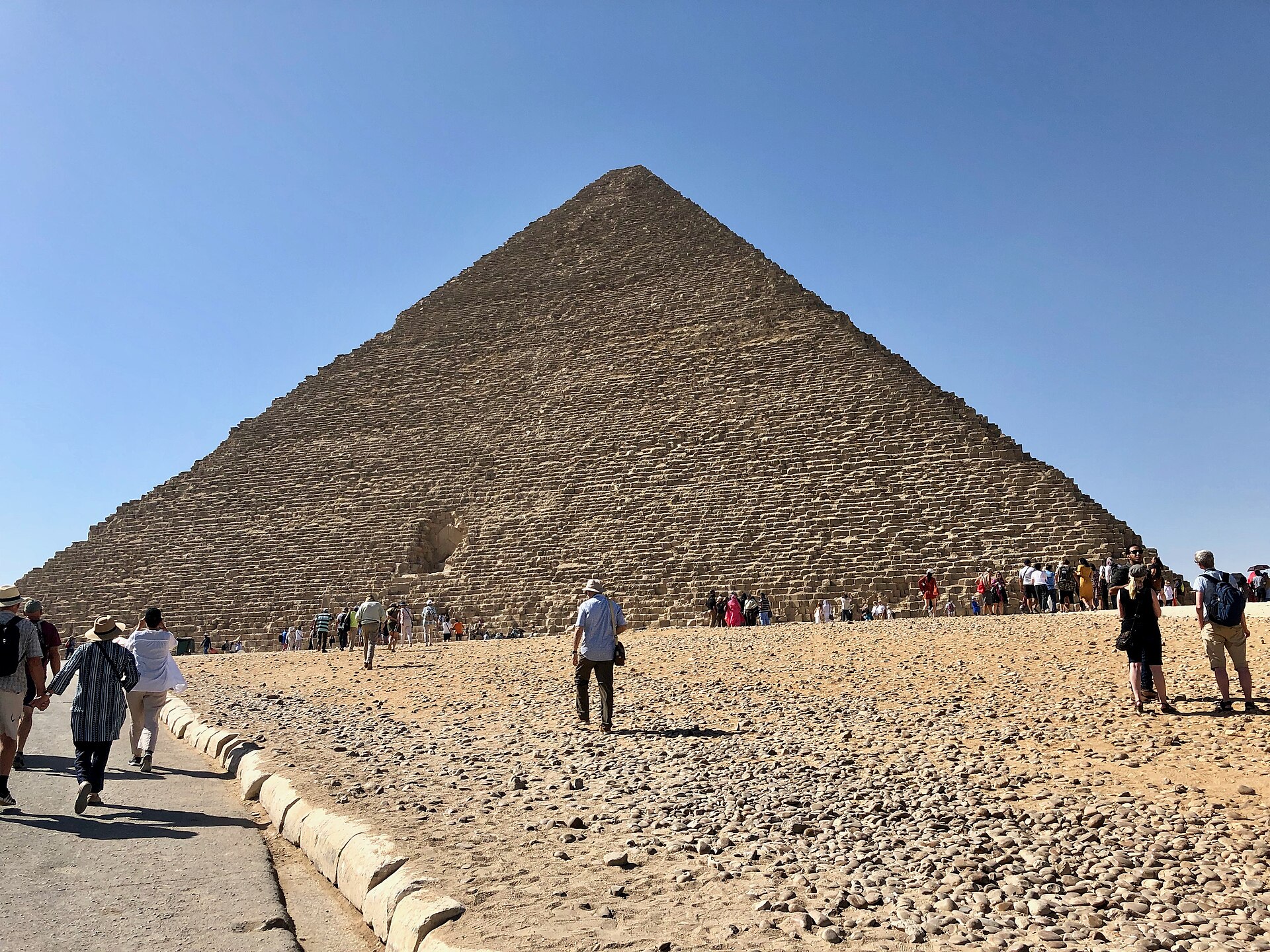
Txllxt TxllxT / Wikimedia Commons. CC0 1.0.Great Pyramid of Giza exterior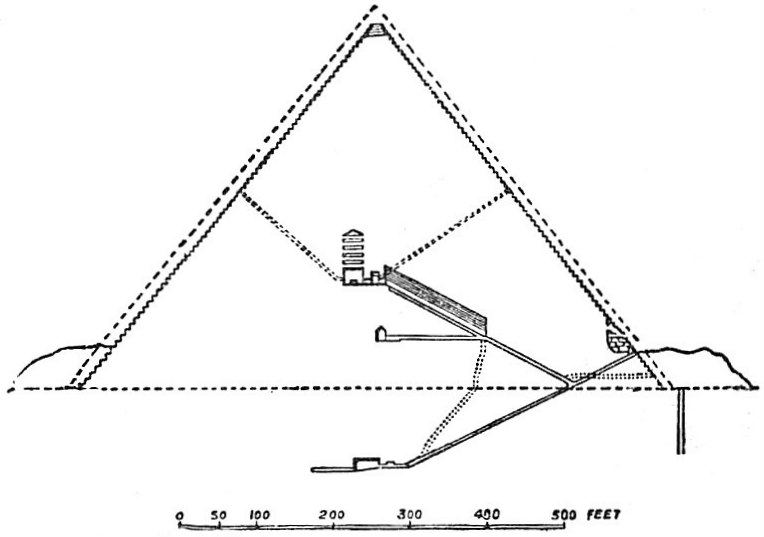
02Visual source
Map the possibilities
Which possibilities survive the pressure?
Give the accepted explanation and its strongest challengers the same hard questions: what fits, what fails, and what is still missing?Competing possibilities
The accepted account and its strongest alternatives.
Inclusion means a possibility is worth testing. It does not mean every possibility currently carries equal evidentiary weight.
Fourth Dynasty royal construction and mortuary complex
Khufu state designed and built the Great Pyramid and integrated precinct as a royal mortuary and cult project. The exact lifting system can remain partly unknown without changing the builder or broad function.
Current treatment
Leading by a substantial margin. Independent archaeological, administrative, chronological, and architectural lines converge on a Fourth Dynasty royal project even though important engineering details remain open.
Fourth Dynasty builders used a substantially different engineering system
Khufu-era Egyptians built the monument, but the primary lifting, staging, material, or counterweight system differed materially from the familiar large external-ramp picture.
Current treatment
Highly plausible. The builder attribution is much firmer than the exact lifting architecture, and future engineering work may substantially revise the standard public picture.
Older Egyptian core later completed or repurposed by Khufu
A pre-Khufu Egyptian phase created a core, platform, internal feature, or earlier monument that Fourth Dynasty builders enlarged, cased, integrated, and claimed within Khufu complex.
Current treatment
Possible but presently unsupported. It is more economical than a vanished ice-age civilization, yet it still requires a physical older phase that has not been shown.
Earlier advanced civilization or inherited high-capacity tradition
A significantly earlier regional civilization built the core or transmitted advanced surveying and construction knowledge later used by dynastic Egyptians. Fourth Dynasty activity represents inheritance, completion, or reuse rather than the full origin.
Current treatment
Not established. PARALLAX treats it as a testable minority possibility rather than nonsense or a default answer to missing data. It currently lacks affirmative older-builder evidence.
Primarily non-funerary technical monument
The Great Pyramid was designed mainly as an acoustic, hydraulic, electromagnetic, observational, initiatory, or energy-related system; later royal mortuary context reflects reuse or secondary meaning.
Current treatment
A secondary ritual, acoustic, or astronomical role is plausible. A primary power-plant or machine function is currently speculative and substantially weaker than the royal mortuary reading.
Possibility map
Stress-test every serious explanation.
Select a possibility to see what would need to be true, what supports it, what weakens it, what is missing, and how seriously the current record allows PARALLAX to treat it.
Primary questionDoes the available archaeological and engineering evidence adequately explain when, why, and how the Great Pyramids at Giza were built, or do significant gaps support substantially different interpretations of their age, construction, or purpose?
Fourth Dynasty royal construction and mortuary complex
What would need to be true
Khufu state designed and built the Great Pyramid and integrated precinct as a royal mortuary and cult project. The exact lifting system can remain partly unknown without changing the builder or broad function.
What supports it
- Merer contemporary transport log naming Akhet-Khufu
- Khufu names and crew marks in construction contexts
- Old Kingdom mortar radiocarbon and monument sequence
- Local quarry, imported stone, harbor, settlement, and provisioning evidence
- Integrated temple, causeway, boat-pit, subsidiary-pyramid, and cemetery context
- Visible development from earlier Egyptian pyramid projects
What weakens it
- No complete construction manual or preserved lifting system
- No identified mummy or original grave inventory
- Unresolved functions for several internal features and newly detected voids
- Attribution evidence is convergent rather than one explicit royal building decree
What evidence is missing
- A contemporary project archive covering design, labor, and lifting from foundation to completion.
- Direct evidence connecting each major internal space to its intended function.
How PARALLAX treats it now
Leading by a substantial margin. Independent archaeological, administrative, chronological, and architectural lines converge on a Fourth Dynasty royal project even though important engineering details remain open.
Discriminating evidenceOpen the categories that can move the assessment
These links lead to the underlying evidence reviews. Direction is kept separate from importance and is never converted into a score.
High impactMerer transport log
Strongly favors Khufu-era construction activity
Open 012-AHigh impactKhufu names and builders marks
Favors Khufu-era authorship
Open 012-AHigh impactMortar radiocarbon dates
Favors Old Kingdom construction
Open 012-BHigh impactRoyal mortuary-complex architecture
Strongly favors royal mortuary and cult purpose
Open 012-CHigh impactQuarries, waterways, and stone delivery
Strongly favors Egyptian state logistics
Open 012-DHigh impactKnown tools and experimental archaeology
Supports physical feasibility with period technology
Open 012-EThis map does not award points for novelty or authority. Compare serious possibilities, inspect what each one explains, and follow the evidence categories back to their detailed reviews.
Evidence matrix
Current direction by category.
Current direction shows what a category supports, challenges, or leaves unresolved. Evidence impact shows how important that category is to understanding the case, without turning uncertainty into a fake score.
How to read this
Current direction says what the evidence presently supports, challenges, or leaves unresolved. Evidence impact says how important that category is to understanding the case. Impact does not mean support for either side.
Evidence categoryCurrent directionEvidence impactKey limitation / note
Evidence categoryMerer transport log
Read review5 linked sources
Current directionStrongly favors Khufu-era construction activity
Evidence impactHigh impactCentral to the case or capable of materially changing the assessment.
Key limitation / note
Documents Tura stone delivery to , not the complete lifting method or every core block.
Evidence categoryKhufu names and builders marks
Read review5 linked sources
Current directionFavors Khufu-era authorship
Evidence impactHigh impactCentral to the case or capable of materially changing the assessment.
Key limitation / note
Strongest in convergence; direct pigment dating and complete provenance would improve confidence.
Evidence categoryMortar radiocarbon dates
Read review3 linked sources
Current directionFavors Old Kingdom construction
Evidence impactHigh impactCentral to the case or capable of materially changing the assessment.
Key limitation / note
Old wood and residual charcoal broaden and offset dates from the actual placement event.
Evidence categoryDixon cedar date
Read review3 linked sources
Current directionShows older reused material; chronology ambiguous
Evidence impactMedium impactMeaningfully informs the case but is not decisive alone.
Key limitation / note
Dates the tree growth, not securely the shaft or surrounding masonry.
Evidence categoryRoyal mortuary-complex architecture
Read review4 linked sources
Current directionStrongly favors royal mortuary and cult purpose
Evidence impactHigh impactCentral to the case or capable of materially changing the assessment.
Key limitation / note
Actual interment is not directly preserved and multiple functions could coexist.
Evidence categoryMissing mummy and grave inventory
Read review4 linked sources
Current directionLimits certainty about use; does not establish another function
Evidence impactMedium impactMeaningfully informs the case but is not decisive alone.
Key limitation / note
Ancient robbery and stripping are expected alternative explanations for absence.
Evidence categoryQuarries, waterways, and stone delivery
Read review3 linked sources
Current directionStrongly favors Egyptian state logistics
Evidence impactHigh impactCentral to the case or capable of materially changing the assessment.
Key limitation / note
Explains acquisition and site delivery better than final vertical placement.
Evidence categoryKnown tools and experimental archaeology
Read review5 linked sources
Current directionSupports physical feasibility with period technology
Evidence impactHigh impactCentral to the case or capable of materially changing the assessment.
Key limitation / note
Task demonstrations do not recover the integrated historical building sequence.
Evidence categoryMissing complete lifting system
Read review5 linked sources
Current directionLeaves construction method unresolved
Evidence impactHigh impactCentral to the case or capable of materially changing the assessment.
Key limitation / note
A gap in method is not affirmative evidence for a different builder.
Evidence categoryBase orientation and geometric precision
Read review4 linked sources
Current directionSupports exceptional ancient surveying capability
Evidence impactHigh impactCentral to the case or capable of materially changing the assessment.
Key limitation / note
Achievement alone does not identify the instrument set, date, or culture.
Evidence categoryOrion and numerical correlations
Read review4 linked sources
Current directionAmbiguous; weak as an independent dating tool
Evidence impactLimited impactRelevant, but too indirect or constrained to carry much of the case.
Key limitation / note
Multiple comparisons and post-selection can make chance matches look intentional.
Evidence categoryMuon-detected Big Void
Read review4 linked sources
Current directionConfirms the internal plan is incomplete
Evidence impactHigh impactCentral to the case or capable of materially changing the assessment.
Key limitation / note
Its geometry and purpose are unknown, so it does not yet favor one origin model.
Evidence categoryNorth-face corridor
Read review4 linked sources
Current directionConfirms another designed hidden space
Evidence impactMedium impactMeaningfully informs the case but is not decisive alone.
Key limitation / note
Likely structural or access interpretations remain unverified.
Evidence categoryDeep SAR structure claims
Read review4 linked sources
Current directionCurrently unreliable
Evidence impactLimited impactRelevant, but too indirect or constrained to carry much of the case.
Key limitation / note
The central 2022 paper was formally retracted in August 2026.
Evidence categoryReconstituted-limestone microstructure
Read review4 linked sources
Current directionMixed and sample-limited
Evidence impactMedium impactMeaningfully informs the case but is not decisive alone.
Key limitation / note
Candidate signatures conflict with natural and need representative blinded sampling.
Evidence category2026 Relative Erosion Method preprint
Read review6 linked sources
Current directionClaims a much older date but remains unverified
Evidence impactLimited impactRelevant, but too indirect or constrained to carry much of the case.
Key limitation / note
No peer review, known-age validation, or stable local erosion calibration has been demonstrated.
Evidence categoryNo secure older construction phase
Read review6 linked sources
Current directionStrongly limits the earlier-civilization hypothesis
Evidence impactHigh impactCentral to the case or capable of materially changing the assessment.
Key limitation / note
Absence is not absolute disproof, but the proposed older project should leave affirmative material traces.
Evidence categoryAcoustic and physical chamber behavior
Read review3 linked sources
Current directionReal effects; primary function ambiguous
Evidence impactLow impactAdds context but has little power to separate the interpretations.
Key limitation / note
A machine claim requires a demonstrated system, not resonances alone.
Evidence reviews
The repeatable review structure for future cases.
Each category separates the core question, established observations, source quality, competing interpretations, assessment, unresolved issues, and sources.
012-A
Chronology and Builder Attribution
Current directionStrongly favors a Khufu-era royal project
Question tested
Does the surviving record securely place the Great Pyramid construction in Khufu Fourth Dynasty reign?
Current read
No single inscription says Khufu ordered every stage of the pyramid, but contemporary logistics, names inside construction spaces, radiocarbon, quarrying, and the integrated royal complex converge on his reign.
Established Observations
- FACTMerer log records limestone deliveries from Tura to Akhet-Khufu during the final part of Khufu reign.
- FACTWork-gang and quarry marks in construction spaces include Khufu royal names and contemporary crew terminology.
- SUPPORTED INFERENCEThe pyramid, temple, causeway, quarry, boat pits, and subsidiary burials form an integrated Fourth Dynasty royal project rather than isolated architecture.
- UNKNOWNNo surviving document narrates the complete planning and construction sequence from foundation to completion.
Evidence Quality
High overall. The strongest material includes a contemporary administrative papyrus, primary marks, archaeological context, and scientific dates. Each source has limits, but they are partly independent.
Accepted / Conventional Reading
- Khufu commissioned the Great Pyramid and associated complex during the Fourth Dynasty.
- Administrative records and builders marks are ordinary remains of the project organization.
- The convergence matters more than any single disputed artifact.
Challenge / Alternative Reading
- Merer may document casing or restoration logistics without proving the age of the core.
- Builders marks have been alleged to be modern additions, and Khufu names could indicate later ownership or work rather than first construction.
- Fourth Dynasty integration could represent completion or reuse of an older monument.
PARALLAX Current Read
The combined attribution record strongly favors construction as Khufu Fourth Dynasty royal project. The evidence is not a complete building diary, but an older inherited core currently lacks the physical phase boundary needed to compete at equal weight.
012-B
Radiocarbon and the Dixon Wood
Current directionFavors Old Kingdom construction, with old-material offsets
Question tested
Do scientific dates support the Fourth Dynasty chronology, or do older results require a much earlier pyramid?
Current read
Mortar samples broadly support the Old Kingdom sequence but often predate historical reign estimates. The much older Dixon cedar is real; it dates the wood, not securely the moment the shaft or pyramid was built.
Established Observations
- FACTRadiocarbon samples associated with Great Pyramid mortar fall in the third millennium BC, with spreads and offsets older than conventional reign dates.
- FACTThe Dixon cedar fragment returned a calibrated range of 3341-3094 BC.
- SUPPORTED INFERENCEReuse of long-lived wood and old charcoal can explain older organic dates without moving the stone construction to the same age.
- UNKNOWNThe exact growth, reuse, storage, and insertion history of each dated organic fragment cannot be reconstructed.
Evidence Quality
High for the laboratory determinations and moderate for connecting each organic sample to construction. Old wood and residual charcoal are recognized archaeological problems.
Accepted / Conventional Reading
- The grouped dates support an Old Kingdom pyramid program and preserve the accepted monument sequence.
- Offsets are expected when builders burn or reuse old wood in a wood-scarce society.
- The Dixon fragment supplies a terminus after which it could be installed, not a date for the surrounding stone.
Challenge / Alternative Reading
- Older dates may show that historical chronologies are too late or that older material was incorporated into a later project.
- The Dixon wood age is sometimes presented as evidence for a pre-Khufu internal system.
- Wide spreads make radiocarbon less decisive than simple summaries imply.
PARALLAX Current Read
The radiocarbon record supports third-millennium construction but is not precise enough to select a single reign by itself. The Dixon wood is older than Khufu, yet its context does not currently establish an older pyramid.
012-C
Function and Royal-Complex Context
Current directionFavors royal mortuary and cult function
Question tested
Is a royal mortuary purpose adequately supported despite the absence of an identified mummy or grave goods?
Current read
The Great Pyramid sits inside a standard royal complex with temple, causeway, subsidiary pyramids, boat pits, cemetery, and a granite sarcophagus. Emptiness limits certainty about actual interment but is weak evidence for a wholly different purpose after ancient robbery.
Established Observations
- FACTThe monument belongs to a royal precinct with a pyramid temple, causeway, valley connection, boat pits, subsidiary pyramids, and elite tombs.
- FACTA large lidless granite sarcophagus remains in the upper chamber conventionally called the King Chamber.
- FACTNo identified royal mummy or original grave inventory survives inside the Great Pyramid.
- SUPPORTED INFERENCEThe complex is best understood within the developing Old Kingdom royal mortuary tradition.
Evidence Quality
High for architecture and context; moderate for reconstructing exact ritual use because the complex was stripped, damaged, and incompletely inscribed.
Accepted / Conventional Reading
- The pyramid was the central monument of Khufu mortuary cult and intended royal burial complex.
- Robbery and reuse explain the missing body, goods, closures, and fittings.
- The unusual interior reflects architectural experimentation within the pyramid tradition.
Challenge / Alternative Reading
- No confirmed burial means tomb function should not be treated as directly observed.
- The chamber and passage system differs from a simple burial container and may have ceremonial, initiatory, observational, or technical purposes.
- Later Egyptians could have surrounded an inherited monument with a royal cult complex.
PARALLAX Current Read
Royal mortuary and cult function is the strongest contextual explanation. Actual interment is not directly established, and secondary ritual or technical functions remain open where they produce testable evidence.
012-D
Quarrying, Materials, and River Logistics
Current directionFavors an Egyptian state logistics system
Question tested
Can known Fourth Dynasty quarrying and transport systems account for the pyramid materials?
Current read
Local limestone, imported Tura limestone, Aswan granite, nearby quarries, Nile access, and Merer crew provide a coherent supply chain. The chain does not solve final placement of the heaviest blocks.
Established Observations
- FACTMost core limestone is geologically local to Giza, while fine casing limestone came from the eastern Nile region and granite from southern Egypt.
- FACTMerer crew transported limestone by boat through waterways to the Khufu complex.
- FACTA former Nile branch ran near the pyramid fields and their valley-temple access points.
- UNKNOWNThe exact route and rigging for every granite beam and upper-course stone are not preserved.
Evidence Quality
High for source areas and river transport; moderate for reconstructing the final delivery path where ancient surfaces are incomplete.
Accepted / Conventional Reading
- The state exploited a local quarry for bulk material and used Nile shipping for higher-quality stone.
- Seasonal labor, specialists, harbors, storage, and provisioning made the project an organizational achievement as much as a mechanical one.
Challenge / Alternative Reading
- Moving the material to Giza does not explain the precision or vertical placement of heavy granite.
- An inherited core could still receive Fourth Dynasty casing and additions through the documented supply chain.
PARALLAX Current Read
Known Egyptian logistics adequately explain material acquisition and delivery to Giza. They do not, by themselves, identify the complete lifting architecture.
012-E
Lifting and Construction Methods
Current directionFeasible in principle; exact system unresolved
Question tested
Do known tools, sledges, ramps, ropes, and labor make construction feasible without requiring lost high technology?
Current read
Experiments and archaeological analogues show that simple machines, abrasives, lubrication, rope hauling, surveying, and organized labor can perform relevant tasks. No single ramp or lifting model is proved for every construction stage.
Established Observations
- FACTAppropriately wetted sand can substantially reduce sled friction under controlled conditions.
- FACTA Khufu-era quarry ramp at Hatnub used a steep central slope, side stairs, and postholes consistent with rope-assisted hauling.
- FACTExperimental archaeology demonstrates stone cutting, drilling, fitting, and moving with copper, stone, abrasives, wood, rope, and lubricants.
- UNKNOWNThe geometry, sequence, and removal of the Great Pyramid lifting system remain unsettled.
Evidence Quality
Moderate to high. Experiments establish physical capability and quarry finds establish period technology, but model-to-monument transfer remains inferential.
Accepted / Conventional Reading
- No anomalous technology is required; many combinations of ramps, levers, sledges, counterweights, and staged work remain physically possible.
- Construction methods evolved across earlier pyramids before Giza.
- A system made largely from perishable materials would leave less evidence than the stone monument.
Challenge / Alternative Reading
- Demonstrating isolated tasks does not demonstrate the integrated schedule, accuracy, and high-level placement of the most difficult blocks.
- The lack of a preserved complete ramp system leaves room for a materially different method.
- Unrecognized mechanical knowledge or an inherited technique could explain efficiency without requiring modern machines.
PARALLAX Current Read
Known technology makes the project physically plausible, so missing blueprints are not evidence of a lost industrial system. The exact construction method remains a major legitimate unknown.
012-F
Surveying Precision and Astronomical Claims
Current directionConfirms exceptional surveying; does not identify a lost civilization
Question tested
Does the pyramid precision or astronomical pattern require knowledge beyond Fourth Dynasty Egypt?
Current read
The base, cardinal orientation, leveling, and selected masonry are exceptionally precise. Precision establishes skill. It does not identify the builder, method, or date without independent context.
Established Observations
- FACTModern and historical surveys confirm near-cardinal orientation, a highly regular base, and carefully controlled chamber geometry.
- SUPPORTED INFERENCEThe builders used repeatable surveying, leveling, and quality-control procedures.
- DISPUTEDThe three-pyramid ground plan has been interpreted as a deliberate map of Orion whose epoch encodes a much earlier date.
- FACTPattern significance falls when many possible stars, scales, rotations, monuments, and target dates are considered.
Evidence Quality
High for measured geometry; mixed for proposed astronomical intent because many alignments and numerical matches can be tested after the fact.
Accepted / Conventional Reading
- Simple sighting, leveling, cord, plumb, and repeated measurement can generate impressive cumulative accuracy.
- Astronomical orientation fits Egyptian religious and calendrical interests without redating the structure.
Challenge / Alternative Reading
- The achieved precision may indicate a surveying tradition more sophisticated than surviving tools suggest.
- Orion and other alignments may preserve inherited astronomical knowledge or deliberate reference to an earlier epoch.
PARALLAX Current Read
The precision is real, impressive, and consistent with a mature Egyptian surveying system. It does not presently discriminate in favor of a prehistoric builder or a 10,500 BC construction date.
012-G
Hidden Spaces and Remote Sensing
Current directionConfirms unknown spaces; purpose and chronology unresolved
Question tested
What do modern scans establish, and do unknown spaces support a different history or function?
Current read
Muon imaging securely detected the Big Void and . These discoveries prove the internal map is incomplete. They do not yet identify contents, purpose, construction phase, or builder.
Established Observations
- FACTThree independent muon systems detected a void at least 30 meters long above the Grand Gallery.
- FACTMuon and complementary measurements identified a roughly 9-meter north-face corridor behind a chevron structure.
- UNKNOWNThe Big Void shape, access, contents, structural role, and relationship to construction sequence remain unknown.
- FACTThe journal retracted the 2022 SAR-tomography paper used to support later viral claims of vast deep structures.
Evidence Quality
High for the replicated muon anomalies and corridor geometry. Low for viral deep-structure claims derived from a now-retracted SAR method.
Accepted / Conventional Reading
- The voids are construction spaces, stress-relieving architecture, corridors, or abandoned internal features within the Fourth Dynasty build.
- Non-destructive imaging is progressively correcting an incomplete internal plan.
Challenge / Alternative Reading
- Unknown spaces may preserve inaccessible evidence about purpose, construction sequence, or an earlier core.
- The scale and placement of the Big Void could challenge current structural explanations once its geometry is resolved.
- Claims of much deeper structures should be tested, but the retracted SAR paper cannot currently establish them.
PARALLAX Current Read
The internal architectural record is demonstrably incomplete. That is important, but current scans do not support claims of an older civilization or non-funerary machine without additional discriminating evidence.
Video Context
These clips are included to clarify how a claim is presented or explained. They are not substitutes for the source trail.
How muon imaging found the hidden spaces
Mission overview that helps visualize muon detectors and scan locations. The Nature and Nature Communications papers establish the findings.
A project presentation, not an independent validation or evidence of what the voids contain.
ScanPyramids Mission
012-H
Cast-Stone and Geopolymer Hypothesis
Current directionScientifically testable but not supported as the dominant method
Question tested
Were substantial parts of the Great Pyramid cast from reconstituted limestone rather than quarried as blocks?
Current read
Selected microscopy has been interpreted as reconstituted stone, while petrographic studies identify natural sedimentary fabrics. Quarries, transport records, bedding, fossils, and tool traces weigh against wholesale casting.
Established Observations
- DISPUTEDSelected samples contain microstructures interpreted by Barsoum and colleagues as reconstituted limestone.
- FACTOther examined samples preserve natural limestone features and lack a required artificial binder signature.
- FACTAncient quarrying and limestone transport to the Khufu complex are independently documented.
- UNKNOWNNo representative blinded sampling program has mapped possible prepared material across core, casing, repair, and mortar.
Evidence Quality
Mixed. Peer-reviewed microstructural work exists, but sample provenance and representativeness are limited; rebuttals also rely on small samples.
Accepted / Conventional Reading
- The pyramid is overwhelmingly built from quarried stone, set and repaired with mortar.
- Unusual chemistry may reflect natural limestone, mortar infiltration, salts, conservation, or sample context.
Challenge / Alternative Reading
- Some blocks may have been cast or agglomerated in place, reducing transport and fitting demands.
- A hybrid method could coexist with clearly quarried stone and leave subtle chemical signatures.
PARALLAX Current Read
The hypothesis deserves controlled testing, but current evidence does not support casting as the primary construction method. Limited use of prepared material remains possible until representative sampling is done.
012-I
Older Core or Earlier Advanced Civilization
Current directionPossible in principle; not established by the current record
Question tested
Does the physical evidence support an earlier civilization building or transmitting the core design before Fourth Dynasty Egypt?
Current read
Earlier activity at Giza and gaps in the construction record make inheritance testable. The case becomes evidentiary only if it identifies an older construction phase, securely dated material, distinctive tools, settlements, or a demonstrable transmission chain.
Established Observations
- FACTHuman activity and Egyptian cultural development predate Khufu at Giza and elsewhere in the Nile Valley.
- UNVERIFIED CLAIMA 2026 preprint estimates late-Pleistocene pyramid ages from differential surface erosion.
- FACTErosion rates on Giza limestone vary with lithology, moisture, salt, exposure, burial, pollution, and karst history.
- UNKNOWNNo accepted sealed context currently ties a pre-Fourth-Dynasty high-capacity building culture to Great Pyramid core construction.
Evidence Quality
High for the Fourth Dynasty context and low to mixed for much-earlier dating claims. The most direct 2026 late-Pleistocene age claim is an unreviewed erosion-rate preprint with major calibration problems.
Accepted / Conventional Reading
- The Great Pyramid culminates a visible Egyptian sequence from mastabas through step and true pyramids.
- Fourth Dynasty evidence is expected because Fourth Dynasty Egyptians designed and built the structure.
- Missing perishable equipment and incomplete records do not require an earlier civilization.
Challenge / Alternative Reading
- Fourth Dynasty builders may have inherited an older core, site plan, surveying system, or technical tradition and completed or repurposed it.
- Exceptional precision, uncertain lifting methods, unusual interiors, and much older organic or erosion claims can be treated as leads for a multi-phase model.
- A lost civilization need not be global or industrial; it could be an earlier regional culture whose durable evidence is sparse or submerged.
PARALLAX Current Read
An earlier advanced civilization is a legitimate hypothesis only when translated into material predictions. Current evidence strongly favors Fourth Dynasty authorship, while no secure older core, builder culture, or transmission chain has been demonstrated. The question remains open to direct discovery, not to gaps alone.
Video Context
These clips are included to clarify how a claim is presented or explained. They are not substitutes for the source trail.
The public case for missing construction knowledge
A concise presentation of why the missing construction method is treated by some readers as evidence of inherited knowledge. PARALLAX tests the underlying claims separately.
Popular advocacy cannot establish an older builder. The primary archaeological, dating, and engineering sources determine the evidentiary weight.
Graham Hancock and Lex Fridman
012-J
Non-Funerary and Power-Plant Claims
Current directionInteresting physical effects; functional claim unsupported
Question tested
Do the chambers, materials, acoustics, or geometry establish that the Great Pyramid was primarily a technical machine?
Current read
Stone chambers have acoustic, mechanical, thermal, and electromagnetic behavior. A power-plant interpretation must demonstrate deliberate input, process, output, residue, and infrastructure. No complete ancient system has met that burden.
Established Observations
- FACTThe interior combines limestone passages, a granite chamber, shafts, corbelled space, and load-distributing structures.
- FACTEnclosed stone spaces exhibit resonances and other physical responses determined by geometry and material.
- SPECULATIONThe chamber system formed a chemical, acoustic, or electromagnetic power generator.
- UNKNOWNNo agreed original contents or equipment inventory survives for all chambers and shafts.
Evidence Quality
Low for the full power-plant model because its central mechanism is advocacy-based and lacks archaeological operation evidence; high for the measured architecture itself.
Accepted / Conventional Reading
- The internal system served burial, ritual, access, closure, and structural functions.
- Physical resonance and field concentration are expected properties of large stone cavities and do not prove operational intent.
Challenge / Alternative Reading
- The interior resembles a designed process system more than a simple tomb, and missing artifacts may reflect stripping or concealment.
- Granite, shafts, subterranean spaces, and water-table context could have participated in an unknown technology.
PARALLAX Current Read
A secondary acoustic, symbolic, or sensory function is plausible. A primary power plant is not supported by a demonstrated mechanism or archaeological system, and the absence of a mummy does not fill that gap.
03Visual source
Name what remains
What still does not sit right?
Keep the stubborn gaps visible. Then state what the record can presently carry without pretending suspicion is proof or authority is closure.Open questions / What still does not sit right
The unanswered questions that matter.
- What exact lifting system was used for each construction stage?
- Can full-scale experiments place the heaviest granite within plausible time, labor, and safety constraints?
- What is the complete three-dimensional form and function of the Big Void?
- Do inaccessible spaces preserve original tools, closures, residues, inscriptions, or datable material?
- Can short-lived organic material be sampled from sealed primary mortar contexts?
- Can builders-mark pigment be analyzed or dated without unacceptable damage?
- Was Khufu actually interred in the upper chamber?
- Which internal features are structural, ritual, abandoned, or functional?
- Can representative blinded petrography resolve limited cast-stone claims?
- Can an erosion-dating method be validated on known-age Egyptian structures before it is used on the pyramid?
- Is any masonry interface demonstrably older than the Fourth Dynasty complex?
- What specific material culture would an earlier advanced builder predict at Giza or its supply network?
- Can the Khufu harbor, canal, and quarry chronology be reconstructed at project-phase resolution?
- Which astronomical alignments are independently predicted by contemporary Egyptian evidence?
- What important records or physical traces were destroyed by ancient robbery, quarrying, excavation, restoration, or modern access?
What would change the picture
Evidence must be allowed to move the assessment.
- A sealed pre-Fourth-Dynasty construction layer physically bonded to the core would materially strengthen an older-phase model.
- Replicated dates from short-lived organics in primary core context substantially older than the Old Kingdom would force chronological revision.
- Distinctive pre-dynastic tools, quarries, settlements, or transport infrastructure at the required scale would support an earlier civilization.
- A validated erosion method that correctly dates independently known monuments and then replicates a much older pyramid age would carry substantial weight.
- A complete Fourth Dynasty project archive naming design, work phases, and lifting methods would strongly narrow the remaining attribution and engineering questions.
- Diagnostic ramp anchors, wear, sockets, staging surfaces, or internal features matching one construction model would raise that model above feasibility.
- Direct inspection of the Big Void showing an older construction boundary or unexpected original equipment would materially alter the case.
- Representative blinded material analysis showing widespread artificial binder inside intact blocks would strengthen a hybrid or cast-stone method.
- A reproducible non-funerary operating system with realistic inputs, outputs, residues, and archaeological infrastructure would change the purpose assessment.
- Evidence that the Khufu names or Merer archive are inauthentic would remove important attribution lines, but the remaining chronology and complex context would still require reassessment rather than automatic reversal.
Why this case matters
Why this conflict deserves scrutiny.
The method gap is real
The public is often given a confident ramp illustration where archaeology has several partial models. Saying the exact system is unresolved is more credible than defending one textbook picture as fact.
A civilization should receive its own achievement
Underestimating ancient Egyptian organization and craft can make ordinary evidence look impossible. Respect for the builders means testing their demonstrated capacities, not flattening them into primitive labor.
Alternative history needs predictions
An earlier civilization is not disqualified because it is unconventional. It is strengthened by older construction phases, tools, settlements, and dates, and weakened when those expected traces do not appear.
Discovery is still happening
Muon imaging proved that a monument surveyed for centuries still contains major unknowns. The proper response is neither closure nor fantasy, but better measurement.
The case teaches separation
Builder, date, method, precision, and purpose are separate claims. A weakness in one does not automatically overturn the others, and strong attribution does not erase legitimate engineering unknowns.
What the evidence currently suggests
Where the record points - v0.1.1
The Great Pyramid is best explained as a Fourth Dynasty Egyptian royal project commissioned for Khufu. The strongest case is cumulative: Merer contemporary log, builders marks, radiocarbon, stone sources, quarries, waterways, settlements, architectural sequence, and the integrated royal precinct point in the same direction.
The standard public construction story is less secure than the builder attribution. Known tools and simple machines make the project feasible, but no complete ramp and lifting sequence has been established for every phase, especially the highest and heaviest granite placement.
Royal mortuary and cult function is better supported than a primary technical-machine interpretation. Actual interment is not directly demonstrated, and ritual, astronomical, acoustic, or symbolic secondary functions may have coexisted.
The Big Void and north-face corridor are genuine discoveries. Their purpose is unknown. They justify continued non-destructive investigation but do not currently establish an older builder, hidden archive, or power system.
A cast-stone contribution is scientifically testable. Existing sample studies are too small and disputed to support wholesale casting, while quarrying, transport, sedimentary fabrics, and tool evidence favor predominantly natural blocks.
An older Egyptian phase or earlier advanced civilization is possible in principle and deserves explicit tests. It is not currently supported by a secure older construction boundary, short-lived primary-context dates, a matching material culture, or a transmission record. Gaps in the Fourth Dynasty method cannot supply that missing affirmative evidence.
The 2026 late-Pleistocene erosion date is preliminary and unverified, and the SAR paper behind viral deep-structure claims has been retracted. Neither presently outweighs the established archaeological record. The investigation remains open to better dating, representative material analysis, and direct study of inaccessible spaces.
04Visual source
Inspect the record
Follow the evidence back to its sources.
Trace the sources, shared foundations, definitions, corrections, and revision history behind the public assessment.Source record
Inspect the material.
- Primary evidencepyramid-merer
Les papyrus de la mer Rouge I: Le journal de Merer
Primary evidenceDirect material, dataset, exhibit, transcript, or record; directness does not remove context checks.- Provenance
- Excavated papyrus archive published by the mission director through the IFAO.
- Directness
- Contemporary administrative log for a transport crew working in the Khufu-era construction system.
- Method
- Archaeological excavation, papyrus reconstruction, Old Egyptian transcription, translation, and contextual analysis.
- Corroboration
- Matches the Tura casing-stone source, Khufu complex name, harbor logistics, and broader Fourth Dynasty administrative record.
- Limit
- It documents stone delivery and active work at Akhet-Khufu, not the complete lifting method, the date of every core block, or proof that Merer crew built the whole pyramid.
- Verification
- Publication and translated log passages reviewed.
Edition and translation of Fourth Dynasty papyri from Wadi al-Jarf. Merer log records repeated transport of limestone from Tura to Akhet-Khufu, the Great Pyramid complex, near the end of Khufu reign.
- Technical / scientific analysispyramid-c14
Radiocarbon Dates of Old and Middle Kingdom Monuments in Egypt
Technical sourceScientific, engineering, forensic, or specialist analysis; weight follows method and reproducibility.- Method
- Accelerator mass spectrometry and calibrated date comparison across more than 450 monument samples collected in two campaigns.
- Corroboration
- Broadly preserves the accepted Old Kingdom monument sequence and places Great Pyramid-associated mortar in the third millennium BC.
- Limit
- Old wood, residual charcoal, broad ranges, and outliers prevent mortar dates from functioning as an exact construction-year clock.
- Verification
- Paper, tables, limitations, and DOI reviewed.
Large radiocarbon program using organic material from mortar and other contexts across Old and Middle Kingdom monuments, including the Giza pyramids.
- Primary evidencepyramid-intchron
Khufu Pyramid radiocarbon records
Primary evidenceDirect material, dataset, exhibit, transcript, or record; directness does not remove context checks.- Directness
- Exposes individual sample records behind broader chronological synthesis.
- Limit
- Samples date organic inclusions, usually in mortar, and may predate the moment the mortar was placed.
- Verification
- Record page and sample metadata reviewed.
Sample-level database entries for radiocarbon determinations associated with the Great Pyramid.
- Technical / scientific analysispyramid-dixon-wood
The Great Pyramid of Giza: A Newly Discovered Piece of Cedar Wood
Technical sourceScientific, engineering, forensic, or specialist analysis; weight follows method and reproducibility.- Limit
- The authors identify old wood as a plausible explanation and treat the date as a terminus after which the wood entered the pyramid, not a direct pyramid construction date.
- Verification
- Article, date range, and authors interpretation reviewed.
Study of the rediscovered Dixon relic cedar fragment from a Great Pyramid shaft, radiocarbon dated to 3341-3094 cal BC.
- Technical / scientific analysispyramid-workers-settlement
Neighborhood to National Network: The Transformation of the Giza Settlement
Technical sourceScientific, engineering, forensic, or specialist analysis; weight follows method and reproducibility.- Method
- Long-term excavation, architectural phasing, ceramics, sealings, faunal remains, and administrative comparison.
- Limit
- Much of the excavated settlement record is later Fourth Dynasty; it demonstrates the Giza labor system more directly than it identifies the exact Khufu workforce.
- Verification
- Open article and stated chronology reviewed.
Synthesis of the roughly 20-hectare Heit el-Ghurab settlement and its relationship to national labor, provisioning, and administration at the Giza pyramid field.
- Archival materialpyramid-digital-giza
Great Pyramid of Khufu site record
Archival recordHistorical or FOIA/source-file material; relevance depends on provenance, completeness, and context.- Provenance
- Research archive integrating major Giza expedition records.
- Limit
- A catalog and document hub; individual claims still depend on the linked excavation record or publication.
- Verification
- Site record and linked collections reviewed.
Catalog record connecting plans, photographs, excavations, objects, bibliography, and component structures for the Great Pyramid.
- Primary evidencepyramid-quarry-marks
Operations Carried on at the Pyramids of Gizeh in 1837, Volume II
Primary evidenceDirect material, dataset, exhibit, transcript, or record; directness does not remove context checks.- Provenance
- Public-domain scan of the discoverer excavation-era publication preserved by Internet Archive.
- Directness
- Primary record of discovery claims, chamber access, and the marks as documented by the expedition.
- Limit
- Not independent of Vyse expedition and produced after destructive tunneling. Later documentation and other Khufu-era evidence must test the marks rather than treating the original account as self-authenticating.
- Verification
- Public scan, discovery account, and relevant plates reviewed.
Original published account and plates from the expedition that opened the upper chambers and recorded painted quarry marks, including Khufu royal names.
- Technical / scientific analysispyramid-boat-marks
Newly discovered graffiti on cover stones of the Khufu boat pit
Technical sourceScientific, engineering, forensic, or specialist analysis; weight follows method and reproducibility.- Limit
- The marks relate directly to the boat-pit operation and surrounding complex, not every stage of pyramid masonry.
- Verification
- Abstract, article, and mark descriptions reviewed.
Study of transport and crew markings on sealing stones beside the Great Pyramid, including names associated with Khufu and Djedefre.
- Secondary analysispyramid-old-kingdom
Egypt in the Old Kingdom
Context sourceUseful synthesis or historical framing; claims should be traced back when possible.- Limit
- Broad synthesis rather than a primary excavation report or direct functional test of the Great Pyramid interior.
- Verification
- Essay and cited architectural sequence reviewed.
Museum synthesis of pyramid-complex development, royal mortuary architecture, and Old Kingdom state organization.
- Secondary analysispyramid-oxford-giza
Giza
Context sourceUseful synthesis or historical framing; claims should be traced back when possible.- Limit
- Synthesis can identify earlier activity at Giza without demonstrating that an earlier population built the Great Pyramid core.
- Verification
- Abstract, chapter scope, and bibliographic record reviewed.
Specialist overview of the Giza necropolis, development sequence, pre-Khufu activity, and Fourth Dynasty royal complexes.
- Technical / scientific analysispyramid-dash-survey
Determining the Original Size of the Great Pyramid of Giza
Technical sourceScientific, engineering, forensic, or specialist analysis; weight follows method and reproducibility.- Method
- Eighty-four measured baseline points, statistical line fitting, and orientation reconstruction.
- Limit
- Measures the achieved geometry; it does not by itself identify the instruments, workforce, date, or cultural authorship.
- Verification
- DOI, method summary, and AERA field account reviewed.
Modern survey using surviving casing-edge points to estimate the original base dimensions and cardinal orientation.
- Primary evidencepyramid-petrie
The Pyramids and Temples of Gizeh
Primary evidenceDirect material, dataset, exhibit, transcript, or record; directness does not remove context checks.- Limit
- A nineteenth-century survey with incomplete access and methods superseded in places by modern instrumentation.
- Verification
- Digitized volume and relevant measurement tables reviewed.
Foundational high-precision survey of the Giza pyramids, passages, chambers, casing, orientation, and stonework.
- Technical / scientific analysispyramid-wet-sand
Sliding Friction on Wet and Dry Sand
Technical sourceScientific, engineering, forensic, or specialist analysis; weight follows method and reproducibility.- Limit
- Demonstrates a feasible transport principle at laboratory scale, not direct proof of the exact Giza haulage system.
- Verification
- Paper abstract, DOI, experiment, and scope reviewed.
Laboratory study showing that an appropriate amount of water can reduce sled drag over sand by suppressing the sand pile that forms ahead of the sled.
- Technical / scientific analysispyramid-hatnub
Hatnub: a newly discovered ancient quarry ramp system
Technical sourceScientific, engineering, forensic, or specialist analysis; weight follows method and reproducibility.- Limit
- Direct evidence of Fourth Dynasty hauling capability at Hatnub, not a preserved ramp on the Great Pyramid itself.
- Verification
- Project report, archaeological context, and dating claim reviewed.
Field report on a steep central quarry ramp with side stairs and postholes dated to the reign of Khufu, interpreted as a rope-assisted hauling system.
- Technical / scientific analysispyramid-stocks
Immutable laws of friction: preparing and fitting stone blocks into the Great Pyramid
Technical sourceScientific, engineering, forensic, or specialist analysis; weight follows method and reproducibility.- Limit
- Experiments establish plausible capabilities and rates for selected tasks, not the complete historical sequence or labor total.
- Verification
- Publisher abstract, DOI, and experimental conclusions reviewed.
Experimental archaeology on marking, dressing, sliding, bedding, and fitting stone with simple tools, abrasives, mud, and gypsum mortar.
- Technical / scientific analysispyramid-drilling
Ancient Egyptian Stone-Drilling: An Experimental Perspective on a Scholarly Disagreement
Technical sourceScientific, engineering, forensic, or specialist analysis; weight follows method and reproducibility.- Limit
- Tool replication is task-specific and does not establish how every Giza granite surface was produced.
- Verification
- Experiment description, materials, and reported traces reviewed.
Experimental tests of copper tubes and stone-cutting abrasives on hard Egyptian stone, addressing the cutting traces that often drive lost-technology claims.
- Technical / scientific analysispyramid-ahramat
The Egyptian pyramid chain was built along the now abandoned Ahramat Nile Branch
Technical sourceScientific, engineering, forensic, or specialist analysis; weight follows method and reproducibility.- Limit
- Strengthens regional transport feasibility but does not recover the final stone-lifting method on each pyramid face.
- Verification
- Open paper, methods, figures, and DOI reviewed.
Remote sensing, sediment coring, and geophysical mapping identify a former Nile branch beside the pyramid fields and explain valley-temple water access.
- Technical / scientific analysispyramid-big-void
Discovery of a big void in Khufu Pyramid by observation of cosmic-ray muons
Technical sourceScientific, engineering, forensic, or specialist analysis; weight follows method and reproducibility.- Method
- Nuclear emulsion films, scintillator hodoscopes, and gas detectors observed cosmic-ray muon transmission from different positions.
- Limit
- Establishes a density anomaly and approximate geometry; it does not identify construction date, contents, or function.
- Verification
- Paper, DOI, methods, and finding reviewed.
Three independent muon-detection methods identified a void at least 30 meters long above the Grand Gallery.
- Technical / scientific analysispyramid-north-corridor
Precise characterization of a corridor-shaped structure in Khufu Pyramid
Technical sourceScientific, engineering, forensic, or specialist analysis; weight follows method and reproducibility.- Limit
- Its structural role or destination remains unknown; an unknown void is not evidence for a preferred builder or extraordinary function.
- Verification
- Open paper, dimensions, methods, and limits reviewed.
Muon imaging and later endoscopic inspection characterize a roughly 9-meter corridor behind the north-face chevron.
- Technical / scientific analysispyramid-sar-retraction
Retraction: Synthetic Aperture Radar Doppler Tomography Reveals Details of Undiscovered High-Resolution Internal Structure of the Great Pyramid of Giza
Technical sourceScientific, engineering, forensic, or specialist analysis; weight follows method and reproducibility.- Limit
- The retraction concerns the SAR-tomography claims; it does not invalidate independent muon detections inside the Great Pyramid.
- Verification
- Retraction date, DOI, stated reasons, and author disagreement reviewed.
Formal retraction record relevant to viral claims of deep structures or a city beneath the pyramids.
The journal retracted the 2022 paper for serious methodological and statistical concerns; the authors disagreed with the decision.
- Technical / scientific analysispyramid-barsoum
Microstructural Evidence of Reconstituted Limestone Blocks in the Great Pyramids of Egypt
Technical sourceScientific, engineering, forensic, or specialist analysis; weight follows method and reproducibility.- Limit
- The sample set is small and provenance is contested; observed microstructure has competing natural and mortar-related explanations.
- Verification
- Repository record, DOI, claims, and sample limitations reviewed.
Microscopy and chemistry study arguing that selected pyramid samples contain features compatible with reconstituted limestone.
- Independent technical analysispyramid-jana
The Great Pyramid Debate: Evidence from Detailed Petrographic Examinations of Casing Stones
Independent critiqueTechnical analysis outside the principal institution; judged by methods and source trail, not outsider status.- Limit
- Conference proceedings and only two pyramid samples; it cannot rule out every form of prepared material in every location.
- Verification
- Complete proceedings paper and sample discussion reviewed.
Detailed petrographic rebuttal reporting natural sedimentary fabrics and no required geopolymer binder in the examined samples.
- Unverified materialpyramid-rem-preprint
Preliminary Report on Absolute Dating of the Egyptian Pyramids by the Relative Erosion Method
Needs verificationLogged for traceability but not treated as established.- Method
- Measures recession on exposed and formerly covered surfaces, assumes a shared linear erosion rate, and extrapolates elapsed time.
- Limit
- Not peer reviewed; the linear-rate assumption is unvalidated locally, exposure histories differ, sample estimates vary widely, and no known-age monument calibration is supplied.
- Verification
- Preprint status, method, estimates, and internal limitations reviewed.
Unreviewed preprint estimating Great Pyramid construction in the late Pleistocene from differential erosion and an assumed casing-removal date.
- Technical / scientific analysispyramid-karst
Karstification and weathering processes on the Giza Plateau
Technical sourceScientific, engineering, forensic, or specialist analysis; weight follows method and reproducibility.- Limit
- Explains process complexity but does not independently date Great Pyramid masonry.
- Verification
- Article, DOI, and process discussion reviewed.
Field study of karst and weathering variability across Giza limestone, relevant to attempts to convert recession directly into calendar age.
- Technical / scientific analysispyramid-orion-statistics
Point-Pattern Matching and Probability in Archaeoastronomy
Technical sourceScientific, engineering, forensic, or specialist analysis; weight follows method and reproducibility.- Limit
- Tests geometric coincidence probabilities, not the complete symbolic beliefs or surveying intent of the builders.
- Verification
- Paper, method, and probability interpretation reviewed.
Quantitative analysis of star-ground pattern matching, including the Giza-Orion comparison and the multiple-comparisons problem.
- Technical / scientific analysispyramid-edge-ramp-model
A computational framework for evaluating an edge-integrated, multi-ramp construction model of the Great Pyramid of Giza
Technical sourceScientific, engineering, forensic, or specialist analysis; weight follows method and reproducibility.- Limit
- Modeled feasibility depends on assumptions and does not establish that this exact system was historically used.
- Verification
- Open paper, assumptions, modeled schedule, and proposed predictions reviewed.
Computational model testing whether adaptive edge ramps and plausible work cycles can fit a multi-decade construction schedule.
- Advocacy / interpretivepyramid-hancock-video
How was the Great Pyramid built? Graham Hancock and Lex Fridman
Interpretive sourcePopular, advocacy, or explanatory presentation; useful for framing claims, not establishing them.- Directness
- Direct record of a prominent public alternative interpretation.
- Limit
- Advocacy and interpretation, not primary archaeological evidence. Every technical claim is assessed against the original sources in this case.
- Verification
- Video identity and relevance verified.
Short broad-audience presentation of the claim that the accepted construction story leaves major engineering questions open and may underestimate inherited knowledge.
- Advocacy / interpretivepyramid-dunn
The Giza Power Plant: Technologies of Ancient Egypt
Interpretive sourcePopular, advocacy, or explanatory presentation; useful for framing claims, not establishing them.- Limit
- The proposed system lacks a demonstrated ancient energy input, complete mechanism, output network, operational residue, or archaeological machinery context.
- Verification
- Publisher description and core model reviewed as an advocacy claim.
Book-length engineering interpretation proposing a non-funerary energy-generating function for the Great Pyramid.
- Popular explanationpyramid-scanpyramids-video
Ancient Egypt: the biggest archaeological mission of the 21st century
Popular explanationBroad-audience explanation; can clarify a claim but cannot carry technical evidence by itself.- Limit
- Mission presentation simplifies the research; the peer-reviewed muon papers carry the technical claims.
- Verification
- Video identity and connection to published results verified.
Visual explanation of the ScanPyramids program, muon imaging, the Big Void, and the north-face corridor.
Source relationships
Where the argument shares a foundation.
This view identifies records reused across observations, evidence reviews, or other PARALLAX investigations. It prevents citation volume from being mistaken for independent confirmation.
Repeated citation is not independent corroboration.
A record is counted once even when several sections rely on it. This audit shows the sources carrying more than one part of the public argument.
Great Pyramid of Khufu site record
Archival material
- Review reuse
- 6 evidence reviews
- Observation reuse
- 10 established observations
- Cross-case reuse
- 0 other investigations
Les papyrus de la mer Rouge I: Le journal de Merer
Primary evidence
- Review reuse
- 3 evidence reviews
- Observation reuse
- 5 established observations
- Cross-case reuse
- 0 other investigations
The Pyramids and Temples of Gizeh
Primary evidence
- Review reuse
- 4 evidence reviews
- Observation reuse
- 4 established observations
- Cross-case reuse
- 0 other investigations
Egypt in the Old Kingdom
Secondary analysis
- Review reuse
- 3 evidence reviews
- Observation reuse
- 4 established observations
- Cross-case reuse
- 0 other investigations
Radiocarbon Dates of Old and Middle Kingdom Monuments in Egypt
Technical / scientific analysis
- Review reuse
- 3 evidence reviews
- Observation reuse
- 2 established observations
- Cross-case reuse
- 1 other investigations
Appears in012-A Chronology and Builder Attribution012-B Radiocarbon and the Dixon Wood012-I Older Core or Earlier Advanced Civilization
Same underlying URL also used byThe Sphinx Water-Erosion Hypothesis
Giza
Secondary analysis
- Review reuse
- 2 evidence reviews
- Observation reuse
- 3 established observations
- Cross-case reuse
- 0 other investigations
The Great Pyramid of Giza: A Newly Discovered Piece of Cedar Wood
Technical / scientific analysis
- Review reuse
- 1 evidence reviews
- Observation reuse
- 3 established observations
- Cross-case reuse
- 0 other investigations
Appears in012-B Radiocarbon and the Dixon Wood
Hatnub: a newly discovered ancient quarry ramp system
Technical / scientific analysis
- Review reuse
- 2 evidence reviews
- Observation reuse
- 2 established observations
- Cross-case reuse
- 0 other investigations
Determining the Original Size of the Great Pyramid of Giza
Technical / scientific analysis
- Review reuse
- 1 evidence reviews
- Observation reuse
- 2 established observations
- Cross-case reuse
- 0 other investigations
Discovery of a big void in Khufu Pyramid by observation of cosmic-ray muons
Technical / scientific analysis
- Review reuse
- 1 evidence reviews
- Observation reuse
- 2 established observations
- Cross-case reuse
- 0 other investigations
Appears in012-G Hidden Spaces and Remote Sensing
Microstructural Evidence of Reconstituted Limestone Blocks in the Great Pyramids of Egypt
Technical / scientific analysis
- Review reuse
- 1 evidence reviews
- Observation reuse
- 2 established observations
- Cross-case reuse
- 0 other investigations
The Great Pyramid Debate: Evidence from Detailed Petrographic Examinations of Casing Stones
Independent technical analysis
- Review reuse
- 1 evidence reviews
- Observation reuse
- 2 established observations
- Cross-case reuse
- 0 other investigations
Glossary
Plain-English terms for this case.
Definitions focus on words that materially affect how the evidence is understood.
Akhet-Khufu
Ancient Egyptian name of Khufu pyramid complex, commonly translated as Khufu Horizon.
The name appears in Merer transport log and anchors the papyrus to the active royal project.
Construction boundary
A physical interface showing that one phase was built, cut, weathered, or repaired before another.
A securely dated boundary is central to testing an older inherited core.
GeopolymerCast stone, Agglomerated stone
An inorganic binder system proposed by some researchers as a way ancient builders could have formed reconstituted limestone blocks.
The case distinguishes testable material analysis from broad claims that all pyramid stone was poured.
Related evidence
Modeled feasibility
A result showing that a proposed method can work under stated assumptions, without establishing that ancient builders actually used it.
Related evidence
Mortuary complex
An integrated royal funerary landscape that can include pyramid, temples, causeway, boat pits, subsidiary pyramids, and cemeteries.
Related evidence
Multiple-comparisons problem
The increased chance of finding an apparently impressive match when many targets, alignments, dates, scales, or transformations are tried.
Related evidence
MuographyMuon tomography
Non-destructive imaging that measures cosmic-ray muons passing through material to detect density differences and voids.
It can locate a void without identifying what the space means or contains.
Related evidence
North-face corridor
A roughly 9-meter corridor-shaped space detected behind the Great Pyramid north-face chevrons and later seen by endoscope.
Related evidence
Old wood effect
A radiocarbon offset produced when old, stored, or reused wood is dated later in its use life than when its growth rings formed.
Relevant to mortar charcoal and especially the older Dixon cedar fragment.
Related evidence
Petrography
Microscopic study of rock texture, minerals, fossils, pores, fractures, and cement used to identify origin and alteration.
Related evidence
Quarry mark
Painted or incised construction notation used to identify crews, destinations, orientation, or stone handling.
Related evidence
Relative Erosion Method
A proposed dating approach that compares recession on surfaces with different assumed exposure durations and extrapolates an erosion rate.
Its Great Pyramid application is a 2026 unreviewed preprint and lacks local known-age calibration.
Related evidence
ScanPyramids Big Void
A muon-detected low-density space at least about 30 meters long above the Great Pyramid Grand Gallery.
Its exact geometry, access, and purpose remain unresolved.
Related evidence
Terminus post quem
The earliest possible date after which an event occurred; the dated object can be older than the context where it was deposited.
The Dixon wood date does not require the shaft to have been built when the tree grew.
Related evidence
Challenge tools
PARALLAX can be challenged.
Challenges are evaluated by evidentiary quality, not ideological alignment.
Revision history
Important changes remain traceable.
Corrected the edge-ramp study title and DOI metadata.
September 3, 2026
- Replaced an incorrect DOI prefix with the registered npj Heritage Science DOI.
- Aligned the source title with the published article record.
- Made no change to the evidence assessment or case conclusion.
Opened INV-012 with separate assessments of chronology, engineering, function, hidden spaces, and earlier-civilization claims.
September 3, 2026
- Reviewed contemporary papyri, radiocarbon, workers and quarry evidence, surveying, experimental engineering, and remote sensing.
- Added ten evidence reviews and five explicit possibilities without assigning equal weight.
- Included an older Egyptian core and earlier advanced civilization as testable possibilities with required material evidence.
- Logged the 2026 erosion-dating preprint as unverified and the 2022 SAR-tomography paper as retracted.
- Added source-linked gallery images and click-to-play videos for ScanPyramids and the popular lost-knowledge case.