Does the available evidence better support a cosmic impact or as a major trigger of the Younger Dryas event, or non-impact climate and ecological explanations?
The Younger Dryas Impact Hypothesis
Does the available evidence better support a cosmic impact or as a major trigger of the Younger Dryas event, or non-impact climate and ecological explanations?
PaleoclimateImpact ScienceArchaeologyGeochemistry
- Category
- Paleoclimate / Impact Science
- Source record
- 38 sources
- Evidence reviews
- 08
- Current version
- v0.1.4
This investigation separates the real climate event from the wider claim package about , wildfires, extinctions, and Paleoindian cultural change. Interesting anomalies are logged, but not inflated into conclusions.
Authority does not receive automatic closure, and dissent does not receive automatic credibility. This case remains open to stronger records, technical correction, and good-faith challenge.
Case briefing
Enter the conflict before the conclusion.
The accepted account is documented as a claim to test, not a truth to inherit. Serious alternatives face the same standard.
The prevailing account explains the through deglacial Earth-system change, including , ocean-circulation weakening, sea ice, atmosphere, and possibly volcanism. Extinction and cultural change are treated as complex processes rather than one sudden cosmic catastrophe.
People disagree because some reported microscopic and geochemical anomalies are interesting, but , replication, crater evidence, and broad ecological claims remain heavily contested.
- The precise trigger and sequence of the abrupt cooling remain debated.
- Researchers have reported platinum, , nanodiamonds, melt products, and other unusual materials near proposed boundary layers.
- or ice-impact scenarios could avoid a simple preserved crater, while some local high-temperature claims remain technically contested rather than fully explained.
At a glance
What is firmly established
- The Younger Dryas was a real abrupt cooling interval near the end of the last deglaciation.
- The Greenland/North Atlantic onset is commonly placed near 12,870 yr BP on refined ice-core timescales.
- The modern Younger Dryas Impact Hypothesis was published by Firestone et al. in 2007.
- The YDIH claim package includes climate forcing, impact proxies, biomass burning, megafaunal extinction, and human cultural disruption.
- Claimed impact markers include microspherules, magnetic grains, carbon spherules, nanodiamonds, meltglass, shocked minerals, charcoal, and platinum anomalies.
- Several independent studies report non-replication, non-unique proxy origins, or problems with identification and counting criteria.
- No confirmed crater has been dated to the Younger Dryas onset.
- The Hiawatha impact structure is dated to about 58 million years ago and is not a Younger Dryas crater.
- The GISP2 platinum anomaly is a real reported geochemical feature, but its source and timing remain contested.
- Two 2025 PLOS One YDIH-supporting papers were retracted in 2026 over serious methodological, chronological, sampling, data-reporting, or identification concerns.
Still open
What remains disputed or unresolved
- Whether reported impact proxies are correctly identified and uniquely diagnostic of cosmic impact.
- Whether proxy-bearing layers are synchronous at the Younger Dryas onset across enough sites to support a global event.
- Whether high-temperature melt products at Abu Hureyra and similar sites require an airburst or impact explanation.
- Whether the GISP2 platinum spike is extraterrestrial, volcanic, post-depositional, local, regional, or global.
- Whether an airburst or fragmented-object scenario can explain the evidence without a crater and without becoming unfalsifiably flexible.
- Whether wildfire and black-mat evidence indicates a sudden continent-scale burn event or regional environmental change.
- Whether late Pleistocene extinctions and Paleoindian cultural transitions were abrupt enough to implicate a single catastrophic trigger.
Evidence snapshot
Where the major categories currently point.
Current direction and evidence impact are separate. Open any review for the complete observations, interpretations, source quality, and unresolved questions.
How to read this
Current direction says what the evidence presently supports, challenges, or leaves unresolved. Evidence impact says how important that category is to understanding the case. Impact does not mean support for either side.
Evidence categoryCurrent directionEvidence impactKey limitation / note
Evidence categoryYounger Dryas climate event
Read review5 linked sources
Current directionEstablishes the event, not its cause
Evidence impactHigh impactCentral to the case or capable of materially changing the assessment.
Key limitation / note
The abrupt cooling interval is real; the dispute is cause and mechanism.
Evidence categoryMeltwater, AMOC, and sea ice
Read review3 linked sources
Current directionLeans non-impact
Evidence impactHigh impactCentral to the case or capable of materially changing the assessment.
Key limitation / note
Known deglacial processes explain much of the pattern, though the exact trigger is unsettled.
Evidence categoryVolcanic forcing
Read review13 linked sources
Current directionEmerging non-impact support
Evidence impactMedium impactMeaningfully informs the case but is not decisive alone.
Key limitation / note
Recent volcanic interpretations are testable and currently reduce the need for an impact trigger.
Evidence categoryBoundary chronology
Read review4 linked sources
Current directionLeans against broad YDIH
Evidence impactHigh impactCentral to the case or capable of materially changing the assessment.
Key limitation / note
A global event should be synchronous; many claimed sites have weak or disputed age control.
Evidence categoryMicroscopic impact proxies
Read review4 linked sources
Current directionMixed / contested
Evidence impactHigh impactCentral to the case or capable of materially changing the assessment.
Key limitation / note
The strongest pro-impact category, but also the one most affected by identification and replication disputes.
Evidence categoryPlatinum anomaly
Read review5 linked sources
Current directionDisputed; not unique
Evidence impactMedium impactMeaningfully informs the case but is not decisive alone.
Key limitation / note
GISP2 platinum is important, but volcanic and other explanations remain viable.
Evidence categoryCrater and airburst physics
Read review4 linked sources
Current directionFavors non-impact
Evidence impactHigh impactCentral to the case or capable of materially changing the assessment.
Key limitation / note
No confirmed crater is known, and airburst models need tighter predictions.
Evidence categoryWildfire, extinctions, and humans
Read review12 linked sources
Current directionFavors complex non-impact causes
Evidence impactHigh impactCentral to the case or capable of materially changing the assessment.
Key limitation / note
The records do not currently show one synchronized continent-scale catastrophe.
Current read
Where the record points after review.
PARALLAX does not require the reader to adopt a conclusion.
Based on the sources reviewed for v0.1.3, the available evidence currently better supports non-impact explanations for the Younger Dryas onset and associated ecological or cultural changes than it supports the Younger Dryas Impact Hypothesis as a broad causal account.
The strongest reasons are the absence of a confirmed Younger Dryas-age crater, major chronology and reproducibility problems, contested proxy identification, weak support for continent-scale wildfire or human collapse, and plausible non-impact climate mechanisms.
That does not make every YDIH-associated observation irrelevant. Some local proxy claims, especially high-temperature materials and platinum/geochemical anomalies, remain worth testing under stronger protocols.
Hancock material is included as public interpretation of the unconventional case, not as primary scientific evidence; its technical claims are paired with underlying papers and rebuttals.
The case remains open, but the current direction of evidence is uneven: interesting impact claims exist, while the broad catastrophe hypothesis is not established.
What would change it
The assessment remains revisable.
- Blind, preregistered, multi-lab replication of impact proxies in directly dated Younger Dryas boundary layers would materially strengthen the YDIH.
- A confirmed crater, crater field, or direct ejecta record securely dated to the Younger Dryas onset would change the assessment substantially.
- High-resolution ice-core replication showing a coherent extraterrestrial geochemical signal at the onset would strengthen the impact interpretation.
- A constrained physical airburst/impact model matching energy, proxy production, distribution, and environmental effects would reduce current mechanism problems.
- Strong evidence that volcanic, sedimentary, biological, or wildfire processes reproduce the claimed proxies would further weaken the impact interpretation.
- New archaeological or paleontological chronologies showing abrupt, synchronous demographic and extinction effects tied to the same boundary would reopen the biological/cultural assessment.
01Visual source
Enter the conflict
What story were we given, and why is it questioned?
Begin with the account most people receive, then inspect why it remains contested before testing every serious possibility.The story we were given
The accepted account, stated without caricature.
The prevailing account explains the through deglacial Earth-system change, including , ocean-circulation weakening, sea ice, atmosphere, and possibly volcanism. Extinction and cultural change are treated as complex processes rather than one sudden cosmic catastrophe.
Why people question it
The pressure points that keep this case open.
A contradiction is not proof of a preferred theory. It is a reason to keep asking better questions.
- 01
The precise trigger and sequence of the abrupt cooling remain debated.
- 02
Researchers have reported platinum, , nanodiamonds, melt products, and other unusual materials near proposed boundary layers.
- 03
or ice-impact scenarios could avoid a simple preserved crater, while some local high-temperature claims remain technically contested rather than fully explained.
At a glance
What is firmly established
- The Younger Dryas was a real abrupt cooling interval near the end of the last deglaciation.
- The Greenland/North Atlantic onset is commonly placed near 12,870 yr BP on refined ice-core timescales.
- The modern Younger Dryas Impact Hypothesis was published by Firestone et al. in 2007.
- The YDIH claim package includes climate forcing, impact proxies, biomass burning, megafaunal extinction, and human cultural disruption.
- Claimed impact markers include microspherules, magnetic grains, carbon spherules, nanodiamonds, meltglass, shocked minerals, charcoal, and platinum anomalies.
- Several independent studies report non-replication, non-unique proxy origins, or problems with identification and counting criteria.
- No confirmed crater has been dated to the Younger Dryas onset.
- The Hiawatha impact structure is dated to about 58 million years ago and is not a Younger Dryas crater.
- The GISP2 platinum anomaly is a real reported geochemical feature, but its source and timing remain contested.
- Two 2025 PLOS One YDIH-supporting papers were retracted in 2026 over serious methodological, chronological, sampling, data-reporting, or identification concerns.
Still open
What remains disputed or unresolved
- Whether reported impact proxies are correctly identified and uniquely diagnostic of cosmic impact.
- Whether proxy-bearing layers are synchronous at the Younger Dryas onset across enough sites to support a global event.
- Whether high-temperature melt products at Abu Hureyra and similar sites require an airburst or impact explanation.
- Whether the GISP2 platinum spike is extraterrestrial, volcanic, post-depositional, local, regional, or global.
- Whether an airburst or fragmented-object scenario can explain the evidence without a crater and without becoming unfalsifiably flexible.
- Whether wildfire and black-mat evidence indicates a sudden continent-scale burn event or regional environmental change.
- Whether late Pleistocene extinctions and Paleoindian cultural transitions were abrupt enough to implicate a single catastrophic trigger.
Scope
What this investigation is, and is not, asking.
This case asks whether a cosmic impact or airburst is currently the best-supported explanation for the Younger Dryas onset and associated proxy, ecological, and archaeological claims.
It reviews climate mechanisms, chronology, claimed impact proxies, platinum and geochemistry, crater and airburst scenarios, wildfire and black-mat evidence, megafaunal extinction, Paleoindian cultural change, recent rebuttals, and retractions.
It does not investigate lost-civilization narratives, mythic transmission claims, media personalities, or religious framing. The evidence is evaluated as geology, climate science, archaeology, and source quality.
Timeline
Case chronology.
A compact record of the events, tests, publications, and review moments that define the current investigation.
Younger Dryas onset in Greenland/North Atlantic records
Refined ice-core chronologies place the abrupt cooling onset near 12,870 yr BP, with trigger details still debated.
Meltwater-routing explanation formalized
Broecker and colleagues connect Laurentide meltwater routing to the Younger Dryas cold episode, establishing a major non-impact framework.
Modern YDIH proposal published
Firestone et al. propose an extraterrestrial event near 12.9 ka tied to cooling, extinctions, ecological change, and human cultural shifts.
Replication and proxy-identification disputes intensify
Independent studies challenge microspherules, nanodiamonds, carbon spherules, platinum-group evidence, and proxy uniqueness.
Proponent counter-evidence expands
Pro-impact papers argue for high-temperature melt products, wide spherule deposition, a platinum anomaly, and Bayesian chronological support.
Hiawatha crater dated far older than the Younger Dryas
Dating places the Greenland Hiawatha impact structure at about 58 Ma, removing it as a Younger Dryas crater candidate.
Comprehensive refutation and formal rebuttal exchange
Holliday et al. publish a comprehensive critical review, followed by a proponent rejection and a critical rebuttal.
Volcanic forcing and source-quality updates
New volcanic interpretations of the platinum/climate record appear, while PLOS retracts recent YDIH-supporting papers over methods, dating, and sampling concerns.
Gallery
Visual context for the evidence.
These images are included as source-linked context, not as proof by themselves. Captions describe what the image can help inspect.
This image provides visual context. It does not establish cause, identity, date, or interpretation by itself.
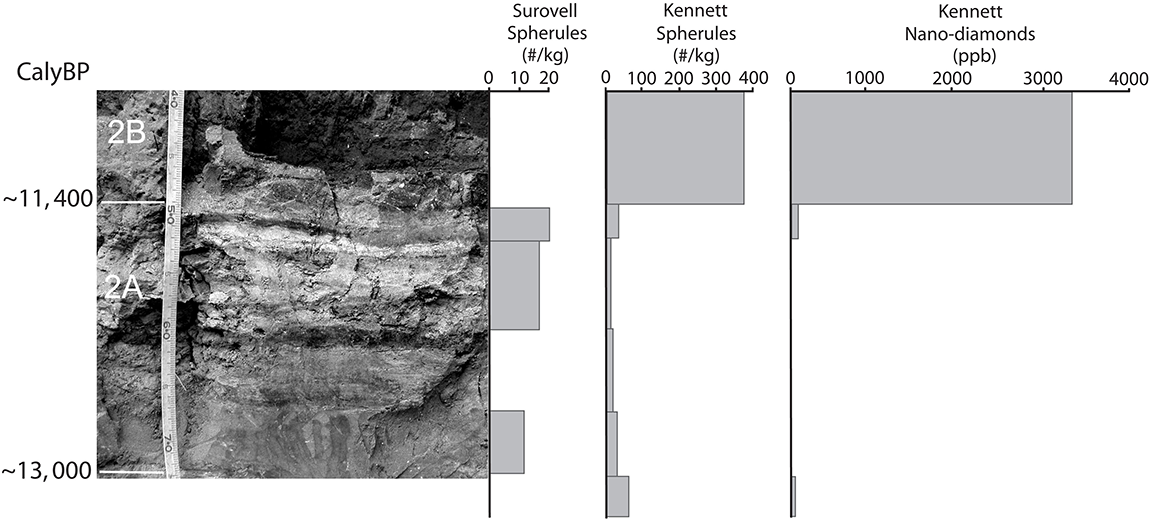
Holliday, Surovell, and Johnson, PLOS One (2016). CC BY 4.0.PLOS One figure pageThis image provides visual context. It does not establish cause, identity, date, or interpretation by itself.
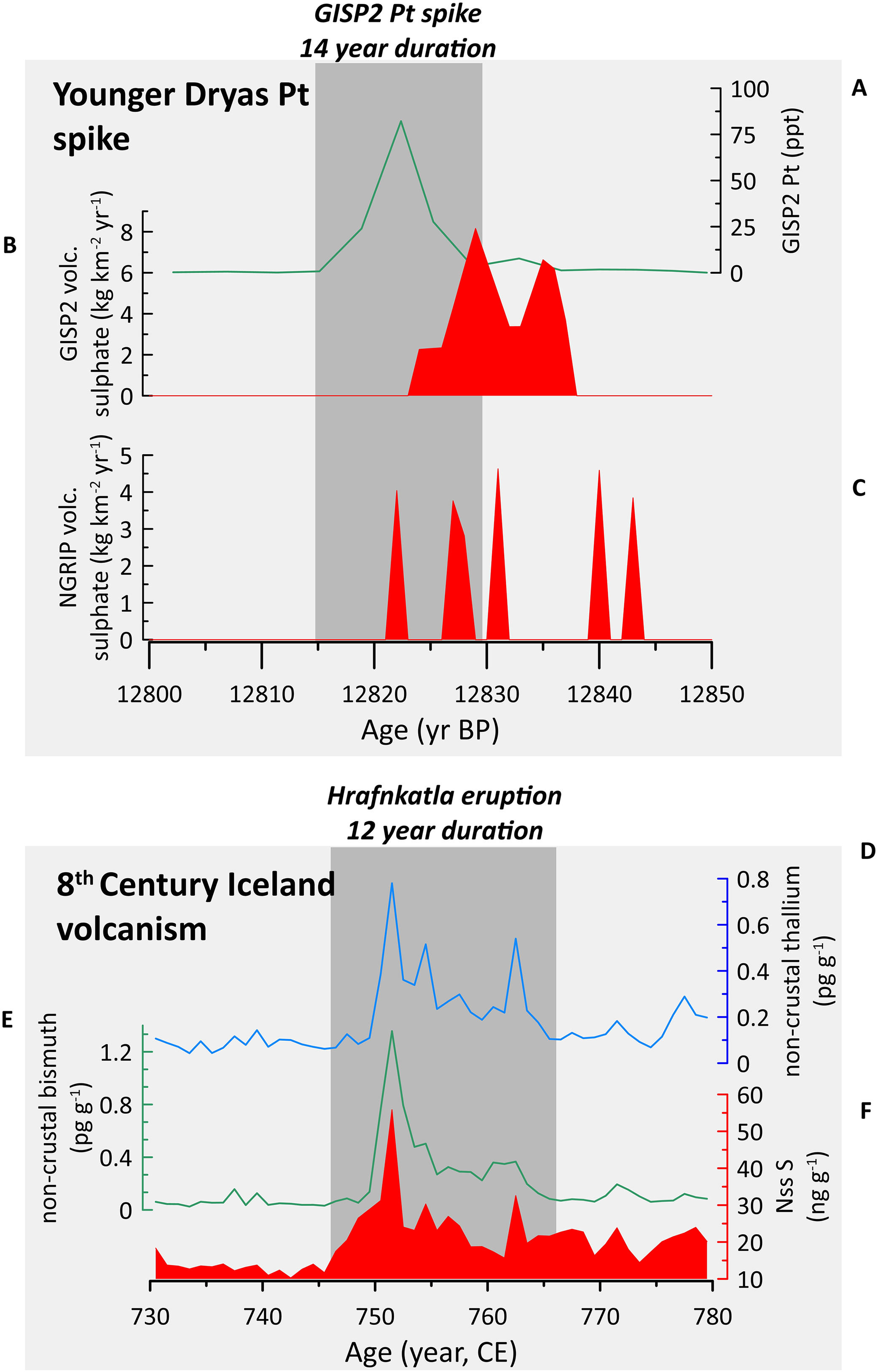
Green et al., PLOS One (2025). CC BY 4.0.PLOS One figure pageThis image provides visual context. It does not establish cause, identity, date, or interpretation by itself.
Green et al., PLOS One (2025). CC BY 4.0.PLOS One figure page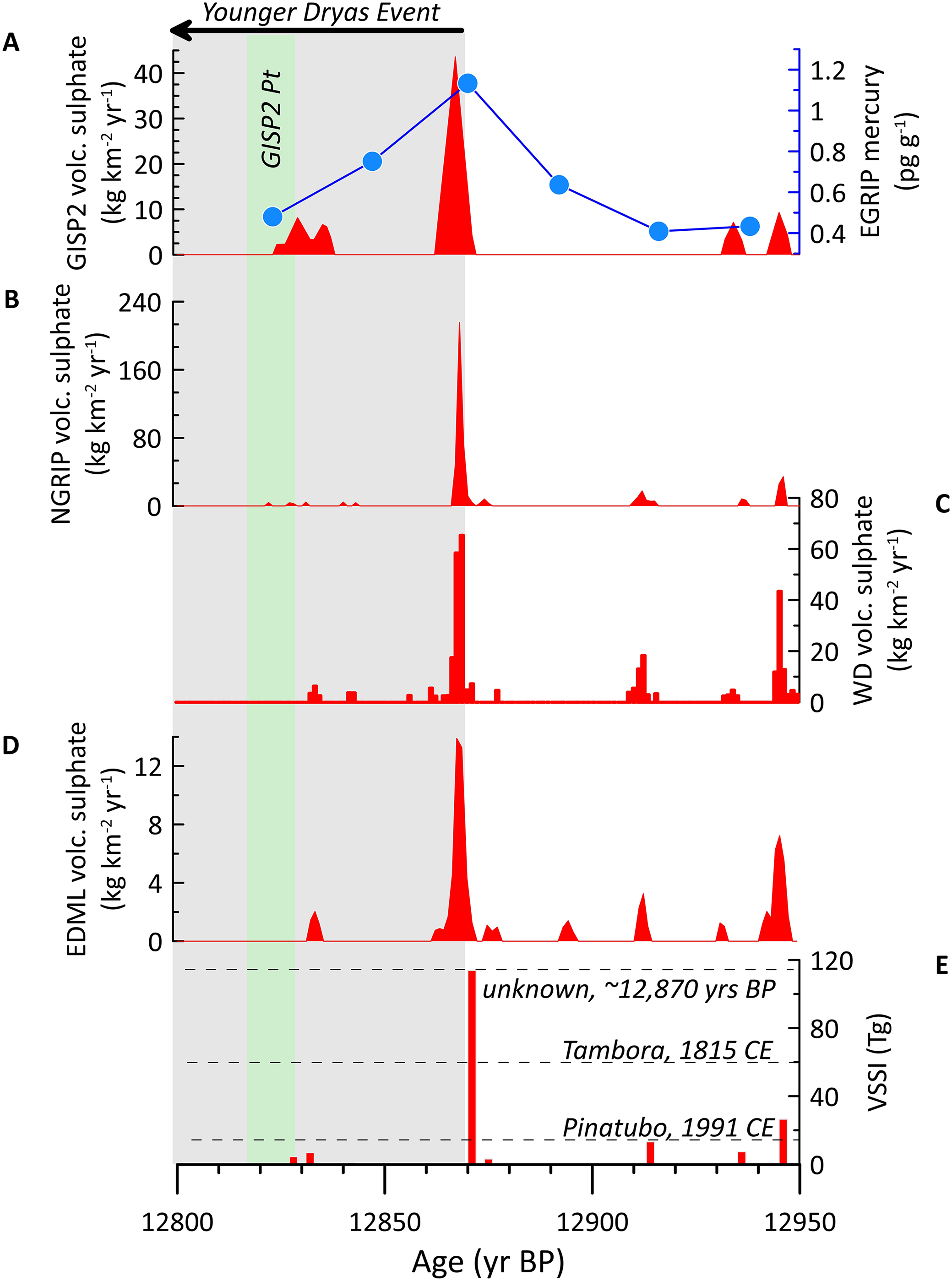
02Visual source
Map the possibilities
Which possibilities survive the pressure?
Give the accepted explanation and its strongest challengers the same hard questions: what fits, what fails, and what is still missing?Competing possibilities
The accepted account and its strongest alternatives.
Inclusion means a possibility is worth testing. It does not mean every possibility currently carries equal evidentiary weight.
Interpretation A - Non-impact climate and ecological explanations
The Younger Dryas was driven primarily by Earth-system processes during deglaciation, with claimed impact proxies remaining contested, non-unique, local, weakly dated, or insufficiently reproduced.
Current treatment
Leading explanation. Known deglacial mechanisms fit more of the record with fewer unsupported steps, but the exact trigger is not settled.
Interpretation B - Cosmic impact or airburst trigger
One or more extraterrestrial objects struck or exploded near the Younger Dryas onset, leaving a multi-proxy boundary layer and contributing materially to climate, wildfire, extinction, and human-cultural changes.
Current treatment
Serious minority hypothesis with some live proxy questions. The broad global catastrophe claim is not established by the current chronology, replication, or mechanism record.
Possibility map
Stress-test every serious explanation.
Select a possibility to see what would need to be true, what supports it, what weakens it, what is missing, and how seriously the current record allows PARALLAX to treat it.
Primary questionDoes the available evidence better support a Younger Dryas cosmic impact or airburst as a major trigger of the Younger Dryas event, or non-impact climate and ecological explanations?
Interpretation A - Non-impact climate and ecological explanations
What would need to be true
The Younger Dryas was driven primarily by Earth-system processes during deglaciation, with claimed impact proxies remaining contested, non-unique, local, weakly dated, or insufficiently reproduced.
What supports it
- Known deglacial mechanisms such as meltwater routing, AMOC weakening, sea-ice feedbacks, and atmospheric circulation change plausibly explain much of the climate pattern.
- Recent volcanic-forcing work provides another testable non-impact pathway near the onset.
- Chronological critiques challenge the claim of a tightly synchronous global impact layer.
- Independent studies have failed to reproduce or have disputed several key proxy classes.
- No confirmed Younger Dryas-age crater exists, and Hiawatha is about 58 million years old.
- Wildfire, black-mat, megafaunal, and archaeological records do not clearly show a single instantaneous catastrophe.
What weakens it
- The precise Younger Dryas trigger remains debated rather than fully settled.
- Meltwater routing and volcanic forcing both retain unresolved timing and mechanism questions.
- Some local high-temperature proxy claims remain technically interesting and need better explanation.
What evidence is missing
- A high-resolution causal sequence linking a specific non-impact forcing mechanism to the abrupt onset.
- Replicated ordinary-process explanations for the strongest surviving proxy assemblages.
How PARALLAX treats it now
Leading explanation. Known deglacial mechanisms fit more of the record with fewer unsupported steps, but the exact trigger is not settled.
Discriminating evidenceOpen the categories that can move the assessment
These links lead to the underlying evidence reviews. Direction is kept separate from importance and is never converted into a score.
High impactYounger Dryas climate event
Establishes the event, not its cause
Open evidence matrixHigh impactMeltwater, AMOC, and sea ice
Leans non-impact
Open evidence matrixHigh impactBoundary chronology
Leans against broad YDIH
Open evidence matrixHigh impactMicroscopic impact proxies
Mixed / contested
Open evidence matrixHigh impactCrater and airburst physics
Favors non-impact
Open evidence matrixHigh impactWildfire, extinctions, and humans
Favors complex non-impact causes
Open evidence matrixThis map does not award points for novelty or authority. Compare serious possibilities, inspect what each one explains, and follow the evidence categories back to their detailed reviews.
Evidence matrix
Current direction by category.
Current direction shows what a category supports, challenges, or leaves unresolved. Evidence impact shows how important that category is to understanding the case, without turning uncertainty into a fake score.
How to read this
Current direction says what the evidence presently supports, challenges, or leaves unresolved. Evidence impact says how important that category is to understanding the case. Impact does not mean support for either side.
Evidence categoryCurrent directionEvidence impactKey limitation / note
Evidence categoryYounger Dryas climate event
Read review5 linked sources
Current directionEstablishes the event, not its cause
Evidence impactHigh impactCentral to the case or capable of materially changing the assessment.
Key limitation / note
The abrupt cooling interval is real; the dispute is cause and mechanism.
Evidence categoryMeltwater, AMOC, and sea ice
Read review3 linked sources
Current directionLeans non-impact
Evidence impactHigh impactCentral to the case or capable of materially changing the assessment.
Key limitation / note
Known deglacial processes explain much of the pattern, though the exact trigger is unsettled.
Evidence categoryVolcanic forcing
Read review13 linked sources
Current directionEmerging non-impact support
Evidence impactMedium impactMeaningfully informs the case but is not decisive alone.
Key limitation / note
Recent volcanic interpretations are testable and currently reduce the need for an impact trigger.
Evidence categoryBoundary chronology
Read review4 linked sources
Current directionLeans against broad YDIH
Evidence impactHigh impactCentral to the case or capable of materially changing the assessment.
Key limitation / note
A global event should be synchronous; many claimed sites have weak or disputed age control.
Evidence categoryMicroscopic impact proxies
Read review4 linked sources
Current directionMixed / contested
Evidence impactHigh impactCentral to the case or capable of materially changing the assessment.
Key limitation / note
The strongest pro-impact category, but also the one most affected by identification and replication disputes.
Evidence categoryPlatinum anomaly
Read review5 linked sources
Current directionDisputed; not unique
Evidence impactMedium impactMeaningfully informs the case but is not decisive alone.
Key limitation / note
GISP2 platinum is important, but volcanic and other explanations remain viable.
Evidence categoryCrater and airburst physics
Read review4 linked sources
Current directionFavors non-impact
Evidence impactHigh impactCentral to the case or capable of materially changing the assessment.
Key limitation / note
No confirmed crater is known, and airburst models need tighter predictions.
Evidence categoryWildfire, extinctions, and humans
Read review12 linked sources
Current directionFavors complex non-impact causes
Evidence impactHigh impactCentral to the case or capable of materially changing the assessment.
Key limitation / note
The records do not currently show one synchronized continent-scale catastrophe.
Evidence reviews
The repeatable review structure for future cases.
Each category separates the core question, established observations, source quality, competing interpretations, assessment, unresolved issues, and sources.
003-A
Climate Event And Triggers
Current directionLeans non-impact
Question tested
Does the climate record require a cosmic trigger?
Current read
The climate event is real and abrupt, but known deglacial mechanisms and newer volcanic-forcing work currently explain more of the pattern than a cosmic trigger does.
Established Observations
- FACTThe Younger Dryas was an abrupt cooling interval during the last deglaciation, visible especially in Greenland and North Atlantic climate records.
- SUPPORTED INFERENCEMeltwater routing, Atlantic overturning changes, and sea-ice feedbacks remain physically plausible non-impact explanations.
- DISPUTEDThe exact trigger and routing of the Younger Dryas transition remain debated.
- SUPPORTED INFERENCERecent volcanic-forcing work provides a testable non-impact alternative to impact-trigger claims.
Evidence Quality
Strong for the existence and timing of the climate event; moderate for trigger attribution because meltwater, , sea-ice, and volcanic mechanisms still have unresolved details.
Accepted / Conventional Reading
- The Younger Dryas can be explained by deglacial ocean-atmosphere-cryosphere processes without invoking a bolide.
- Volcanic forcing may have contributed to triggering or amplifying the transition, but this remains under active testing.
Challenge / Alternative Reading
- A cosmic impact or airburst supplied the abrupt forcing that destabilized climate systems at the Younger Dryas onset.
- The climate trigger problem is treated as part of a larger proxy package that includes platinum, spherules, melt products, and biomass burning.
PARALLAX Current Read
THE CLIMATE EVENT IS ESTABLISHED; AN IMPACT TRIGGER IS NOT REQUIRED BY THE CURRENT RECORD
003-B
Chronology And Synchroneity
Current directionFavors non-impact caution
Question tested
Are claimed impact indicators securely dated to the same boundary event?
Current read
A global impact should leave a tightly timed signal. Chronological critiques report weak age control at many sites, while proponent Bayesian analyses argue for broader synchronicity.
Established Observations
- FACTProponents have treated synchronicity of boundary indicators as a key test of the hypothesis.
- DISPUTEDMeltzer et al. found that many claimed sites lacked adequate dating or did not align with the asserted boundary window.
- DISPUTEDKennett et al. argued that Bayesian chronological analyses support a synchronous boundary age at sites across four continents.
- FACTThe Lubbock Lake blind test reported a major magnetic-spherule/nanodiamond peak in a younger layer rather than the expected Younger Dryas boundary sample.
Evidence Quality
High for the existence of a formal chronological dispute; mixed for individual sites because dating quality varies sharply by context.
Accepted / Conventional Reading
- Claimed YDB layers are too inconsistently dated to establish a single global impact event.
- Radiocarbon overlap and modeled windows should not substitute for directly dated proxy-bearing layers.
Challenge / Alternative Reading
- When age uncertainties are modeled together, the boundary layers are consistent with a narrow synchronous event.
- Some critical studies may apply dating standards inconsistently or reject legitimate boundary assignments too aggressively.
PARALLAX Current Read
CHRONOLOGY IS A CENTRAL WEAKNESS FOR THE GLOBAL IMPACT CLAIM
003-C
Impact Proxies
Current directionMixed but currently weak for broad YDIH
Question tested
Do , , meltglass, carbon spherules, and shocked minerals reliably identify a Younger Dryas impact?
Current read
The proxy suite is the strongest pro-impact area, but it is also where identification, uniqueness, dating, and reproducibility disputes are most severe.
Established Observations
- FACTThe original YDIH and later proponent papers report magnetic grains, microspherules, carbon spherules, nanodiamonds, meltglass, and other proposed indicators.
- FACTHancock amplified the YDIH boundary-field and nanodiamond/proxy claims for a broad audience; those claims still have to be evaluated through the underlying scientific papers and rebuttals.
- DISPUTEDIndependent studies have reported failure to reproduce key microspherule and nanodiamond results.
- DISPUTEDSome carbonaceous forms interpreted as impact-related have been argued to resemble fungal sclerotia or other terrestrial materials.
- SUPPORTED INFERENCEHigh-temperature melt-product claims remain among the more technically interesting pro-impact arguments, especially at Abu Hureyra.
Evidence Quality
Mixed. There are peer-reviewed proponent papers and peer-reviewed critiques, but several claims depend on microscopic classification and site-specific methods.
Accepted / Conventional Reading
- Most claimed proxies are not uniquely diagnostic, are inconsistently identified, or are not reproduced by independent teams.
- Some materials may be terrestrial, reworked, pyrogenic, volcanic, sedimentary, biological, or affected by sampling and counting criteria.
Challenge / Alternative Reading
- The relevant evidence is the full proxy assemblage, not any one particle class in isolation.
- High-temperature materials and repeated proxy reports at multiple sites indicate a real extraordinary event that critics have not fully explained.
PARALLAX Current Read
PROXY CLAIMS REMAIN IMPORTANT BUT DO NOT CURRENTLY ESTABLISH A GLOBAL IMPACT
003-D
Platinum And Geochemistry
Current directionDisputed; not uniquely impact
Question tested
Does the platinum and platinum-group-element record distinguish impact from volcanic or terrestrial sources?
Current read
The is real and important, but recent work argues it may be volcanic and offset from the onset.
Established Observations
- FACTPetaev et al. reported a large platinum anomaly in the GISP2 ice core near the Younger Dryas onset.
- DISPUTEDThe platinum anomaly has been interpreted as possible extraterrestrial input, but its high Pt/Ir and Pt/Al ratios complicate simple meteorite explanations.
- FACTPaquay et al. did not find extraterrestrial platinum-group-element evidence in several studied depositional records.
- SUPPORTED INFERENCEGreen et al. argue that a volcanic origin for the GISP2 platinum spike is plausible and should be tested in other cores.
Evidence Quality
Strong for the existence of published geochemical measurements; weaker for source attribution because multiple mechanisms remain possible.
Accepted / Conventional Reading
- The platinum spike is an anomaly, but not a decisive impact fingerprint.
- Volcanic aerosols, source fractionation, post-depositional behavior, and local/regional effects must be tested before invoking a bolide.
Challenge / Alternative Reading
- The platinum spike is one of the strongest geochemical clues for unusual extraterrestrial input near the Younger Dryas boundary.
- Its unusual ratios may reflect an unusual impactor rather than a typical chondritic meteorite.
PARALLAX Current Read
PLATINUM IS A REAL ANOMALY, BUT NOT A DECISIVE IMPACT MARKER
003-E
Craters, Airbursts, And Physics
Current directionFavors non-impact
Question tested
Is there a self-consistent physical event scenario that fits the claimed evidence?
Current read
No confirmed -age crater is known, Hiawatha is much older, and scenarios remain too flexible unless they produce stronger predictions.
Established Observations
- FACTNo confirmed impact crater has been dated to the Younger Dryas onset.
- FACTThe Hiawatha impact structure is dated to about 58 million years ago, not the Younger Dryas.
- SUPPORTED INFERENCEAirburst or ice-impact scenarios can explain the absence of a classic crater but must still explain energy, distribution, proxy production, and environmental effects.
- DISPUTEDThe YDIH event scenario has varied across papers, making direct falsification harder and predictive power weaker.
Evidence Quality
Strong for Hiawatha dating and crater absence in reviewed literature; moderate for modeling because the proposed event has changed across the debate.
Accepted / Conventional Reading
- A large event should have more direct physical evidence, and the lack of a dated crater or stable event model weakens the hypothesis.
- Airbursts are possible in principle, but the proposed scale and consequences need stronger quantitative support.
Challenge / Alternative Reading
- A fragmented comet, airburst swarm, or ice-sheet impact could produce widespread proxies while leaving little or no preserved crater evidence.
- Absence of a crater is therefore not sufficient to dismiss the hypothesis.
PARALLAX Current Read
NO CONFIRMED EVENT STRUCTURE CURRENTLY SUPPORTS A YOUNGER DRYAS IMPACT
003-F
Wildfire, Black Mats, And Sediments
Current directionLeans non-impact
Question tested
Do fire and black-mat records indicate a sudden impact-caused biomass-burning event?
Current read
and fire proxies are visually persuasive but do not currently establish a synchronous continent-scale burn event.
Established Observations
- FACTYDIH proponents include charcoal, soot, carbonaceous particles, and black mats in the claimed impact package.
- SUPPORTED INFERENCEMarlon et al. did not find evidence for a unique continentwide wildfire pulse at the Younger Dryas onset.
- SUPPORTED INFERENCEPigati et al. argued that wetland black mats and some markers can accumulate through non-impact processes over broad time ranges.
- DISPUTEDSome pro-impact work interprets carbon-rich layers and particles as evidence for biomass burning linked to cosmic impact.
Evidence Quality
Moderate to strong. Paleofire and wetland studies directly test claimed environmental consequences, though regional records vary.
Accepted / Conventional Reading
- Black mats often indicate hydrologic, ecological, or depositional change, not necessarily catastrophe.
- The fire record does not show the unique, synchronous, continent-scale burn pulse predicted by the broad YDIH package.
Challenge / Alternative Reading
- Boundary charcoal, soot, and carbonaceous material record impact-triggered biomass burning over very large areas.
- Local sediment complexity may obscure a short-lived event signal in some records.
PARALLAX Current Read
FIRE AND BLACK-MAT EVIDENCE DOES NOT CURRENTLY SUPPORT A GLOBAL CATASTROPHE
003-G
Megafauna And Human Change
Current directionFavors complex non-impact explanations
Question tested
Do extinction and archaeological records require a sudden impact catastrophe?
Current read
Extinctions and Paleoindian changes were real, but the current record does not show a single synchronous collapse caused by a cosmic event.
Established Observations
- FACTThe original YDIH tied the proposed impact to megafaunal extinctions and rapid human behavioral shifts.
- SUPPORTED INFERENCEBuchanan et al. did not find evidence supporting a sudden Paleoindian demographic collapse due to extraterrestrial impact.
- DISPUTEDThe timing of late Pleistocene extinctions varies by species and region and does not cleanly reduce to one event.
- SUPPORTED INFERENCEA technological transition away from Clovis is not automatically evidence of population collapse.
Evidence Quality
Moderate to strong for broad archaeological critique; variable by taxon, region, and dating resolution.
Accepted / Conventional Reading
- Climate change, habitat change, human hunting pressure, ecological cascading, and regional variation better explain the late Pleistocene record than a single impact event.
- Cultural change in stone-tool traditions does not equal disappearance of people.
Challenge / Alternative Reading
- A cosmic event provided an abrupt ecological shock that contributed to megafaunal loss and disrupted Clovis-era lifeways.
- The impact need not explain every extinction alone to have been a major contributing cause.
PARALLAX Current Read
EXTINCTION AND CULTURAL RECORDS DO NOT CURRENTLY REQUIRE AN IMPACT
003-H
Recent Publication Record
Current directionKeeps case open; lowers confidence in broad YDIH
Question tested
How should recent proponent papers, rebuttals, and retractions affect the current assessment?
Current read
The debate is active, but recent retractions and continuing source-quality disputes reinforce the need for cautious, claim-by-claim review.
Established Observations
- FACTSweatman reviewed the impact evidence in 2021 and argued the YDIH should be accepted.
- FACTHolliday et al. published a comprehensive 2023 refutation, followed by a 2024 proponent rejection and a 2024 rebuttal.
- FACTPLOS One retracted 2025 YDIH-supporting papers in 2026 over chronology, sampling, methodology, data-reporting, or material-identification concerns.
- DISPUTEDProponent authors did not uniformly agree with the retractions, so the editorial actions reduce confidence in specific papers rather than closing the entire debate.
- FACTHancock articles, interviews, and video pages have presented YDIH to a broad public audience and sometimes foreground interviews or association with YDIH proponents.
- SUPPORTED INFERENCEPopularizers can help explain a claim, but primary scientific papers, replication attempts, and technical rebuttals must establish whether the claim is true.
Evidence Quality
Mixed. Formal peer-reviewed reviews and retractions are high relevance; specialty-venue proponent papers should be logged but weighted cautiously until independent review improves confidence. Hancock material is secondary / advocacy / interpretive and is used only to document public presentation of the claim.
Accepted / Conventional Reading
- Recent retractions and rebuttals highlight persistent methodological weaknesses and overclaiming in the impact literature.
- A high volume of publications cannot replace independent reproducibility and strong chronological control.
- Popular or advocacy presentations can clarify what proponents believe, but they cannot substitute for primary data.
Challenge / Alternative Reading
- The continued appearance of pro-impact papers shows that the case has not been fully settled and that critics may be dismissing convergent evidence too quickly.
- Retracted papers should not be used to invalidate all older or unrelated proxy claims.
- Hancock-platformed interviews and summaries can point readers toward YDIH researchers and source trails that deserve direct inspection.
PARALLAX Current Read
RECENT LITERATURE KEEPS THE QUESTION ACTIVE BUT DOES NOT RESCUE THE BROAD IMPACT CLAIM
Video Context
These clips are included to clarify how a claim is presented or explained. They are not substitutes for the source trail.
Hancock explains why YDIH matters to his broader argument
This timestamped segment is useful for hearing the public version of the Younger Dryas impact claim in Hancock's own framing. PARALLAX treats it as interpretation, then checks the scientific claims against the underlying YDIH papers and rebuttals.
Interview format; not a primary scientific source and not weighed as proof of impact proxies, chronology, or causal mechanism.
Lex Fridman Podcast #449 - Graham Hancock transcript and video
Hancock event with Allen West context
This event page is relevant because it pairs Hancock's presentation with discussion involving Allen West of the Comet Research Group. It helps readers understand proponent/public framing while the evidentiary burden stays with the peer-reviewed literature.
Advocacy/event presentation; claims need to be traced to primary papers, datasets, and technical responses before carrying evidentiary weight.
Ancient Apocalypse: What happened to the world 12,000 years ago and why we should care
03Visual source
Name what remains
What still does not sit right?
Keep the stubborn gaps visible. Then state what the record can presently carry without pretending suspicion is proof or authority is closure.Open questions / What still does not sit right
The unanswered questions that matter.
- Can claimed impact proxies be re-sampled with blind, predeclared, multi-lab protocols?
- Can proxy identification standards be fixed before classification and counting begin?
- Which claimed sites directly date the proxy-bearing layer rather than nearby or interpolated material?
- Is the GISP2 platinum spike present in other Greenland cores with matching timing and duration?
- Can volcanic aerosol, wildfire, sedimentary, biological, or hydrothermal processes reproduce the claimed proxy package?
- Can any airburst or impact model quantitatively explain energy, proxy distribution, environmental effect, and crater absence?
- Are Abu Hureyra and similar high-temperature material claims local anomalies or part of a synchronous global layer?
- Which pro-impact claims remain strongest after excluding retracted or lower-confidence sources?
What would change the picture
Evidence must be allowed to move the assessment.
- Blind, preregistered, multi-lab replication of impact proxies in directly dated Younger Dryas boundary layers would materially strengthen the YDIH.
- A confirmed crater, crater field, or direct ejecta record securely dated to the Younger Dryas onset would change the assessment substantially.
- High-resolution ice-core replication showing a coherent extraterrestrial geochemical signal at the onset would strengthen the impact interpretation.
- A constrained physical airburst/impact model matching energy, proxy production, distribution, and environmental effects would reduce current mechanism problems.
- Strong evidence that volcanic, sedimentary, biological, or wildfire processes reproduce the claimed proxies would further weaken the impact interpretation.
- New archaeological or paleontological chronologies showing abrupt, synchronous demographic and extinction effects tied to the same boundary would reopen the biological/cultural assessment.
Why this case matters
Why this conflict deserves scrutiny.
Anomaly is not conclusion
The case is useful because it contains real anomalies, real uncertainty, and real public fascination.
PARALLAX has to distinguish between evidence that deserves inspection and evidence strong enough to carry a global causal claim.
A stress test for public science
The debate shows how hard it is to communicate uncertainty when the same topic touches climate science, archaeology, extinctions, impact physics, and popular imagination.
The strongest version of the case requires source discipline, not reflexive dismissal or excitement.
Why it matters to PARALLAX
The YDIH lets PARALLAX model evidence-first disagreement: conventional explanations receive no automatic victory, but unconventional claims must still meet their burden.
The reader should see exactly where the current record is strong, where it is contested, and what would change the assessment.
What the evidence currently suggests
Where the record points - v0.1.4
PARALLAX does not require the reader to adopt a conclusion.
Based on the sources reviewed for v0.1.3, the available evidence currently better supports non-impact explanations for the Younger Dryas onset and associated ecological or cultural changes than it supports the Younger Dryas Impact Hypothesis as a broad causal account.
The strongest reasons are the absence of a confirmed Younger Dryas-age crater, major chronology and reproducibility problems, contested proxy identification, weak support for continent-scale wildfire or human collapse, and plausible non-impact climate mechanisms.
That does not make every YDIH-associated observation irrelevant. Some local proxy claims, especially high-temperature materials and platinum/geochemical anomalies, remain worth testing under stronger protocols.
Hancock material is included as public interpretation of the unconventional case, not as primary scientific evidence; its technical claims are paired with underlying papers and rebuttals.
The case remains open, but the current direction of evidence is uneven: interesting impact claims exist, while the broad catastrophe hypothesis is not established.
04Visual source
Inspect the record
Follow the evidence back to its sources.
Trace the sources, shared foundations, definitions, corrections, and revision history behind the public assessment.Source record
Inspect the material.
- Technical / scientific analysisydi-firestone-2007
Evidence for an extraterrestrial impact 12,900 years ago that contributed to the megafaunal extinctions and the Younger Dryas cooling
Technical sourceScientific, engineering, forensic, or specialist analysis; weight follows method and reproducibility.- Limit
- Technical publication does not remove limits in method, data access, replication, or later criticism.
Original modern YDIH proposal connecting a claimed boundary layer to Younger Dryas cooling, megafaunal extinctions, ecological reorganization, and human cultural change.
- Technical / scientific analysisydi-broecker-1989
Routing of meltwater from the Laurentide Ice Sheet during the Younger Dryas cold episode
Technical sourceScientific, engineering, forensic, or specialist analysis; weight follows method and reproducibility.- Limit
- Technical publication does not remove limits in method, data access, replication, or later criticism.
Classic non-impact explanation emphasizing meltwater routing and North Atlantic circulation disruption during the Younger Dryas.
- Technical / scientific analysisydi-condron-2012
Meltwater routing and the Younger Dryas
Technical sourceScientific, engineering, forensic, or specialist analysis; weight follows method and reproducibility.- Limit
- Technical publication does not remove limits in method, data access, replication, or later criticism.
Modeling work arguing that Arctic-routed meltwater is more effective than a St. Lawrence route for triggering Younger Dryas-like cooling.
- Technical / scientific analysisydi-yobo-2026
Volcanic forcing of global climate cooling at the Younger Dryas onset preserved in North American sediments
Technical sourceScientific, engineering, forensic, or specialist analysis; weight follows method and reproducibility.- Limit
- Technical publication does not remove limits in method, data access, replication, or later criticism.
Recent volcanic-forcing paper relevant to non-impact triggers. Important but still requiring follow-up replication and integration with other records.
- Technical / scientific analysisydi-green-2025
A possible volcanic origin for the Greenland ice core Pt anomaly near the Bolling-Allerod/Younger Dryas boundary
Technical sourceScientific, engineering, forensic, or specialist analysis; weight follows method and reproducibility.- Limit
- Technical publication does not remove limits in method, data access, replication, or later criticism.
Open-access geochemical and chronological assessment arguing that the GISP2 platinum spike may reflect fractionated volcanic material and is offset from the Younger Dryas onset.
- Technical / scientific analysisydi-surovell-2009
An independent evaluation of the Younger Dryas extraterrestrial impact hypothesis
Technical sourceScientific, engineering, forensic, or specialist analysis; weight follows method and reproducibility.- Limit
- Technical publication does not remove limits in method, data access, replication, or later criticism.
Independent analysis of magnetic minerals and microspherules from multiple sites that reported inability to reproduce the original proxy results.
- Technical / scientific analysisydi-lecompte-2012
Independent evaluation of conflicting microspherule results
Technical sourceScientific, engineering, forensic, or specialist analysis; weight follows method and reproducibility.- Limit
- Technical publication does not remove limits in method, data access, replication, or later criticism.
Proponent-side response and reanalysis addressing disputed microspherule recovery and methods.
- Technical / scientific analysisydi-bunch-2012
Very high-temperature impact melt products as evidence for cosmic airbursts and impacts 12,900 years ago
Technical sourceScientific, engineering, forensic, or specialist analysis; weight follows method and reproducibility.- Limit
- Technical publication does not remove limits in method, data access, replication, or later criticism.
Pro-impact paper arguing that melt products require very high temperatures and are consistent with cosmic airburst or impact processes.
- Technical / scientific analysisydi-wittke-2013
Evidence for deposition of 10 million tonnes of impact spherules across four continents 12,800 y ago
Technical sourceScientific, engineering, forensic, or specialist analysis; weight follows method and reproducibility.- Limit
- Technical publication does not remove limits in method, data access, replication, or later criticism.
Proponent study arguing for wide deposition of impact spherules across four continents.
- Technical / scientific analysisydi-kennett-2015
Bayesian chronological analyses consistent with synchronous age of 12,835-12,735 cal B.P. for Younger Dryas boundary on four continents
Technical sourceScientific, engineering, forensic, or specialist analysis; weight follows method and reproducibility.- Limit
- Technical publication does not remove limits in method, data access, replication, or later criticism.
Proponent-side chronological analysis arguing that YDB deposits can be modeled as synchronous across four continents.
- Technical / scientific analysisydi-meltzer-2014
Chronological evidence fails to support claim of an isochronous widespread layer of cosmic impact indicators dated to 12,800 years ago
Technical sourceScientific, engineering, forensic, or specialist analysis; weight follows method and reproducibility.- Limit
- Technical publication does not remove limits in method, data access, replication, or later criticism.
Chronological critique arguing that many reported sites lack adequate age control or do not fall within the claimed Younger Dryas boundary window.
- Technical / scientific analysisydi-holliday-2014
The Younger Dryas impact hypothesis: a cosmic catastrophe
Technical sourceScientific, engineering, forensic, or specialist analysis; weight follows method and reproducibility.- Limit
- Technical publication does not remove limits in method, data access, replication, or later criticism.
Broad critical review of crater, proxy, chronology, wildfire, extinction, and archaeological claims.
- Technical / scientific analysisydi-holliday-2016
A Blind Test of the Younger Dryas Impact Hypothesis
Technical sourceScientific, engineering, forensic, or specialist analysis; weight follows method and reproducibility.- Limit
- Technical publication does not remove limits in method, data access, replication, or later criticism.
Open-access blind split test at Lubbock Lake reporting low or absent expected proxy peaks and a major younger peak, raising reproducibility and identification concerns.
- Technical / scientific analysisydi-pinter-2011
The Younger Dryas impact hypothesis: A requiem
Technical sourceScientific, engineering, forensic, or specialist analysis; weight follows method and reproducibility.- Limit
- Technical publication does not remove limits in method, data access, replication, or later criticism.
Influential critical review concluding that multiple impact-marker claims were not reproducible or were better explained by terrestrial processes.
- Technical / scientific analysisydi-holliday-2023
Comprehensive refutation of the Younger Dryas Impact Hypothesis
Technical sourceScientific, engineering, forensic, or specialist analysis; weight follows method and reproducibility.- Limit
- Technical publication does not remove limits in method, data access, replication, or later criticism.
Large multi-author critical review arguing that YDIH lacks a self-consistent scenario, dated crater, reliable proxy identification, and support from paleoecological or archaeological records.
- Technical / scientific analysisydi-sweatman-2021
The Younger Dryas impact hypothesis: Review of the impact evidence
Technical sourceScientific, engineering, forensic, or specialist analysis; weight follows method and reproducibility.- Limit
- Technical publication does not remove limits in method, data access, replication, or later criticism.
Pro-impact review arguing that accumulated impact evidence supports accepting the YDIH.
- Technical / scientific analysisydi-sweatman-2024
Rejection of Holliday et al.'s alleged refutation of the Younger Dryas impact hypothesis
Technical sourceScientific, engineering, forensic, or specialist analysis; weight follows method and reproducibility.- Limit
- Technical publication does not remove limits in method, data access, replication, or later criticism.
Formal proponent response rejecting the 2023 comprehensive refutation and defending the published YDIH evidence base.
- Technical / scientific analysisydi-holliday-2024
Rebuttal of Sweatman, Powell, and West's rejection of Holliday et al.
Technical sourceScientific, engineering, forensic, or specialist analysis; weight follows method and reproducibility.- Limit
- Technical publication does not remove limits in method, data access, replication, or later criticism.
Formal rebuttal from the 2023 critical-review authors addressing the proponent response.
- Technical / scientific analysisydi-kennett-2009
Nanodiamonds in the Younger Dryas boundary sediment layer
Technical sourceScientific, engineering, forensic, or specialist analysis; weight follows method and reproducibility.- Limit
- Technical publication does not remove limits in method, data access, replication, or later criticism.
Proponent nanodiamond paper reporting abundant nanodiamonds in boundary sediments.
- Technical / scientific analysisydi-kinzie-2014
Nanodiamond-Rich Layer across Three Continents Consistent with Major Cosmic Impact at 12,800 Cal BP
Technical sourceScientific, engineering, forensic, or specialist analysis; weight follows method and reproducibility.- Directness
- Underlying technical source for nanodiamond and Younger Dryas boundary-field claims.
- Method
- Reports extraction and identification protocols for nanodiamond-like materials across multiple stratigraphic sections.
- Limit
- Proponent-side interpretation remains disputed by later nanodiamond identification and reproducibility critiques.
Underlying pro-impact scientific source for widely circulated Younger Dryas boundary-field and nanodiamond claims, including imagery later used in popular presentations.
- Technical / scientific analysisydi-daulton-2010
No evidence of nanodiamonds in Younger-Dryas sediments to support an impact event
Technical sourceScientific, engineering, forensic, or specialist analysis; weight follows method and reproducibility.- Limit
- Technical publication does not remove limits in method, data access, replication, or later criticism.
Critical nanodiamond study arguing that reported impact nanodiamonds were not confirmed and may reflect misidentified materials.
- Technical / scientific analysisydi-tian-2011
Evidence against a Younger Dryas impact event from nanodiamonds in sediments
Technical sourceScientific, engineering, forensic, or specialist analysis; weight follows method and reproducibility.- Limit
- Technical publication does not remove limits in method, data access, replication, or later criticism.
Critical work arguing that nanodiamond findings are not unique evidence for a Younger Dryas impact.
- Technical / scientific analysisydi-daulton-2017
No evidence of lonsdaleite in the Younger Dryas boundary layer
Technical sourceScientific, engineering, forensic, or specialist analysis; weight follows method and reproducibility.- Limit
- Technical publication does not remove limits in method, data access, replication, or later criticism.
Later critical nanodiamond/lonsdaleite work relevant to the claimed impact-marker suite.
- Technical / scientific analysisydi-scott-2010
Fungus, not comet or catastrophe, accounts for carbonaceous spherules in the Younger Dryas impact layer
Technical sourceScientific, engineering, forensic, or specialist analysis; weight follows method and reproducibility.- Limit
- Technical publication does not remove limits in method, data access, replication, or later criticism.
Critical study arguing that carbonaceous spherules and elongates can be explained as fungal sclerotia rather than impact products.
- Technical / scientific analysisydi-paquay-2009
Absence of geochemical evidence for an impact event at the Bolling-Allerod/Younger Dryas transition
Technical sourceScientific, engineering, forensic, or specialist analysis; weight follows method and reproducibility.- Limit
- Technical publication does not remove limits in method, data access, replication, or later criticism.
Geochemical study reporting no extraterrestrial platinum-group-element enrichment anomaly in studied depositional settings.
- Technical / scientific analysisydi-petaev-2013
Large Pt anomaly in the Greenland ice core points to a cataclysm at the onset of Younger Dryas
Technical sourceScientific, engineering, forensic, or specialist analysis; weight follows method and reproducibility.- Limit
- Technical publication does not remove limits in method, data access, replication, or later criticism.
Ice-core geochemistry paper reporting a platinum anomaly near the Younger Dryas onset and discussing possible extraterrestrial input.
- Technical / scientific analysisydi-marlon-2009
Wildfire responses to abrupt climate change in North America
Technical sourceScientific, engineering, forensic, or specialist analysis; weight follows method and reproducibility.- Limit
- Technical publication does not remove limits in method, data access, replication, or later criticism.
Paleofire study relevant to claims of continent-scale biomass burning at the Younger Dryas onset.
- Technical / scientific analysisydi-pigati-2012
Accumulation of impact markers in desert wetlands and implications for the Younger Dryas impact hypothesis
Technical sourceScientific, engineering, forensic, or specialist analysis; weight follows method and reproducibility.- Limit
- Technical publication does not remove limits in method, data access, replication, or later criticism.
Study of black mats and wetland contexts arguing that some proposed markers can accumulate through non-impact processes over broad time ranges.
- Technical / scientific analysisydi-buchanan-2008
Paleoindian demography and the extraterrestrial impact hypothesis
Technical sourceScientific, engineering, forensic, or specialist analysis; weight follows method and reproducibility.- Limit
- Technical publication does not remove limits in method, data access, replication, or later criticism.
Archaeological-demography study testing whether the record supports a sudden Paleoindian population crash linked to impact.
- Technical / scientific analysisydi-kenny-2022
A Late Paleocene age for Greenland's Hiawatha impact structure
Technical sourceScientific, engineering, forensic, or specialist analysis; weight follows method and reproducibility.- Limit
- Technical publication does not remove limits in method, data access, replication, or later criticism.
Dating study placing the Hiawatha impact structure at about 58 Ma, excluding it as a Younger Dryas impact crater.
- Technical / scientific analysisydi-moore-2020-abu-hureyra
Evidence of cosmic impact at Abu Hureyra, Syria at the Younger Dryas onset
Technical sourceScientific, engineering, forensic, or specialist analysis; weight follows method and reproducibility.- Limit
- Technical publication does not remove limits in method, data access, replication, or later criticism.
Pro-impact study reporting high-temperature meltglass and other proxies at Abu Hureyra.
- Technical / scientific analysisydi-pino-2019-pilauco
Sedimentary record from Patagonia, southern Chile supports cosmic-impact triggering of biomass burning, climate change, and megafaunal extinctions at 12.8 ka
Technical sourceScientific, engineering, forensic, or specialist analysis; weight follows method and reproducibility.- Limit
- Technical publication does not remove limits in method, data access, replication, or later criticism.
Pro-impact study from Pilauco, Chile reporting platinum, spherules, meltglass, nanodiamonds, and ecological change.
- Primary evidenceydi-plos-baffin-retraction-2026
Retraction: A 12,800-year-old layer with cometary dust, microspherules, and platinum anomaly recorded in multiple cores from Baffin Bay
Primary evidenceDirect material, dataset, exhibit, transcript, or record; directness does not remove context checks.- Limit
- Directness does not by itself establish authenticity, completeness, or the correct interpretation outside the documented provenance.
Formal retraction notice citing concerns about citations, methods, chronology, calibration, sampling design, data attribution, and material identification.
This linked record is the publisher retraction notice; the underlying 2025 article is retracted.
- Primary evidenceydi-plos-quartz-retraction-2026
Retraction: Shocked quartz at the Younger Dryas onset supports cosmic airbursts/impacts
Primary evidenceDirect material, dataset, exhibit, transcript, or record; directness does not remove context checks.- Limit
- Directness does not by itself establish authenticity, completeness, or the correct interpretation outside the documented provenance.
Formal retraction notice citing age-model and sampling-strategy problems that call the reported conclusions into question.
This linked record is the publisher retraction notice; the underlying 2025 article is retracted.
- Technical / scientific analysisydi-moore-2026-white-pond
Microspherules, meltglass, and nanoparticles from the Younger Dryas boundary layer at White Pond, USA
Technical sourceScientific, engineering, forensic, or specialist analysis; weight follows method and reproducibility.- Limit
- Technical publication does not remove limits in method, data access, replication, or later criticism.
Recent proponent paper from a specialty venue; logged for completeness but weighted cautiously until independent replication and venue context are assessed.
- Advocacy / interpretiveydi-hancock-2014-cataclysm
Fingerprint Of A Global Cataclysm 12,800 Years Ago
Interpretive sourcePopular, advocacy, or explanatory presentation; useful for framing claims, not establishing them.- Directness
- Public presentation of the unconventional case, not direct scientific evidence.
- Limit
- Advocacy framing can overstate certainty and extends into lost-civilization claims outside the core YDIH evidence.
- Verification
- Included for public-interpretation context; technical claims require underlying scientific sources.
Secondary / advocacy / interpretive source. Useful for showing how Hancock presented YDIH to a broad audience as a global catastrophe claim; not treated as primary scientific evidence. Technical claims are checked against sources such as Firestone 2007 and Kinzie et al. 2014.
- Advocacy / interpretiveydi-hancock-lex-2024
Graham Hancock: Lost Civilization of the Ice Age and Ancient Human History
Interpretive sourcePopular, advocacy, or explanatory presentation; useful for framing claims, not establishing them.- Directness
- Interview transcript documenting Hancock public framing and stated reasoning.
- Limit
- Not a primary scientific source; claims must be checked against peer-reviewed YDIH and rebuttal literature.
- Verification
- Included for public-interpretation context only.
Secondary / interpretive interview transcript. Included to show Hancock explaining why he finds YDIH persuasive and how he separates the impact claim from broader lost-civilization claims. It is public framing, not evidentiary proof.
- Advocacy / interpretiveydi-hancock-west-2025
Presentation: Ancient Apocalypse - What happened to the world 12,000 years ago and why we should care
Interpretive sourcePopular, advocacy, or explanatory presentation; useful for framing claims, not establishing them.- Directness
- Public event page tying Hancock presentation to a YDIH proponent interview.
- Limit
- Advocacy/event framing; underlying technical claims require primary scientific evidence.
- Verification
- Included for public-interpretation context only.
Secondary / advocacy / interpretive video page. Relevant because it pairs a Hancock presentation with an on-stage conversation with Allen West of the Comet Research Group. Underlying YDIH claims are evaluated through the scientific literature, not through the video itself.
Source relationships
Where the argument shares a foundation.
This view identifies records reused across observations, evidence reviews, or other PARALLAX investigations. It prevents citation volume from being mistaken for independent confirmation.
Repeated citation is not independent corroboration.
A record is counted once even when several sections rely on it. This audit shows the sources carrying more than one part of the public argument.
Evidence for an extraterrestrial impact 12,900 years ago that contributed to the megafaunal extinctions and the Younger Dryas cooling
Technical / scientific analysis
- Review reuse
- 6 evidence reviews
- Observation reuse
- 6 established observations
- Cross-case reuse
- 0 other investigations
Comprehensive refutation of the Younger Dryas Impact Hypothesis
Technical / scientific analysis
- Review reuse
- 4 evidence reviews
- Observation reuse
- 6 established observations
- Cross-case reuse
- 0 other investigations
A possible volcanic origin for the Greenland ice core Pt anomaly near the Bolling-Allerod/Younger Dryas boundary
Technical / scientific analysis
- Review reuse
- 2 evidence reviews
- Observation reuse
- 5 established observations
- Cross-case reuse
- 0 other investigations
The Younger Dryas impact hypothesis: a cosmic catastrophe
Technical / scientific analysis
- Review reuse
- 3 evidence reviews
- Observation reuse
- 4 established observations
- Cross-case reuse
- 0 other investigations
Volcanic forcing of global climate cooling at the Younger Dryas onset preserved in North American sediments
Technical / scientific analysis
- Review reuse
- 2 evidence reviews
- Observation reuse
- 2 established observations
- Cross-case reuse
- 0 other investigations
The Younger Dryas impact hypothesis: Review of the impact evidence
Technical / scientific analysis
- Review reuse
- 2 evidence reviews
- Observation reuse
- 2 established observations
- Cross-case reuse
- 0 other investigations
Rejection of Holliday et al.'s alleged refutation of the Younger Dryas impact hypothesis
Technical / scientific analysis
- Review reuse
- 2 evidence reviews
- Observation reuse
- 2 established observations
- Cross-case reuse
- 0 other investigations
Nanodiamond-Rich Layer across Three Continents Consistent with Major Cosmic Impact at 12,800 Cal BP
Technical / scientific analysis
- Review reuse
- 2 evidence reviews
- Observation reuse
- 2 established observations
- Cross-case reuse
- 0 other investigations
Fingerprint Of A Global Cataclysm 12,800 Years Ago
Advocacy / interpretive
- Review reuse
- 2 evidence reviews
- Observation reuse
- 2 established observations
- Cross-case reuse
- 0 other investigations
Very high-temperature impact melt products as evidence for cosmic airbursts and impacts 12,900 years ago
Technical / scientific analysis
- Review reuse
- 1 evidence reviews
- Observation reuse
- 2 established observations
- Cross-case reuse
- 0 other investigations
Appears in003-C Impact Proxies
Bayesian chronological analyses consistent with synchronous age of 12,835-12,735 cal B.P. for Younger Dryas boundary on four continents
Technical / scientific analysis
- Review reuse
- 1 evidence reviews
- Observation reuse
- 2 established observations
- Cross-case reuse
- 0 other investigations
Appears in003-B Chronology And Synchroneity
Chronological evidence fails to support claim of an isochronous widespread layer of cosmic impact indicators dated to 12,800 years ago
Technical / scientific analysis
- Review reuse
- 1 evidence reviews
- Observation reuse
- 2 established observations
- Cross-case reuse
- 0 other investigations
Appears in003-B Chronology And Synchroneity
Glossary
Plain-English terms for this case.
Definitions focus on words that materially affect how the evidence is understood.
Airburst
An explosion or breakup of a cosmic object in the atmosphere rather than at the ground surface.
Airburst scenarios are used to explain how a large event might leave widespread effects without a classic crater.
Related evidence
AMOCAtlantic Meridional Overturning Circulation
Atlantic Meridional Overturning Circulation, a major ocean circulation system that moves heat through the Atlantic.
AMOC weakening is a central non-impact explanation for Younger Dryas cooling.
Related evidence
Black matblack mats
A dark organic-rich sediment layer often linked to wetland or hydrologic conditions.
Black mats are visually striking but can form through non-impact environmental processes.
Related evidence
Boundary layerYounger Dryas boundary layer
A sediment layer claimed to mark a specific transition or event in geological time.
YDIH depends on whether a Younger Dryas boundary layer is real, synchronous, and impact-related across many sites.
Related evidence
Chronology
The ordering and dating of events or layers through time.
Chronology is central because a global impact should leave evidence at the same time across sites.
Related evidence
Clovis cultureClovis
A Paleoindian archaeological culture in North America known partly for distinctive fluted stone projectile points.
Some YDIH versions link the proposed event to Clovis disruption, but the archaeological record is more complex than a simple collapse story.
Related evidence
Impact hypothesisYDIH, Younger Dryas Impact Hypothesis
The proposal that an extraterrestrial object struck Earth or exploded in the atmosphere and caused measurable effects.
In this case, it refers to the claim that a cosmic impact or airburst materially triggered the Younger Dryas and related changes.
Related evidence
Impact proxyproxy evidence, impact proxies
Indirect physical or chemical evidence interpreted as a sign of an impact, such as spherules, shocked minerals, or geochemical anomalies.
Impact proxies carry the YDIH only if they are correctly identified, diagnostic, dated, and replicated.
Related evidence
Megafauna
Large animals, especially the large mammals of the late Pleistocene such as mammoths, mastodons, and giant ground sloths.
YDIH links some extinctions to a catastrophe, but extinction timing varies by region and taxon.
Related evidence
Meltwater pulsemeltwater routing
A relatively rapid release of freshwater from melting ice sheets into oceans or drainage systems.
Meltwater routing is a major non-impact mechanism proposed for disrupting North Atlantic circulation.
Related evidence
Microspherulesspherules, magnetic microspherules
Tiny rounded particles that can form through high-temperature melting, but not only through cosmic impacts.
They are important YDIH proxies, but counts and origins have been repeatedly disputed.
Related evidence
Nanodiamonds
Extremely small diamond-like carbon particles measured at nanometer scale.
Nanodiamond claims were central to early YDIH support, but identification and uniqueness have been strongly contested.
Related evidence
Paleoclimate
The study of past climate using records such as ice cores, sediments, fossils, and chemical signatures.
The Younger Dryas is a paleoclimate event, so climate explanations must fit records across time and region.
Related evidence
Platinum anomalyPt anomaly, GISP2 platinum anomaly
An unusual enrichment of platinum in a layer or sample compared with expected background levels.
The GISP2 platinum anomaly is real enough to matter, but its cause is disputed and may not be uniquely extraterrestrial.
Related evidence
Retraction
A formal journal notice withdrawing a paper from the reliable published record because of serious problems.
Recent YDIH-related retractions do not settle the whole case, but they lower confidence in those specific claims.
Related evidence
Shocked quartz
Quartz grains with microscopic deformation features created by very high-pressure shock.
It can be strong impact evidence when securely identified and dated, but recent YDIH shocked-quartz claims have faced serious scrutiny.
Related evidence
Stratigraphy
The study of sediment or rock layers and their order, context, and relationship through time.
Stratigraphy matters because impact proxies must come from the right layer, not from younger, older, disturbed, or reworked material.
Related evidence
Younger Dryas
A cold climate interval near the end of the last ice age, beginning around 12,870 years before present and ending around 11,700 years before present.
The event itself is established; the dispute is whether a cosmic impact or ordinary Earth-system processes best explain its onset.
Related evidence
Challenge tools
PARALLAX can be challenged.
Challenges are evaluated by evidentiary quality, not ideological alignment.
Revision history
Important changes remain traceable.
Added a conflict-first presentation and possibility map without changing the evidence balance.
September 1, 2026
- Placed the prevailing deglacial account beside the strongest reasons the impact hypothesis remains alive.
- Added explicit missing-evidence and current-standing tests for both possibilities.
- Kept primary science distinct from popular advocacy while preserving the current non-impact lean.
Added embedded video context for public presentation of the YDIH.
August 30, 2026
- Added click-to-play video context to the recent publication record review.
- Labeled Hancock clips as advocacy / interpretive material rather than primary scientific evidence.
- Added public methodology guidance that embedded media clarifies claims but does not replace source evidence.
Audited source balance under the expanded sourcing principle.
August 30, 2026
- Added source-limitation metadata for Hancock public-interpretation sources and Kinzie et al. 2014.
- Clarified that advocacy/popular sources help explain claims but do not establish technical evidence.
- Preserved the non-impact-leaning state-of-evidence assessment after the audit.
Added limited public-interpretation context for Graham Hancock material.
August 30, 2026
- Added an Advocacy / interpretive source type to distinguish popular presentation from primary scientific evidence.
- Added three Hancock or Hancock-platform sources as contextual material, not evidentiary backbone.
- Added Kinzie et al. 2014 as an underlying scientific source for nanodiamond and boundary-field claims referenced in popular framing.
- Updated relevant evidence reviews to state that popularizers can help explain a claim, while primary evidence must establish it.
Initial state-of-evidence report for the Younger Dryas Impact Hypothesis under the PARALLAX protocol.
August 30, 2026
- Opened INV-003 as an active investigation.
- Added climate, chronology, proxy, platinum, crater, wildfire, extinction, and publication-record evidence reviews.
- Added source-linked scientific figures to the investigation gallery.
- Added YDIH sources to the public source library and surfaced INV-003 as the featured homepage case.