Did Vela satellite 6911 detect an atmospheric nuclear test near South Africa on September 22, 1979, or does the available evidence better support a non-nuclear explanation for the recorded double flash?
The Vela Incident: Double Flash Over the South Atlantic
Did Vela satellite 6911 detect an atmospheric nuclear test near South Africa on September 22, 1979, or does the available evidence better support a non-nuclear explanation for the recorded double flash?
Nuclear DetectionIntelligence HistoryRemote SensingNuclear Proliferation
- Category
- Nuclear Detection / Intelligence History / Remote Sensing
- Source record
- 19 sources
- Evidence reviews
- 08
- Current version
- v0.1.2
A nuclear-like signal is not an attributed test. This investigation keeps the physical event, nuclear classification, and responsible actor as separate evidentiary questions so confidence cannot leak from one layer into the next.
Authority does not receive automatic closure, and dissent does not receive automatic credibility. This case remains open to stronger records, technical correction, and good-faith challenge.
Case briefing
Enter the conflict before the conclusion.
The accepted account is documented as a claim to test, not a truth to inherit. Serious alternatives face the same standard.
The White House scientific panel concluded that the September 1979 signal probably was not a nuclear explosion and favored a rare physical event near the aging satellite, possibly involving meteoroid-generated debris.
The event is rare, the spacecraft was old, other systems did not provide clean public confirmation, the leading alternative was never fully modeled, and some of the strongest acoustic and intelligence evidence remains classified.
- Both optical channels recorded a nuclear-like first pulse and double-flash timing that matched the system purpose and prior test experience.
- The favored near-satellite alternative was never fully modeled or reproduced from measured parameters.
- Hydroacoustic, iodine, ionospheric, laboratory, and intelligence evidence has remained disputed, partly classified, or incompletely public while the political consequences of a test were substantial.
At a glance
What is firmly established
- Both optical sensors on Vela 6911 recorded the event at the same time.
- The first pulse and general timing resembled a low-yield atmospheric nuclear explosion.
- The sensors differed materially in their relative response during the second pulse.
- The spacecraft was beyond nominal life and had known subsystem and background-modulation issues.
- The Ruina panel rejected a simple electronic malfunction and favored a rare physical event near the satellite.
- The panel final conclusion was probably not nuclear, not a categorical exclusion of nuclear origin.
- No public direct fallout sample, second-satellite optical record, or seismic detection conclusively confirms the event.
- Contemporary nuclear-detection specialists disputed the panel and judged the signal consistent with a low-yield test.
- The full NRL hydroacoustic report and complete Vela telemetry are not publicly available.
- The IAEA-verified timeline places South Africa first completed weapon in November 1979.
- The public evidence does not identify a responsible actor with high confidence.
Still open
What remains disputed or unresolved
- What caused the second-pulse sensor discrepancy?
- Could a meteoroid or debris interaction reproduce the complete recorded light curve?
- How strongly should other satellite and infrared nondetections count against a small remote test?
- Do the reported hydroacoustic signals independently localize an explosive source?
- Can the Australian iodine-131 excess be tied to this event rather than another source?
- Was the Arecibo ionospheric disturbance causally related or coincidental?
- Did political consequences influence the panel process or only the public policy response?
- If nuclear, did Israel, South Africa, both, or another actor conduct the event?
Evidence snapshot
Where the major categories currently point.
Current direction and evidence impact are separate. Open any review for the complete observations, interpretations, source quality, and unresolved questions.
How to read this
Current direction says what the evidence presently supports, challenges, or leaves unresolved. Evidence impact says how important that category is to understanding the case. Impact does not mean support for either side.
Evidence categoryCurrent directionEvidence impactKey limitation / note
Evidence categoryTwo-channel optical alert
Read review6 linked sources
Current directionFavors nuclear interpretation
Evidence impactHigh impactCentral to the case or capable of materially changing the assessment.
Key limitation / note
Both sensors shared one spacecraft and viewing geometry.
Evidence categoryFirst-pulse shape and timing
Read review6 linked sources
Current directionStrongly favors nuclear interpretation
Evidence impactHigh impactCentral to the case or capable of materially changing the assessment.
Key limitation / note
Diagnostic similarity is powerful but not absolute exclusivity.
Evidence categorySecond-pulse sensor discrepancy
Read review6 linked sources
Current directionFavors non-nuclear origin or measurement complication
Evidence impactHigh impactCentral to the case or capable of materially changing the assessment.
Key limitation / note
No measured cause has conclusively explained the difference.
Evidence categoryPanel non-nuclear model
Read review4 linked sources
Current directionSupports a possible near-satellite event
Evidence impactMedium impactMeaningfully informs the case but is not decisive alone.
Key limitation / note
The proposed debris mechanism was not fully reconstructed or validated.
Evidence categoryOther satellite and infrared nondetections
Read review4 linked sources
Current directionFavors non-nuclear interpretation
Evidence impactHigh impactCentral to the case or capable of materially changing the assessment.
Key limitation / note
Actual coverage, weather, geometry, and thresholds limit exclusion power.
Evidence categorySeismic and immediate debris nondetections
Read review4 linked sources
Current directionLimits the nuclear conclusion
Evidence impactMedium impactMeaningfully informs the case but is not decisive alone.
Key limitation / note
A small atmospheric oceanic event may couple weakly and produce a sparse plume.
Evidence categoryHydroacoustic arrivals
Read review4 linked sources
Current directionFavors nuclear interpretation
Evidence impactHigh impactCentral to the case or capable of materially changing the assessment.
Key limitation / note
The full NRL report, raw traces, and processing record remain unavailable.
Evidence categoryAustralian iodine-131
Read review3 linked sources
Current directionFavors nuclear interpretation
Evidence impactMedium impactMeaningfully informs the case but is not decisive alone.
Key limitation / note
Delayed sampling, modest significance, and source ambiguity limit .
Evidence categoryArecibo ionospheric disturbance
Read review3 linked sources
Current directionAmbiguous / weakly favors nuclear
Evidence impactLimited impactRelevant, but too indirect or constrained to carry much of the case.
Key limitation / note
Traveling disturbances can have several natural causes.
Evidence categorySouth African weapons program
Read review3 linked sources
Current directionSupports capability context, not event responsibility
Evidence impactMedium impactMeaningfully informs the case but is not decisive alone.
Key limitation / note
A real secret program explains suspicion but does not identify the actor.
Evidence categoryIAEA-verified device timeline
Read review3 linked sources
Current directionChallenges solo South African attribution
Evidence impactHigh impactCentral to the case or capable of materially changing the assessment.
Key limitation / note
Does not exclude a foreign device or South African logistical assistance.
Evidence categoryIsraeli capability and bilateral ties
Read review5 linked sources
Current directionSupports plausibility of joint attribution
Evidence impactMedium impactMeaningfully informs the case but is not decisive alone.
Key limitation / note
Capability and relationships remain circumstantial without operational proof.
Evidence categoryRetrospective attribution testimony
Read review5 linked sources
Current directionMixed / unresolved
Evidence impactLimited impactRelevant, but too indirect or constrained to carry much of the case.
Key limitation / note
Much of the visible testimony is indirect, late, or not independently corroborated.
Evidence categoryPolitical incentives and internal conflict
Read review5 linked sources
Current directionLimits confidence in process neutrality
Evidence impactLow impactAdds context but has little power to separate the interpretations.
Key limitation / note
Incentives justify scrutiny but do not determine the physical source.
Current read
Where the record points after review.
The available public evidence better supports a low-yield atmospheric or near-surface nuclear explosion than a non-nuclear optical event. The nuclear-like first pulse and timing, dual-sensor alert, prior Vela record, weakness of the leading debris reconstruction, and several compatible corroborating observations drive that judgment.
Confidence remains below definitive. The second-pulse discrepancy is real, other systems did not provide clean public confirmation, the strongest hydroacoustic material is incompletely inspectable, and no uncontested diagnostic fallout sample is public.
The responsible actor is unknown. Israeli involvement with possible South African assistance is plausible and fits the verified South African device timeline better than a solo South African test, but it is not established by public direct evidence.
The case remains open. New telemetry, acoustic records, diagnostic material, or authenticated operational documentation could materially change both event classification and attribution.
What would change it
The assessment remains revisable.
- Independent confirmation of raw hydroacoustic data localizing an explosive source to the event time would materially strengthen the nuclear interpretation.
- Authenticated diagnostic fallout with a secure chain of custody would move the event toward confirmation.
- Complete telemetry showing a measured background or detector cause for the second-pulse anomaly would strengthen a nuclear reading of the remaining signal.
- A validated meteoroid, debris, or natural model reproducing both sensor traces would materially strengthen the non-nuclear interpretation.
- Calibration evidence demonstrating a known Vela failure mode matching Alert 747 would move the case toward non-nuclear origin.
- Authenticated orders, logs, platform records, or device records would be required for firm state attribution.
01Visual source
Enter the conflict
What story were we given, and why is it questioned?
Begin with the account most people receive, then inspect why it remains contested before testing every serious possibility.The story we were given
The accepted account, stated without caricature.
The White House scientific panel concluded that the September 1979 signal probably was not a nuclear explosion and favored a rare physical event near the aging satellite, possibly involving meteoroid-generated debris.
Why people question it
The pressure points that keep this case open.
A contradiction is not proof of a preferred theory. It is a reason to keep asking better questions.
- 01
Both optical channels recorded a nuclear-like first pulse and double-flash timing that matched the system purpose and prior test experience.
- 02
The favored near-satellite alternative was never fully modeled or reproduced from measured parameters.
- 03
Hydroacoustic, iodine, ionospheric, laboratory, and intelligence evidence has remained disputed, partly classified, or incompletely public while the political consequences of a test were substantial.
At a glance
What is firmly established
- Both optical sensors on Vela 6911 recorded the event at the same time.
- The first pulse and general timing resembled a low-yield atmospheric nuclear explosion.
- The sensors differed materially in their relative response during the second pulse.
- The spacecraft was beyond nominal life and had known subsystem and background-modulation issues.
- The Ruina panel rejected a simple electronic malfunction and favored a rare physical event near the satellite.
- The panel final conclusion was probably not nuclear, not a categorical exclusion of nuclear origin.
- No public direct fallout sample, second-satellite optical record, or seismic detection conclusively confirms the event.
- Contemporary nuclear-detection specialists disputed the panel and judged the signal consistent with a low-yield test.
- The full NRL hydroacoustic report and complete Vela telemetry are not publicly available.
- The IAEA-verified timeline places South Africa first completed weapon in November 1979.
- The public evidence does not identify a responsible actor with high confidence.
Still open
What remains disputed or unresolved
- What caused the second-pulse sensor discrepancy?
- Could a meteoroid or debris interaction reproduce the complete recorded light curve?
- How strongly should other satellite and infrared nondetections count against a small remote test?
- Do the reported hydroacoustic signals independently localize an explosive source?
- Can the Australian iodine-131 excess be tied to this event rather than another source?
- Was the Arecibo ionospheric disturbance causally related or coincidental?
- Did political consequences influence the panel process or only the public policy response?
- If nuclear, did Israel, South Africa, both, or another actor conduct the event?
Scope
What this investigation is, and is not, asking.
This investigation evaluates the optical signal, detector behavior, satellite condition, other monitoring channels, and the leading nuclear and non-nuclear physical explanations.
It then evaluates South African, Israeli, and joint attribution claims separately against verified capability timelines and public operational evidence.
It treats government conclusions, laboratory dissent, retrospective testimony, political incentives, and classification as evidence requiring their own provenance and limitations.
Timeline
Case chronology.
A compact record of the events, tests, publications, and review moments that define the current investigation.
Vela establishes an atmospheric-test detection record
Successive satellites monitor the Partial Test Ban Treaty and confirm the diagnostic value of the optical nuclear double pulse.
Vela 6911 ages beyond its nominal mission
The spacecraft develops subsystem and memory problems while continuing to return monitoring data.
South African test preparations prompt intervention
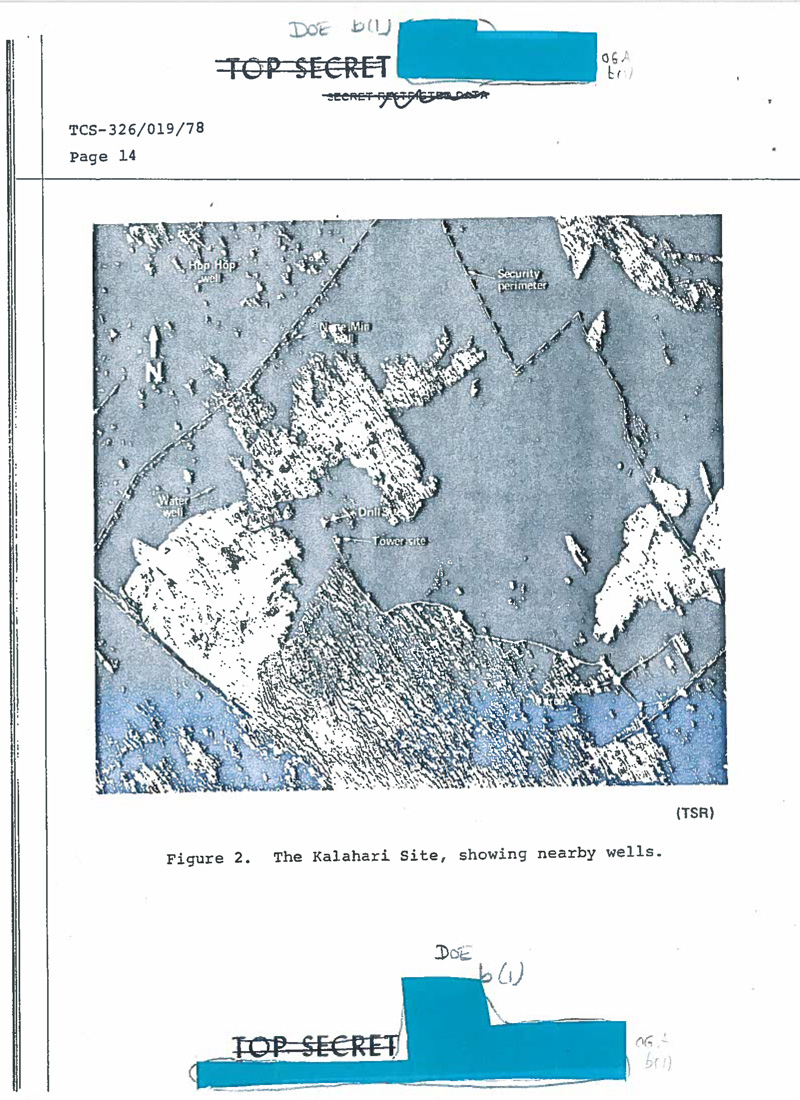
Reconnaissance identifies apparent preparations at Vastrap/Kalahari, and diplomatic pressure leads South Africa to halt the activity.
Vela 6911 records Alert 747
At 00:52:43 UTC both bhangmeters record a nuclear-like double flash over a broad southern-ocean footprint.
Agencies search for independent confirmation
Satellite, seismic, acoustic, ionospheric, weather, and radiological records are reviewed; no uncontested direct confirmation emerges publicly.
Panel preserves competing low-probability explanations
The preliminary findings call the signal generally nuclear-like but identify a significant discrepancy and decline to assign relative probabilities.
Final panel favors a non-nuclear event
The panel concludes probably not nuclear and favors a rare near-satellite physical event, possibly meteoroid-generated debris.
Hydroacoustic dissent enters the policy record
A declassified memorandum records a DIA official claim that NRL acoustic signals located a maritime nuclear shot near the Prince Edward Islands.
South African program timeline is reconstructed and verified
South Africa completes its first weapon in November 1979, later dismantles the arsenal, and opens the program to IAEA verification.
Modern technical studies revisit the public evidence
Peer-reviewed reanalysis challenges the meteoroid model and reassesses hydroacoustic, iodine, and ionospheric observations as compatible corroboration.
Gallery
Visual context for the evidence.
These images are included as source-linked context, not as proof by themselves. Captions describe what the image can help inspect.
This image provides visual context. It does not establish cause, identity, date, or interpretation by itself.
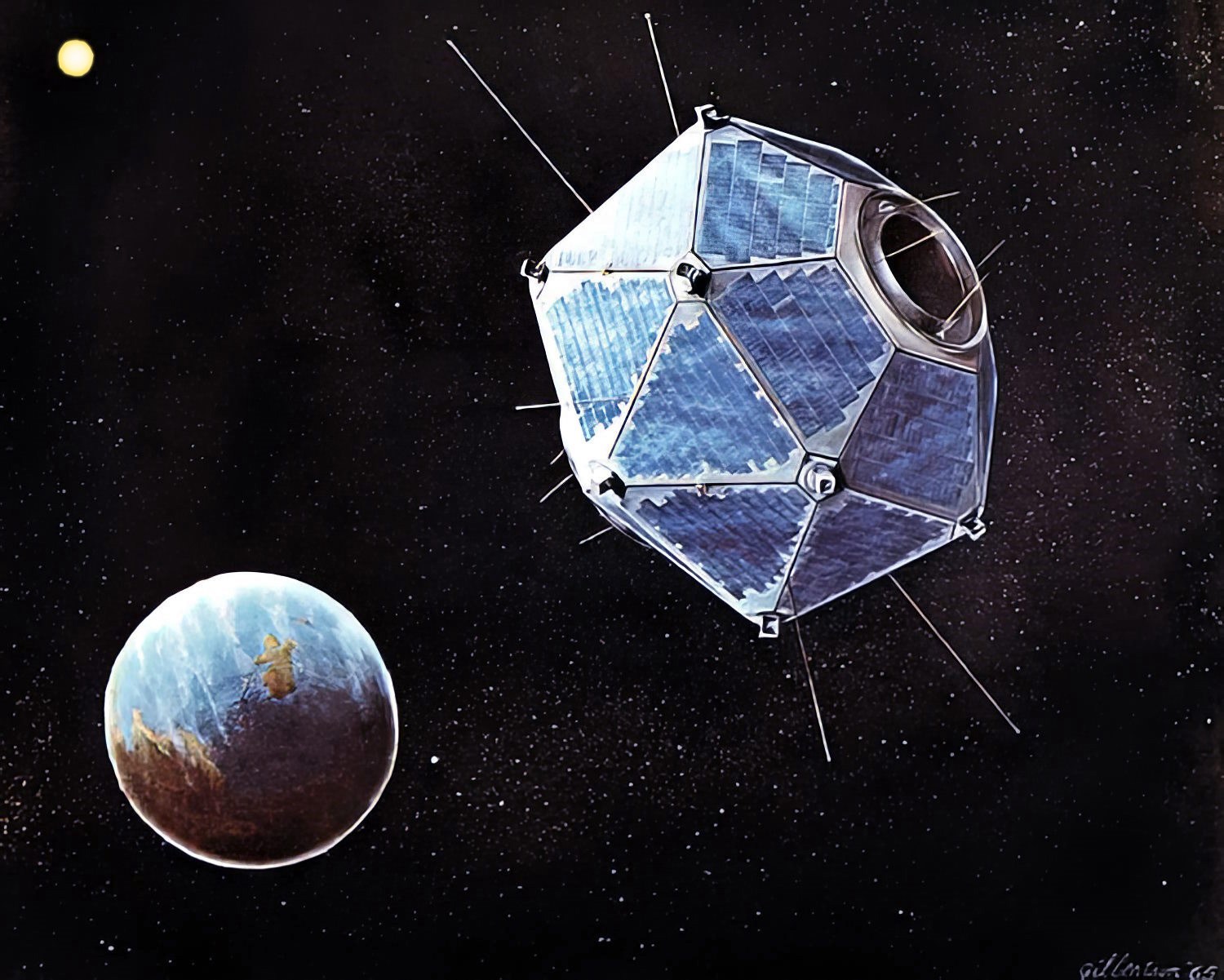
NASA Goddard Space Flight Center Conceptual Image Lab. Public domain, U.S. federal government work.NASA Looks Back at 50 Years of Gamma-Ray Burst ScienceThis image provides visual context. It does not establish cause, identity, date, or interpretation by itself.
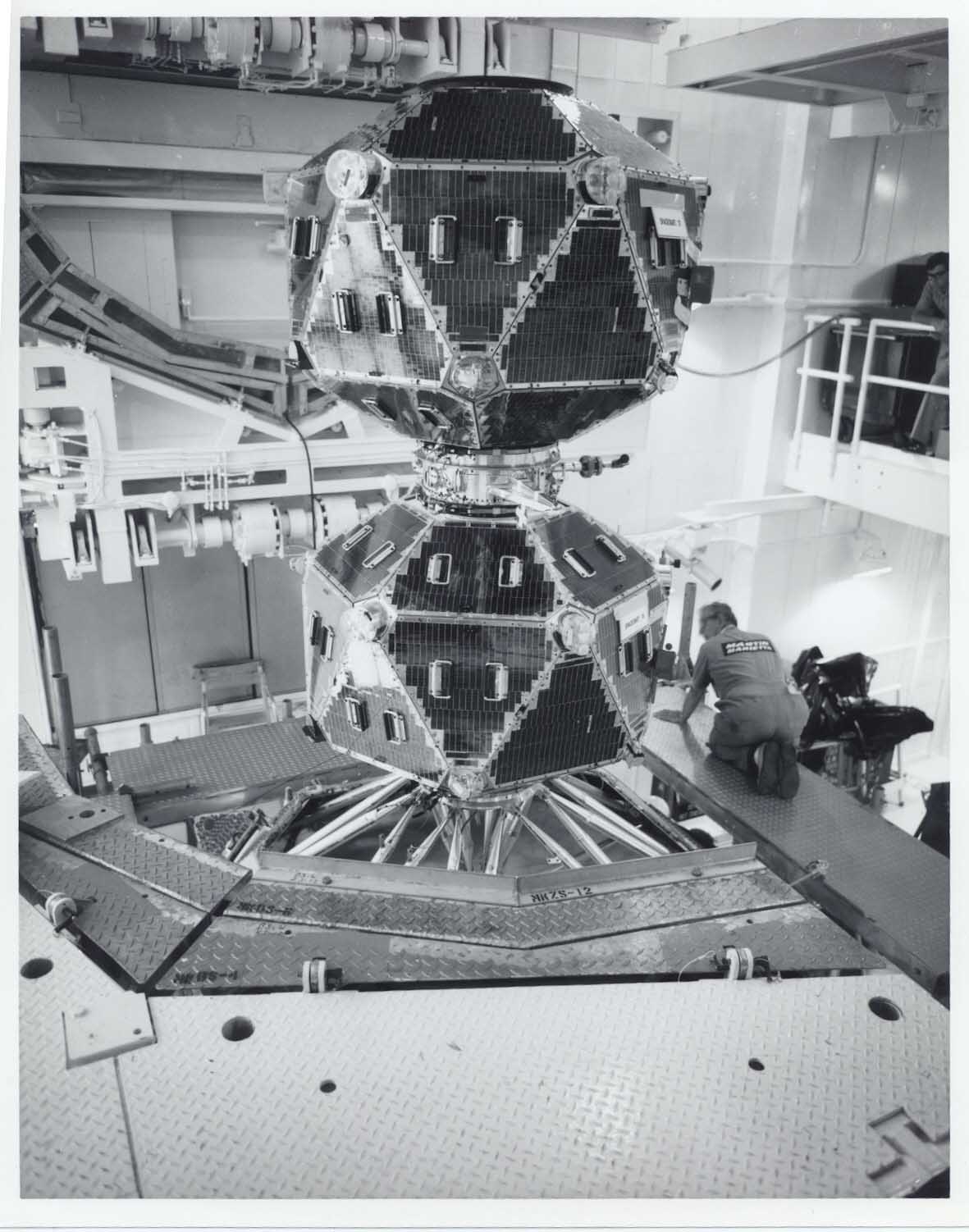
U.S. Air Force / National Security Archive. Public domain, U.S. federal government work.The Vela Flash: Forty Years AgoThis image provides visual context. It does not establish cause, identity, date, or interpretation by itself.
Office of Science and Technology Policy / National Security Archive. U.S. federal government record.Ad Hoc Panel Report on the September 22 EventThis image provides visual context. It does not establish cause, identity, date, or interpretation by itself.
U.S. reconnaissance imagery / National Security Archive. Public domain, U.S. federal government work.The Vela Flash: Forty Years Ago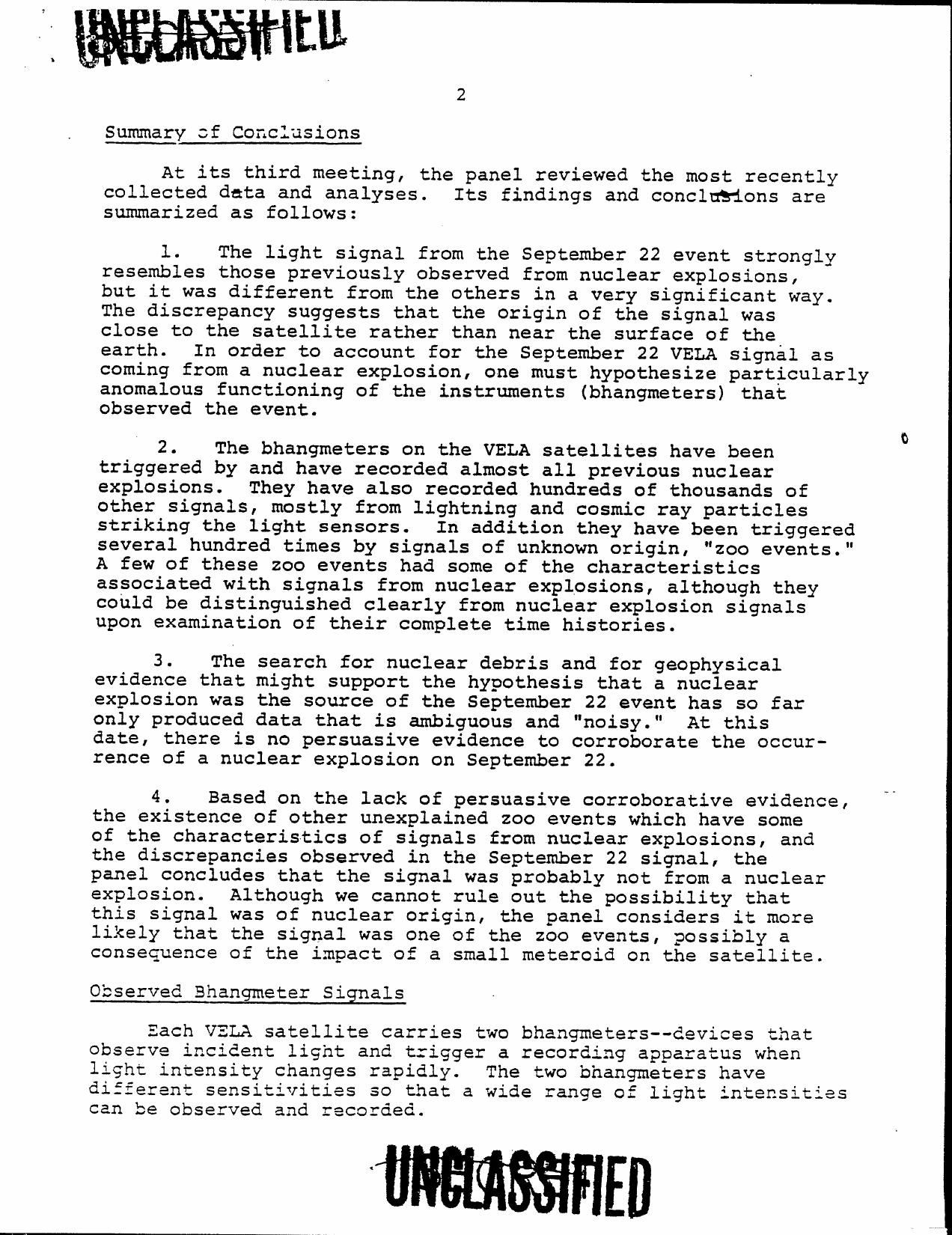
02Visual source
Map the possibilities
Which possibilities survive the pressure?
Give the accepted explanation and its strongest challengers the same hard questions: what fits, what fails, and what is still missing?Competing possibilities
The accepted account and its strongest alternatives.
Inclusion means a possibility is worth testing. It does not mean every possibility currently carries equal evidentiary weight.
Low-yield nuclear detonation, actor unresolved
The satellite detected a real low-yield atmospheric or near-surface nuclear explosion. Cloud, background, or detector behavior produced the later sensor discrepancy.
Current treatment
Leading event-level explanation with material uncertainty. The public record leans nuclear but does not reach definitive confirmation.
Non-nuclear near-satellite optical event
A rare meteoroid, debris, or related space event illuminated both sensors and coincidentally produced a nuclear-like time history.
Current treatment
Possible but currently weaker. It explains the anomalous second pulse better than it explains the complete nuclear-like signal.
Israeli test with possible South African assistance
If nuclear, Israel supplied the device or technical leadership while South Africa supplied geography, logistics, material, monitoring, or political cover.
Current treatment
Plausible attribution if the event was nuclear, but unproven. Capability and relationships do not identify an operator.
Solo South African test
South Africa used its clandestine uranium and weapons program to conduct an independent remote atmospheric test.
Current treatment
Currently weak as a solo attribution. The verified device timeline and lack of an operational trail weigh against it.
Possibility map
Stress-test every serious explanation.
Select a possibility to see what would need to be true, what supports it, what weakens it, what is missing, and how seriously the current record allows PARALLAX to treat it.
Primary questionDid Vela satellite 6911 detect an atmospheric nuclear test near South Africa on September 22, 1979, or does the available evidence better support a non-nuclear explanation for the recorded double flash?
Low-yield nuclear detonation, actor unresolved
What would need to be true
The satellite detected a real low-yield atmospheric or near-surface nuclear explosion. Cloud, background, or detector behavior produced the later sensor discrepancy.
What supports it
- Nuclear-like first pulse and double-flash timing
- Agreement of both optical channels on the first pulse
- Prior Vela confirmation record and specialist assessments
- Directionally compatible hydroacoustic, iodine, and ionospheric clues
What weakens it
- Second-pulse sensor discrepancy
- No uncontested second-platform or direct-fallout confirmation
- Strongest acoustic evidence remains incompletely public
What evidence is missing
- Diagnostic fallout, independently verified hydroacoustic localization, or equivalent second-system confirmation.
- Complete telemetry explaining the second-pulse discrepancy without discarding the nuclear-like first pulse.
How PARALLAX treats it now
Leading event-level explanation with material uncertainty. The public record leans nuclear but does not reach definitive confirmation.
Discriminating evidenceOpen the categories that can move the assessment
These links lead to the underlying evidence reviews. Direction is kept separate from importance and is never converted into a score.
High impactTwo-channel optical alert
Favors nuclear interpretation
Open 009-AHigh impactFirst-pulse shape and timing
Strongly favors nuclear interpretation
Open 009-AHigh impactSecond-pulse sensor discrepancy
Favors non-nuclear origin or measurement complication
Open 009-AHigh impactOther satellite and infrared nondetections
Favors non-nuclear interpretation
Open 009-CHigh impactHydroacoustic arrivals
Favors nuclear interpretation
Open 009-DHigh impactIAEA-verified device timeline
Challenges solo South African attribution
Open 009-FThis map does not award points for novelty or authority. Compare serious possibilities, inspect what each one explains, and follow the evidence categories back to their detailed reviews.
Evidence matrix
Current direction by category.
Current direction shows what a category supports, challenges, or leaves unresolved. Evidence impact shows how important that category is to understanding the case, without turning uncertainty into a fake score.
How to read this
Current direction says what the evidence presently supports, challenges, or leaves unresolved. Evidence impact says how important that category is to understanding the case. Impact does not mean support for either side.
Evidence categoryCurrent directionEvidence impactKey limitation / note
Evidence categoryTwo-channel optical alert
Read review6 linked sources
Current directionFavors nuclear interpretation
Evidence impactHigh impactCentral to the case or capable of materially changing the assessment.
Key limitation / note
Both sensors shared one spacecraft and viewing geometry.
Evidence categoryFirst-pulse shape and timing
Read review6 linked sources
Current directionStrongly favors nuclear interpretation
Evidence impactHigh impactCentral to the case or capable of materially changing the assessment.
Key limitation / note
Diagnostic similarity is powerful but not absolute exclusivity.
Evidence categorySecond-pulse sensor discrepancy
Read review6 linked sources
Current directionFavors non-nuclear origin or measurement complication
Evidence impactHigh impactCentral to the case or capable of materially changing the assessment.
Key limitation / note
No measured cause has conclusively explained the difference.
Evidence categoryPanel non-nuclear model
Read review4 linked sources
Current directionSupports a possible near-satellite event
Evidence impactMedium impactMeaningfully informs the case but is not decisive alone.
Key limitation / note
The proposed debris mechanism was not fully reconstructed or validated.
Evidence categoryOther satellite and infrared nondetections
Read review4 linked sources
Current directionFavors non-nuclear interpretation
Evidence impactHigh impactCentral to the case or capable of materially changing the assessment.
Key limitation / note
Actual coverage, weather, geometry, and thresholds limit exclusion power.
Evidence categorySeismic and immediate debris nondetections
Read review4 linked sources
Current directionLimits the nuclear conclusion
Evidence impactMedium impactMeaningfully informs the case but is not decisive alone.
Key limitation / note
A small atmospheric oceanic event may couple weakly and produce a sparse plume.
Evidence categoryHydroacoustic arrivals
Read review4 linked sources
Current directionFavors nuclear interpretation
Evidence impactHigh impactCentral to the case or capable of materially changing the assessment.
Key limitation / note
The full NRL report, raw traces, and processing record remain unavailable.
Evidence categoryAustralian iodine-131
Read review3 linked sources
Current directionFavors nuclear interpretation
Evidence impactMedium impactMeaningfully informs the case but is not decisive alone.
Key limitation / note
Delayed sampling, modest significance, and source ambiguity limit .
Evidence categoryArecibo ionospheric disturbance
Read review3 linked sources
Current directionAmbiguous / weakly favors nuclear
Evidence impactLimited impactRelevant, but too indirect or constrained to carry much of the case.
Key limitation / note
Traveling disturbances can have several natural causes.
Evidence categorySouth African weapons program
Read review3 linked sources
Current directionSupports capability context, not event responsibility
Evidence impactMedium impactMeaningfully informs the case but is not decisive alone.
Key limitation / note
A real secret program explains suspicion but does not identify the actor.
Evidence categoryIAEA-verified device timeline
Read review3 linked sources
Current directionChallenges solo South African attribution
Evidence impactHigh impactCentral to the case or capable of materially changing the assessment.
Key limitation / note
Does not exclude a foreign device or South African logistical assistance.
Evidence categoryIsraeli capability and bilateral ties
Read review5 linked sources
Current directionSupports plausibility of joint attribution
Evidence impactMedium impactMeaningfully informs the case but is not decisive alone.
Key limitation / note
Capability and relationships remain circumstantial without operational proof.
Evidence categoryRetrospective attribution testimony
Read review5 linked sources
Current directionMixed / unresolved
Evidence impactLimited impactRelevant, but too indirect or constrained to carry much of the case.
Key limitation / note
Much of the visible testimony is indirect, late, or not independently corroborated.
Evidence categoryPolitical incentives and internal conflict
Read review5 linked sources
Current directionLimits confidence in process neutrality
Evidence impactLow impactAdds context but has little power to separate the interpretations.
Key limitation / note
Incentives justify scrutiny but do not determine the physical source.
Evidence reviews
The repeatable review structure for future cases.
Each category separates the core question, established observations, source quality, competing interpretations, assessment, unresolved issues, and sources.
009-A
The Optical Double Flash
Current directionStrongly nuclear-like, with a consequential second-pulse anomaly
Question tested
How closely did match the known optical signature of an atmospheric nuclear explosion?
Current read
Both bhangmeters recorded a nuclear-like first pulse and compatible double-flash timing. Their relative response during the second pulse departed from the known nuclear comparison set. That anomaly reduces confidence but does not erase the parts of the signal on which both sensors agreed.
Established Observations
- FACTBoth Vela 6911 bhangmeters triggered at 00:52:43 UTC on September 22, 1979 and agreed closely on the first pulse.
- FACTThe first pulse, pulse separation, and general light-time history resembled a low-yield atmospheric nuclear explosion.
- FACTThe relative amplitudes recorded by the two sensors during the second pulse did not match the panel known-nuclear comparison set.
- SUPPORTED INFERENCEAgreement on the first pulse makes a one-channel electronic failure unlikely, while the shared spacecraft and geometry prevent the two channels from counting as fully independent confirmation.
- UNKNOWNThe public record does not identify one measured background, cloud, or detector effect that conclusively explains the second-pulse discrepancy.
Evidence Quality
Strong for the recorded characteristics through contemporaneous panel and laboratory reports; incomplete for independent reproduction because the full raw telemetry and comparison library are not public.
Accepted / Conventional Reading
- The second-pulse discrepancy is outside known nuclear behavior and is the strongest evidence that the trigger was a rare non-nuclear event.
- A system designed to issue alerts can still produce a highly convincing false positive when an unusual physical input reaches both sensors.
Challenge / Alternative Reading
- The nuclear-like first pulse and timing carry greater diagnostic weight than the later amplitude ratio, which is more vulnerable to background and propagation effects.
- The panel comparison set was limited by Vela 6911 memory history and may have treated normal detector or cloud variation as disqualifying.
PARALLAX Current Read
NUCLEAR-LIKE CORE SIGNAL; SECOND-PULSE ANOMALY MATERIALLY LIMITS CONFIDENCE
009-B
The Panel and the Meteoroid Explanation
Current directionSerious official alternative, possible but technically incomplete
Question tested
Did the White House panel establish a credible non-nuclear mechanism for the double flash?
Current read
The Ruina panel reasonably emphasized the anomalous sensor ratio, satellite condition, and absence of clean corroboration. It favored a rare near-satellite event, possibly meteoroid-generated debris, but did not produce a complete validated model or assign a reliable probability against the nuclear alternative.
Established Observations
- FACTThe panel included eight technically qualified scientists, reviewed classified and unclassified material, and compared the alert with a large archive of triggers.
- FACTIt ruled out a simple electronic malfunction and favored a physical event near the satellite.
- FACTThe preliminary findings said the signal was more like a nuclear event than any non-nuclear trigger previously recorded.
- FACTThe panel concluded probably not nuclear while preserving nuclear origin as a possibility.
- DISPUTEDLater orbital and micrometeoroid analysis argues that the proposed reflected-debris geometry is substantially less likely than the panel assumed.
Evidence Quality
Strong for the panel process and stated findings. Mixed for the proposed mechanism because important inputs remain classified and the physical reconstruction was incomplete.
Accepted / Conventional Reading
- The panel weighed the whole monitoring record and appropriately refused to declare a test from one anomalous satellite signal.
- The absence of a perfect non-nuclear reconstruction is less important than the nuclear interpretation failure to produce expected corroboration.
Challenge / Alternative Reading
- The panel elevated a speculative mechanism over the detector most diagnostic features without quantitatively demonstrating that mechanism.
- The final probability language became more confident than the preliminary finding and the underlying model justified.
PARALLAX Current Read
CREDIBLE PROCESS AND REAL ANOMALY; LEADING NON-NUCLEAR MECHANISM NOT FULLY DEMONSTRATED
009-C
Other Monitoring Systems and Nondetections
Current directionLimits the nuclear conclusion but does not exclude a small remote test
Question tested
How much should the absence of a second satellite, infrared, seismic, or direct-debris confirmation count against a nuclear event?
Current read
No public independent sensor produced an uncontested direct confirmation. That is meaningful negative evidence. Coverage, weather, event altitude, low yield, and oceanic location may reduce the probability that any one other system would detect it, but complete threshold and geometry records are not public.
Established Observations
- FACTNo second satellite publicly reported an optical or infrared signal conclusively tied to Alert 747.
- FACTNo decisive seismic event was publicly identified, and immediate airborne or environmental collection did not recover diagnostic debris.
- FACTAn early New Zealand rainwater indication was traced to contamination and provides no support for a test.
- SUPPORTED INFERENCEA low-yield atmospheric or near-surface event over remote ocean could evade some systems because of cloud, geometry, coupling, and sparse collection.
- UNKNOWNThe public record does not permit a complete calculation of how likely all relevant systems were to miss the same nuclear event.
Evidence Quality
Moderate to strong for the existence of the nondetections through official reports; incomplete for quantitative expected-detection probability.
Accepted / Conventional Reading
- A nuclear test should have produced at least one clean independent confirmation, and the cumulative silence is more important than explanations for each system separately.
- The failed collection effort distinguishes Alert 747 from confirmed Vela nuclear detections.
Challenge / Alternative Reading
- Monitoring systems have nonuniform coverage and thresholds; a small remote test need not produce every expected signature.
- The hydroacoustic and later isotope evidence may provide the corroboration that the panel considered absent, even if it is not ideal.
PARALLAX Current Read
REAL NEGATIVE EVIDENCE; QUANTITATIVE EXCLUSION POWER REMAINS UNKNOWN
009-D
Hydroacoustic Evidence
Current directionFavors an explosive event; potentially high impact but not fully inspectable
Question tested
Do the reported ocean-acoustic arrivals independently confirm an explosion near the Prince Edward Islands?
Current read
Contemporary NRL work reportedly located nuclear-like maritime acoustic signals near the Prince Edward Islands. Later reconstruction found high signal-to-noise arrivals with compatible timing and bearing. The full report, raw traces, processing chain, and background record remain unavailable.
Established Observations
- FACTA declassified June 1980 memorandum records a DIA official briefing that NRL had identified maritime signals associated with the event and a source near the Prince Edward Islands.
- SUPPORTED INFERENCELater reanalysis describes Ascension Island arrivals with high signal-to-noise ratio, compatible travel time, and a bearing that intersects the proposed region.
- DISPUTEDThe interpretation of direct and reflected paths, source localization, and uniqueness to a nuclear maritime shot remains contested.
- UNKNOWNThe full NRL analysis, raw hydrophone traces, detection processing, and complete comparison background are not public.
Evidence Quality
Potentially strong because it is a separate physical channel. Public quality is reduced by reliance on a declassified briefing memorandum and later reconstruction rather than the complete original dataset.
Accepted / Conventional Reading
- The acoustic observations were not sufficiently unique, timely, or transparent to overcome the anomalous optical record.
- An official describing a classified report cannot substitute for independent access to that report.
Challenge / Alternative Reading
- Independent ocean-acoustic arrivals with compatible timing and bearing are exactly the corroboration expected from a remote maritime explosion.
- The panel conclusion understated high-quality monitoring evidence because the source report remained compartmented.
PARALLAX Current Read
STRONGEST PROPOSED CORROBORATION; PUBLIC REPRODUCIBILITY INCOMPLETE
009-E
Iodine, Ionosphere, and Geophysical Clues
Current directionCompatible and suggestive, individually non-diagnostic
Question tested
Do the Australian and Arecibo ionospheric observations materially corroborate a nuclear event?
Current read
A low-level excess in Australian sheep thyroids and an unusual are both compatible with a southern-ocean event. Delayed sampling, modest statistical significance, transport assumptions, and multiple natural TID causes keep them from serving as direct confirmation.
Established Observations
- FACTAustralian sheep thyroid samples collected beginning one month after the alert contained a low iodine-131 signal assessed near 3.1 standard deviations after background disagreements were resolved.
- SUPPORTED INFERENCELater atmospheric modeling shows a plausible path from the Prince Edward Islands region to southeastern Australia with relevant rainout.
- FACTArecibo recorded an unusual south-to-north traveling ionospheric disturbance with compatible timing and propagation speed.
- FACTA broader Los Alamos geophysical review found no decisive confirmation and judged a separate TIROS-N particle event likely natural.
- UNKNOWNNeither observation can be uniquely assigned to Alert 747 from the public data.
Evidence Quality
Moderate. Contemporary records establish that the observations were real; later technical work improves analysis but relies on incomplete original material and modeled common cause.
Accepted / Conventional Reading
- Both observations are low-specificity anomalies selected after the fact from noisy natural backgrounds.
- The iodine statistics, delayed samples, and uncertain flock history are too weak for event attribution.
Challenge / Alternative Reading
- Two separate physical channels with compatible time, direction, and transport are unlikely to align by chance with a nuclear-like optical alert.
- Expected low concentrations explain why ordinary monitoring stations did not report a stronger plume.
PARALLAX Current Read
DIRECTIONALLY SUPPORTIVE CLUES; NEITHER CHANNEL INDEPENDENTLY CONFIRMS THE EVENT
009-F
South African Capability and Timeline
Current directionReal capability context; verified timeline challenges a solo test
Question tested
Was South Africa capable of conducting a solo nuclear test in September 1979?
Current read
South Africa had enriched uranium, an active weapons program, and prepared test shafts. The IAEA-verified history places its first complete gun-type device in November 1979. This weakens a solo South African test two months earlier while leaving foreign-device or logistical-assistance scenarios open.
Established Observations
- FACTSouth Africa developed a clandestine uranium-enrichment and gun-type nuclear-weapons program and prepared underground test shafts at Vastrap/Kalahari.
- FACTThe IAEA reported that sufficient highly enriched uranium became available in the second half of 1979 and the first complete device was finished in November 1979.
- FACTThe later Circle production facility was built and commissioned after the September 1979 event.
- SUPPORTED INFERENCEA solo South African atmospheric test is less compatible with the verified development sequence than an operation using a foreign device or external technical leadership.
- UNKNOWNThe IAEA chronology does not determine whether South Africa supplied location, logistics, monitoring, or material to another state.
Evidence Quality
Strong for the declared indigenous program timeline through IAEA inspections, records, facilities, and material accounting. Limited for any undeclared foreign-assisted operation.
Accepted / Conventional Reading
- International verification of material and facilities makes an undisclosed complete indigenous device before September 1979 unlikely.
- South African program existence explains suspicion but cannot override the development timeline.
Challenge / Alternative Reading
- A secret program may have withheld or compartmented activities from the later declared record.
- South Africa did not need to own the tested device to provide the operational environment for a joint event.
PARALLAX Current Read
SECRET PROGRAM ESTABLISHED; SOLO SEPTEMBER 1979 TEST WEAKENED BY VERIFIED DEVICE TIMELINE
009-G
Israel, Joint-Test Claims, and Attribution
Current directionIsraeli or joint involvement is plausible; no actor is established
Question tested
If the event was nuclear, does the public evidence identify Israel, South Africa, or a joint operation?
Current read
Israel had relevant capability and substantial defense ties with South Africa. A joint operation is more compatible with the verified South African timeline than a solo indigenous test. Public still rests on capability, relationships, redacted intelligence, and mostly indirect retrospective accounts rather than direct operational proof.
Established Observations
- FACTU.S. intelligence evaluated Israeli, South African, joint, Soviet, Indian, and Pakistani possibilities rather than identifying one actor from the optical signal.
- FACTIsrael possessed relevant nuclear capability and maintained significant defense and technical relations with South Africa.
- SUPPORTED INFERENCEIf the event was nuclear, an Israeli device with possible South African assistance fits the verified capability timeline better than a solo South African device.
- DISPUTEDRetrospective intelligence and participant-adjacent accounts point toward a joint test but vary in access, timing, and corroboration.
- UNKNOWNNo public authenticated order, test log, vessel record, device record, or diagnostic signature conclusively identifies the actor.
Evidence Quality
Moderate for capability and bilateral context; weak to moderate for event because key records are redacted and later testimony is often indirect.
Accepted / Conventional Reading
- The attribution evidence is circumstantial and too weak to identify a state, regardless of the event physics.
- Later stories can converge through repetition of the same underlying rumors rather than independent firsthand knowledge.
Challenge / Alternative Reading
- Capability, a close secret defense relationship, a remote southern-ocean setting, and multiple intelligence-adjacent accounts form a coherent joint-test pattern.
- The absence of public direct records is expected for an operation whose success depended on deniability.
PARALLAX Current Read
JOINT ATTRIBUTION PLAUSIBLE BUT UNPROVEN; RESPONSIBLE ACTOR REMAINS UNKNOWN
009-H
Politics, Process, and Classification
Current directionPolitical pressure and technical conflict established; outcome manipulation not proved
Question tested
Did diplomatic stakes distort the assessment, and what can the public record actually show?
Current read
A confirmed Israeli or South African test would have carried serious arms-control and diplomatic consequences. Internal officials alleged a whitewash, and technical teams disagreed sharply. Those facts justify process scrutiny but do not establish that the panel conclusion was politically dictated.
Established Observations
- FACTThe assessment carried implications for treaty compliance, nonproliferation law, sanctions, relations with Israel and South Africa, and Carter administration diplomacy.
- FACTSome intelligence and technical officials believed nuclear evidence was being discounted and used the term whitewash.
- FACTThe panel preserved uncertainty and did not claim that nuclear origin had been disproved.
- SUPPORTED INFERENCEPolitical consequences could affect evidentiary thresholds, timing, emphasis, and willingness to make a public attribution.
- UNVERIFIED CLAIMThe public record does not prove that political officials ordered scientists to reach a false technical conclusion.
Evidence Quality
Strong for policy stakes and internal disagreement through contemporaneous records. Limited for causal claims about hidden decision-making.
Accepted / Conventional Reading
- The administration used an external scientific panel precisely because the technical and political stakes required caution.
- A high declaration threshold is appropriate when a signal is anomalous and direct corroboration is absent.
Challenge / Alternative Reading
- The panel structure and final language gave policymakers a defensible way to avoid legally and diplomatically costly consequences.
- Classified corroboration and specialist dissent were subordinated to a less-developed non-nuclear mechanism.
PARALLAX Current Read
POLITICAL INCENTIVES AND INTERNAL CONFLICT ESTABLISHED; DIRECTED TECHNICAL WHITEWASH NOT ESTABLISHED
03Visual source
Name what remains
What still does not sit right?
Keep the stubborn gaps visible. Then state what the record can presently carry without pretending suspicion is proof or authority is closure.Open questions / What still does not sit right
The unanswered questions that matter.
- Will the full NRL hydroacoustic report and raw traces be declassified?
- Can the complete Vela 6911 telemetry, calibration history, and comparison library be released in machine-readable form?
- Can modern optical modeling reproduce both sensor records under nuclear and near-satellite debris hypotheses?
- What precisely caused the second-pulse amplitude discrepancy?
- What were the effective coverage and thresholds of overlapping satellites?
- Can the original Australian thyroid spectra, sheep provenance, and calibration records be recovered?
- How sensitive is the proposed fallout transport path to source and weather uncertainty?
- Do state archives contain direct operational records that identify an actor?
- What non-nuclear mechanism can reproduce the complete optical record from measured parameters?
- Why did qualified technical teams assign such different weight to the same signal?
What would change the picture
Evidence must be allowed to move the assessment.
- Independent confirmation of raw hydroacoustic data localizing an explosive source to the event time would materially strengthen the nuclear interpretation.
- Authenticated diagnostic fallout with a secure chain of custody would move the event toward confirmation.
- Complete telemetry showing a measured background or detector cause for the second-pulse anomaly would strengthen a nuclear reading of the remaining signal.
- A validated meteoroid, debris, or natural model reproducing both sensor traces would materially strengthen the non-nuclear interpretation.
- Calibration evidence demonstrating a known Vela failure mode matching Alert 747 would move the case toward non-nuclear origin.
- Authenticated orders, logs, platform records, or device records would be required for firm state attribution.
Why this case matters
Why this conflict deserves scrutiny.
Detection is a chain of inference
No sensor label is self-proving. A signal becomes an event assessment through instrument behavior, comparison data, corroboration, modeling, and human judgment.
Rare events test both models
The nuclear and non-nuclear accounts each invoke unusual circumstances. The better explanation is the one that accounts for more of the record with fewer unsupported assumptions.
Attribution must not borrow confidence
A conclusion about the physical event does not identify the responsible actor. The confidence levels belong to different questions and different evidence.
Classification preserves capability and uncertainty
Sensitive monitoring methods may require protection. Continued secrecy also prevents independent verification, leaving trust to carry weight that should belong to inspectable evidence.
Policy can shape process without deciding physics
Diplomatic consequences can affect thresholds, emphasis, and public action. They do not change photons, acoustics, isotope decay, or the need to test a physical explanation.
What the evidence currently suggests
Where the record points - v0.1.2
The available public evidence better supports a low-yield atmospheric or near-surface nuclear explosion than a non-nuclear optical event. The nuclear-like first pulse and timing, dual-sensor alert, prior Vela record, weakness of the leading debris reconstruction, and several compatible corroborating observations drive that judgment.
Confidence remains below definitive. The second-pulse discrepancy is real, other systems did not provide clean public confirmation, the strongest hydroacoustic material is incompletely inspectable, and no uncontested diagnostic fallout sample is public.
The responsible actor is unknown. Israeli involvement with possible South African assistance is plausible and fits the verified South African device timeline better than a solo South African test, but it is not established by public direct evidence.
The case remains open. New telemetry, acoustic records, diagnostic material, or authenticated operational documentation could materially change both event classification and attribution.
04Visual source
Inspect the record
Follow the evidence back to its sources.
Trace the sources, shared foundations, definitions, corrections, and revision history behind the public assessment.Source record
Inspect the material.
- Primary evidencevela-ruina-preliminary
Preliminary Findings of the Ad Hoc Panel on the September 22 Event
Primary evidenceDirect material, dataset, exhibit, transcript, or record; directness does not remove context checks.- Provenance
- Official Foreign Relations of the United States transcription of the panel findings transmitted within the Carter administration.
- Directness
- Primary record of the panel initial technical judgment and uncertainty.
- Method
- Panel comparison of Alert 747 with known nuclear signals, non-nuclear Vela triggers, satellite history, and available corroborating systems.
- Corroboration
- The broad characterization and sensor discrepancy converge with the final report and contemporary laboratory reviews.
- Limit
- A findings summary rather than the complete raw telemetry, code, comparison set, or briefing record.
- Verification
- Official transcription and document metadata verified.
The panel described the alert as generally nuclear in character and more similar to a nuclear event than any prior non-nuclear trigger, while identifying a significant sensor discrepancy and declining to assign relative probabilities.
- Primary evidencevela-ruina-final
Ad Hoc Panel Report on the September 22 Event
Primary evidenceDirect material, dataset, exhibit, transcript, or record; directness does not remove context checks.- Provenance
- Declassified federal report reproduced as a scan by the National Security Archive.
- Directness
- Primary report for the leading official non-nuclear interpretation.
- Method
- Multidisciplinary review of the optical signal, Vela trigger archive, satellite condition, alternate mechanisms, and searches for independent corroboration.
- Corroboration
- Its description of the anomalous second pulse and negative monitoring results aligns with other declassified records.
- Limit
- The proposed meteoroid or debris mechanism was not developed into a complete validated reconstruction of the measured signal. Much supporting material remains classified or absent.
- Verification
- Declassified scan reviewed page by page.
Final White House scientific panel report concluding that the signal probably was not nuclear and was more likely a rare non-nuclear event, while explicitly not ruling a nuclear explosion out.
- Primary evidencevela-horak
Comments on the September 22 Event
Primary evidenceDirect material, dataset, exhibit, transcript, or record; directness does not remove context checks.- Provenance
- Declassified weapons-laboratory technical memorandum reproduced by the National Security Archive.
- Directness
- Contemporaneous specialist analysis of the event and the panel explanation.
- Method
- Comparison of signal characteristics, detector behavior, and candidate non-nuclear mechanisms with nuclear-test experience.
- Limit
- Written by a laboratory with nuclear-detection expertise and institutional commitments; the public scan does not include all underlying telemetry.
- Verification
- Declassified scan and catalog context verified.
Contemporary Los Alamos assessment arguing that the evidence strongly supported a nuclear explosion.
- Primary evidencevela-mauth
Sandia Assessment of the September 22 Vela Event
Primary evidenceDirect material, dataset, exhibit, transcript, or record; directness does not remove context checks.- Provenance
- Declassified federal laboratory memorandum reproduced by the National Security Archive.
- Directness
- Direct technical dissent from the White House panel by specialists familiar with bhangmeter interpretation.
- Limit
- The publicly available scan is a conclusion-level record and does not make the complete data package independently reproducible.
- Verification
- Declassified scan verified.
Contemporary Sandia analysis describing the optical record as fully consistent with a low-yield atmospheric nuclear event.
- Primary evidencevela-mrc-evaluation
Evaluation of the 22 September 1979 Vela Event
Primary evidenceDirect material, dataset, exhibit, transcript, or record; directness does not remove context checks.- Provenance
- Declassified technical report scan in the National Security Archive collection.
- Directness
- Contemporary analysis from organizations directly involved in nuclear-event monitoring.
- Limit
- Some inputs and assumptions depend on classified monitoring material not included in the public report.
- Verification
- Declassified scan and collection metadata verified.
Contractor and monitoring-community evaluation comparing nuclear and non-nuclear explanations and assigning substantially greater likelihood to a nuclear origin.
- Technical / scientific analysisvela-geophysical-review
A Review of Geophysical Data Relating to the Event of September 22, 1979
Technical sourceScientific, engineering, forensic, or specialist analysis; weight follows method and reproducibility.- Provenance
- Declassified Los Alamos report LA-8672 reproduced by the National Security Archive.
- Directness
- Technical synthesis of independent geophysical channels considered after the alert.
- Method
- Assessment of timing, direction, propagation, and possible natural causes across the available geophysical observations.
- Limit
- Data coverage was sparse and several phenomena had poorly constrained natural backgrounds.
- Verification
- Report scan and publication metadata verified.
Review of ionospheric, auroral, and other geophysical observations that found no decisive confirmation or refutation of a nuclear event.
- Independent technical analysisvela-wright-2017
The 22 September 1979 Vela Incident: The Detected Double-Flash
Independent critiqueTechnical analysis outside the principal institution; judged by methods and source trail, not outsider status.- Provenance
- Peer-reviewed journal article with an open author PDF.
- Directness
- Later reconstruction using declassified signal descriptions and historical technical material.
- Method
- Reanalysis of pulse structure, detector history, orbital geometry, micrometeoroid physics, and competing causal models.
- Corroboration
- Its optical judgment is consistent with several contemporary weapons-laboratory assessments.
- Limit
- The authors did not have the complete raw telemetry or all classified panel inputs and therefore reconstructed parts of the record.
- Verification
- Paper, DOI, and open PDF verified.
Modern technical reassessment of the optical record, satellite history, background modulation, and the panel meteoroid explanation. It concludes that a nuclear detonation is the more likely source.
- Independent technical analysisvela-degeer-2018
The 22 September 1979 Vela Incident: Radionuclide and Hydroacoustic Evidence for a Nuclear Explosion
Independent critiqueTechnical analysis outside the principal institution; judged by methods and source trail, not outsider status.- Provenance
- Peer-reviewed journal article with an open author PDF.
- Directness
- Later technical reconstruction of proposed independent evidence channels.
- Method
- Statistical reassessment, gamma-line interpretation, transport modeling, hydroacoustic timing and bearing reconstruction, and comparison with known tests.
- Corroboration
- Draws on contemporaneous declassified memoranda and monitoring summaries.
- Limit
- Some raw measurements and the complete NRL report were unavailable; source location and common-cause conclusions remain inferential.
- Verification
- Paper, DOI, and open PDF verified.
Reassesses Australian iodine-131, hydroacoustic arrivals, atmospheric transport, and ionospheric evidence as mutually compatible with a nuclear event near the Prince Edward Islands.
- Primary evidencevela-nrl-memo
Memorandum on Naval Research Laboratory Hydroacoustic Findings
Primary evidenceDirect material, dataset, exhibit, transcript, or record; directness does not remove context checks.- Provenance
- Declassified State Department Bureau of Intelligence and Research memorandum published with scan and OCR.
- Directness
- Primary record of an official briefing and internal dissent; secondary to the still-classified NRL report it describes.
- Limit
- The language reflects Varona interpretation, including a whitewash allegation. It does not expose raw traces or the complete NRL method.
- Verification
- Declassified document scan and OCR verified.
Contemporaneous memorandum recording DIA official Jack Varona account that NRL had identified nuclear-like maritime acoustic signals from the Prince Edward Islands region.
- Primary evidencevela-iodine-memo
Intelligence Coordination Memorandum on Iodine-131 in Australian Sheep
Primary evidenceDirect material, dataset, exhibit, transcript, or record; directness does not remove context checks.- Provenance
- Declassified National Security Council intelligence-coordination record with scan and OCR.
- Directness
- Contemporaneous summary of the measurement dispute and later statistical agreement.
- Limit
- A coordination memorandum, not the complete laboratory spectra, sample chain, flock records, or atmospheric transport dataset.
- Verification
- Declassified document and context verified.
Records interagency convergence on an approximately 3.1-standard-deviation iodine-131 excess after resolving background-treatment disagreements.
- Official recordvela-cia-panel-synopsis
Synopsis of the First Ad Hoc Panel Report on the September 22 Event
Official recordInstitutional record; weight depends on evidence, method, provenance, corroboration, and limits.- Provenance
- Declassified CIA memorandum with scan and OCR.
- Directness
- Official contemporaneous summary; less direct than the panel report itself.
- Limit
- Institutional synopsis that may compress caveats and does not provide the underlying data.
- Verification
- Declassified scan and OCR verified.
CIA synopsis preserving how the first panel findings were described inside government, including the nuclear resemblance, sensor discrepancy, and lack of decisive corroboration.
- Primary evidencevela-dci-1979
The 22 September 1979 Event
Primary evidenceDirect material, dataset, exhibit, transcript, or record; directness does not remove context checks.- Provenance
- Declassified intelligence memorandum published as a scan with significant redactions.
- Directness
- Primary record for contemporary attribution analysis and uncertainty.
- Limit
- Key judgments and intelligence remain redacted. The memorandum conditionally assumes a nuclear event and therefore cannot independently establish one.
- Verification
- Declassified scan and document metadata verified.
Interagency intelligence memorandum evaluating possible national actors under the working assumption that the event was a nuclear explosion.
- Official recordvela-iaea-south-africa
The Denuclearization of Africa: South Africa
Official recordInstitutional record; weight depends on evidence, method, provenance, corroboration, and limits.- Provenance
- Official report to the IAEA General Conference based on on-site inspection, records review, material accounting, and facility examination.
- Directness
- Strongest public verification source for South African indigenous device capability and timeline.
- Method
- Independent inventory verification, facility access, documentation review, nuclear-material accounting, and consistency checks.
- Corroboration
- Broad program chronology aligns with later South African disclosures and physical facility evidence.
- Limit
- Retrospective verification cannot guarantee that every undeclared activity was found. It does not assess a foreign-supplied device or logistical assistance.
- Verification
- Official IAEA report PDF verified.
IAEA report on inspection of South Africa nuclear material, facilities, weapon inventory, development sequence, and dismantlement. It places the first completed device in November 1979.
- Archival materialvela-nsarchive-2016
The Vela Incident: South Atlantic Mystery Flash in September 1979
Archival recordHistorical or FOIA/source-file material; relevance depends on provenance, completeness, and context.- Provenance
- University-based archive publishing scans obtained from U.S. government repositories and declassification requests.
- Directness
- Secondary framing around a substantial collection of primary records.
- Corroboration
- The linked records can be checked independently against FRUS and agency releases.
- Limit
- Editorial selection and interpretation are not themselves primary evidence; some linked records remain redacted.
- Verification
- Collection page and linked documents verified.
Curated declassified-document collection covering the alert, panel dispute, intelligence assessment, policy response, and attribution debate.
- Archival materialvela-nsarchive-2019
The Vela Flash: Forty Years Ago
Archival recordHistorical or FOIA/source-file material; relevance depends on provenance, completeness, and context.- Provenance
- Curated collection of declassified federal records and archival images.
- Directness
- Useful discovery and context source; underlying documents carry the evidentiary weight.
- Limit
- The editorial narrative includes interpretation and cannot resolve still-classified technical questions.
- Verification
- Collection page and key documents verified.
Fortieth-anniversary documentary collection with signal history, policy records, South African context, and later attribution material.
- Secondary analysisvela-wilson-2020
Revisiting the 1979 Vela Mystery: A Report on a Critical Oral History Conference
Context sourceUseful synthesis or historical framing; claims should be traced back when possible.- Provenance
- Institutional oral-history project and conference synthesis.
- Directness
- Participant-adjacent retrospective evidence; secondary for the technical event.
- Limit
- Memory after four decades, participant selection, and unavailable underlying classified records constrain the account.
- Verification
- Wilson Center report verified.
Conference report collecting retrospective recollections from people connected to the policy and technical history, including the reported strength of the NRL conclusion.
- Technical / scientific analysisvela-lanl-bhangmeter
Bhangmeters: Seeing the Light
Technical sourceScientific, engineering, forensic, or specialist analysis; weight follows method and reproducibility.- Provenance
- Official Los Alamos National Security Science publication.
- Directness
- Technical explainer for how the detector works, not a new adjudication of Alert 747.
- Method
- Historical and engineering explanation grounded in nuclear-test monitoring practice.
- Limit
- Institutional overview that simplifies details and does not expose the Vela 6911 raw record.
- Verification
- Official laboratory PDF verified.
Accessible technical history of bhangmeter physics, the nuclear double pulse, sensor development, and monitoring use.
- Official recordvela-nasa-history
NASA Looks Back at 50 Years of Gamma-Ray Burst Science
Official recordInstitutional record; weight depends on evidence, method, provenance, corroboration, and limits.- Provenance
- Official NASA mission-history page with federal imagery.
- Directness
- Authoritative for mission context and visual documentation, not for resolving the 1979 signal.
- Limit
- General history rather than case-specific technical analysis.
- Verification
- Official NASA page and image verified.
NASA history of the Vela spacecraft and the monitoring mission that also produced the first gamma-ray burst discoveries.
- Official recordvela-nasa-images
Vela Satellite Images and Mission Context
Official recordInstitutional record; weight depends on evidence, method, provenance, corroboration, and limits.- Provenance
- Official NASA Goddard educational and mission archive.
- Directness
- Visual and hardware context only.
- Limit
- Does not contain the Alert 747 telemetry or assessment.
- Verification
- NASA archive page verified.
NASA image archive showing Vela spacecraft hardware and mission design.
Source relationships
Where the argument shares a foundation.
This view identifies records reused across observations, evidence reviews, or other PARALLAX investigations. It prevents citation volume from being mistaken for independent confirmation.
Repeated citation is not independent corroboration.
A record is counted once even when several sections rely on it. This audit shows the sources carrying more than one part of the public argument.
Ad Hoc Panel Report on the September 22 Event
Primary evidence
- Review reuse
- 5 evidence reviews
- Observation reuse
- 14 established observations
- Cross-case reuse
- 0 other investigations
The 22 September 1979 Event
Primary evidence
- Review reuse
- 3 evidence reviews
- Observation reuse
- 6 established observations
- Cross-case reuse
- 0 other investigations
The Vela Incident: South Atlantic Mystery Flash in September 1979
Archival material
- Review reuse
- 3 evidence reviews
- Observation reuse
- 6 established observations
- Cross-case reuse
- 0 other investigations
Preliminary Findings of the Ad Hoc Panel on the September 22 Event
Primary evidence
- Review reuse
- 3 evidence reviews
- Observation reuse
- 5 established observations
- Cross-case reuse
- 0 other investigations
The 22 September 1979 Vela Incident: The Detected Double-Flash
Independent technical analysis
- Review reuse
- 3 evidence reviews
- Observation reuse
- 5 established observations
- Cross-case reuse
- 0 other investigations
The 22 September 1979 Vela Incident: Radionuclide and Hydroacoustic Evidence for a Nuclear Explosion
Independent technical analysis
- Review reuse
- 2 evidence reviews
- Observation reuse
- 6 established observations
- Cross-case reuse
- 0 other investigations
The Denuclearization of Africa: South Africa
Official record
- Review reuse
- 2 evidence reviews
- Observation reuse
- 6 established observations
- Cross-case reuse
- 0 other investigations
Memorandum on Naval Research Laboratory Hydroacoustic Findings
Primary evidence
- Review reuse
- 2 evidence reviews
- Observation reuse
- 5 established observations
- Cross-case reuse
- 0 other investigations
A Review of Geophysical Data Relating to the Event of September 22, 1979
Technical / scientific analysis
- Review reuse
- 2 evidence reviews
- Observation reuse
- 4 established observations
- Cross-case reuse
- 0 other investigations
The Vela Flash: Forty Years Ago
Archival material
- Review reuse
- 2 evidence reviews
- Observation reuse
- 4 established observations
- Cross-case reuse
- 0 other investigations
Comments on the September 22 Event
Primary evidence
- Review reuse
- 2 evidence reviews
- Observation reuse
- 3 established observations
- Cross-case reuse
- 0 other investigations
Revisiting the 1979 Vela Mystery: A Report on a Critical Oral History Conference
Secondary analysis
- Review reuse
- 2 evidence reviews
- Observation reuse
- 2 established observations
- Cross-case reuse
- 0 other investigations
Glossary
Plain-English terms for this case.
Definitions focus on words that materially affect how the evidence is understood.
Alert 747September 22 event, Vela Incident
The event identifier used for the Vela 6911 optical trigger recorded at 00:52:43 UTC on September 22, 1979.
Related evidence
Attribution
The process of identifying the actor responsible for an event using operational, technical, intelligence, and contextual evidence.
Confidence that an event was nuclear cannot be transferred automatically to a preferred actor.
Bhangmeteroptical nuclear detector
A fast optical sensor designed to recognize the light-time pattern of an atmospheric nuclear explosion.
Vela 6911 carried two bhangmeters. Their agreement and disagreement are both central to Alert 747.
Related evidence
Double pulse
The characteristic bright-dim-bright optical history produced as a nuclear fireball and shock front evolve.
The shape is highly diagnostic when the complete signal and context match, but it is not logically exclusive to nuclear events.
Related evidence
Hydroacoustic signal
Sound energy traveling through the ocean, often over long distances through deep-water propagation channels.
Reported arrivals at Ascension Island are the leading proposed independent confirmation, but the complete public record is missing.
Related evidence
Iodine-131
A short-lived radioactive isotope produced by nuclear fission and also used in medicine and industry.
Low levels in Australian sheep thyroids are suggestive only if source, timing, transport, and background are handled correctly.
Related evidence
Traveling ionospheric disturbanceTID
A propagating wave-like change in the ionosphere that can be produced by explosions, earthquakes, weather, or space-weather processes.
Related evidence
Zoo event
Vela-program shorthand for optical triggers not confirmed as nuclear explosions, covering several possible causes.
The label identifies a category; it does not itself explain the physical source.
Related evidence
Challenge tools
PARALLAX can be challenged.
Challenges are evaluated by evidentiary quality, not ideological alignment.
Revision history
Important changes remain traceable.
Corrected DOI metadata for both modern Vela technical reassessments.
September 3, 2026
- Replaced two incorrect Taylor & Francis DOI values with the registered article DOIs.
- Aligned the radionuclide and hydroacoustic article title with the published record.
- Made no change to the evidence assessment or case conclusion.
Added the panel account, reasons for doubt, and a four-branch possibility map.
September 1, 2026
- Made the official probably-not-nuclear account visible as a claim to be tested rather than a closure statement.
- Added missing-evidence and current-standing tests for event and actor possibilities.
- Preserved the nuclear-leaning event assessment and unresolved attribution.
Opened INV-009 with separate event-identification and actor-attribution assessments.
September 1, 2026
- Reviewed the optical signal, satellite condition, and competing nuclear and non-nuclear explanations.
- Added hydroacoustic, iodine-131, ionospheric, geophysical, and monitoring-system evidence.
- Compared South African, Israeli, joint, and unresolved attribution against verified capability timelines.
- Published eight evidence reviews, fourteen evidence-map categories, open questions, and change criteria.