Does the available evidence better support an internal center-wing fuel-tank explosion, or an external missile / external initiating event, as the initiating cause of TWA Flight 800's destruction?
TWA Flight 800
Does the available evidence better support an internal center-wing fuel-tank explosion, or an external missile / external initiating event, as the initiating cause of TWA Flight 800's destruction?
AviationHistorical ControversyPublic Records
- Category
- Aviation / Historical Controversy
- Source record
- 9 sources
- Evidence reviews
- 05
- Current version
- v0.1.6
PARALLAX does not begin with a predetermined answer. This report presents the strongest available evidence for the main competing explanations, the weaknesses of each, and the questions that remain unresolved.
Authority does not receive automatic closure, and dissent does not receive automatic credibility. This case remains open to stronger records, technical correction, and good-faith challenge.
Case briefing
Enter the conflict before the conclusion.
The accepted account is documented as a claim to test, not a truth to inherit. Serious alternatives face the same standard.
The official investigation concluded that an electrical fault most likely ignited a flammable center-wing-tank mixture, causing an internal explosion and breakup. Missile and bomb scenarios were rejected because the recovered wreckage and radar record did not show the signatures investigators expected.
People disagree because several real anomalies exist, but the strongest recovered physical evidence still leans toward an internal tank explosion rather than an external missile event.
- The precise ignition path was never recovered or demonstrated end to end.
- Some witnesses described a rising or apparently separate luminous object rather than only the burning aircraft.
- Trace explosive compounds, unusual radar returns, early terrorism leads, and formal investigation-party dissent keep the external-event question alive.
At a glance
What is firmly established
- TWA Flight 800 was a Boeing 747-131 operating from New York toward Paris on July 17, 1996.
- The aircraft broke apart shortly after departure.
- All 230 people aboard were killed.
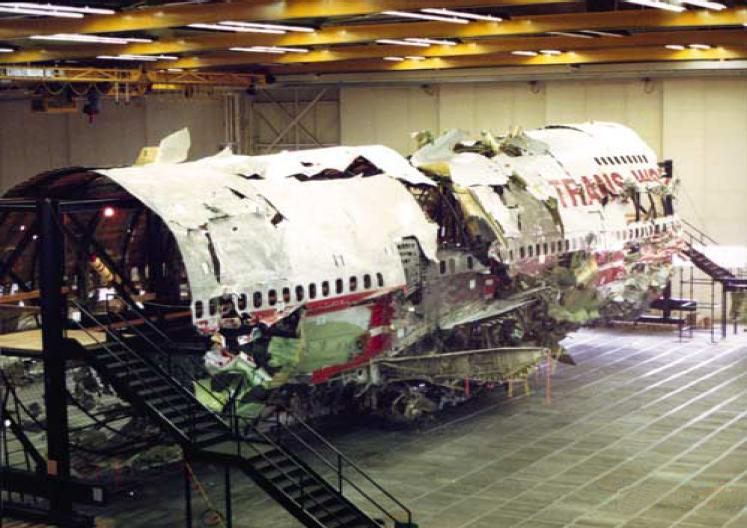
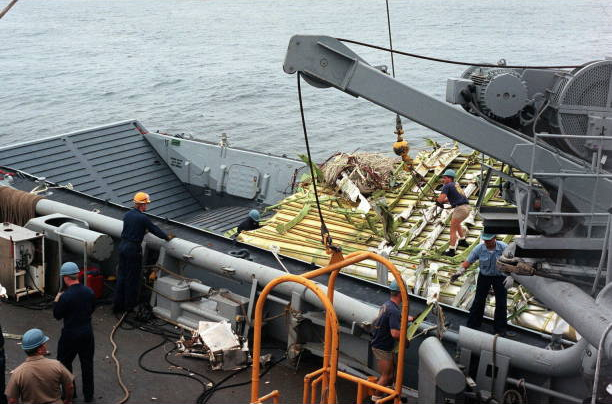
- More than 95% of the aircraft was eventually recovered.
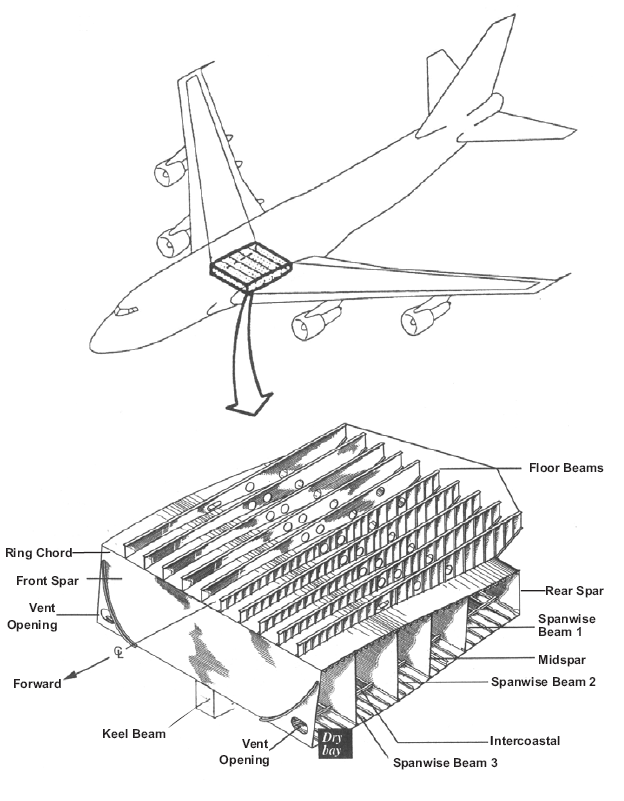
- The center wing tank experienced an explosion.
- The NTSB concluded that a flammable fuel-air mixture inside the center wing tank ignited and initiated the accident sequence.
- The exact ignition source was not identified with certainty.
- Hundreds of eyewitnesses reported visual phenomena associated with the event.
- Trace explosive compounds were detected on several wreckage samples.
- Investigators did not identify definitive missile-warhead fragmentation or missile-impact signatures in the recovered wreckage.
- A 1996 FBI cable released via FOIA in 2026 records early investigative leads involving a radar object, missile-consistent witness information, and Cairo faxes claiming credit.
- IAMAW submitted an investigation-party report disputing aspects of wiring, arcing, wreckage handling, database, witness, and fire/explosion interpretation while also acknowledging that the center wing tank exploded.
Still open
What remains disputed or unresolved
- Whether a subset of eyewitnesses observed a missile or other object distinct from the aircraft.
- Whether unusual radar returns have causal significance.
- How explosive residues found on the wreckage should be interpreted.
- Whether technical dissent raised by former investigators reveals significant weaknesses in the official reconstruction.
- How the early Cairo-fax and missile-origin leads were resolved within the complete FBI case file.
- How IAMAW party-report challenges to wiring, arcing, L3-door damage, WCS splatter, witness handling, and tag-database validity should be reconciled with the final NTSB sequence.
- The exact mechanism that supplied ignition energy inside the center wing tank.
- Whether any external event can explain the total evidence better than an internal ignition event.
Evidence snapshot
Where the major categories currently point.
Current direction and evidence impact are separate. Open any review for the complete observations, interpretations, source quality, and unresolved questions.
How to read this
Current direction says what the evidence presently supports, challenges, or leaves unresolved. Evidence impact says how important that category is to understanding the case. Impact does not mean support for either side.
Evidence categoryCurrent directionEvidence impactKey limitation / note
Evidence categoryEyewitness evidence
Read review5 linked sources
Current directionMixed / disputed
Evidence impactHigh impactCentral to the case or capable of materially changing the assessment.
Key limitation / note
Mass record does not establish a missile; some individual accounts remain important.
Evidence categoryRadar evidence
Read review3 linked sources
Current directionModerately favors internal event
Evidence impactMedium impactMeaningfully informs the case but is not decisive alone.
Key limitation / note
No incoming missile track; non-detection is not decisive.
Evidence categoryWreckage / warhead signatures
Read review4 linked sources
Current directionStrongly favors internal event
Evidence impactHigh impactCentral to the case or capable of materially changing the assessment.
Key limitation / note
Large recovered sample lacked definitive missile-warhead damage.
Evidence categoryExplosive residue
Read review3 linked sources
Current directionAmbiguous
Evidence impactMedium impactMeaningfully informs the case but is not decisive alone.
Key limitation / note
Trace compounds are real but lack matching physical blast evidence.
Evidence categoryCenter-wing-tank flammability
Read review5 linked sources
Current directionStrongly established
Evidence impactHigh impactCentral to the case or capable of materially changing the assessment.
Key limitation / note
Testing supports a flammable tank atmosphere and internal explosion plausibility.
Evidence categoryExact ignition sourceLogged evidence
Current directionUnresolved
Evidence impactMedium impactMeaningfully informs the case but is not decisive alone.
Key limitation / note
The exact source of ignition energy was not determined with certainty.
Evidence categorySpike-tooth fracturesLogged evidence
Current directionWeakly discriminatory
Evidence impactLow impactAdds context but has little power to separate the interpretations.
Key limitation / note
Rapid strain may be real without identifying a cause.
Evidence category2013 technical challengeLogged evidence
Current directionRaises questions
Evidence impactMedium impactMeaningfully informs the case but is not decisive alone.
Key limitation / note
Legitimate dissent, but not currently enough to overturn the physical case.
Evidence categoryIAMAW party reportLogged evidence
Current directionFormal dissent / context
Evidence impactLimited impactRelevant, but too indirect or constrained to carry much of the case.
Key limitation / note
Strengthens the record of party-source dissent while also rejecting witness proof of a conclusively observed outside object.
Evidence categoryFOIA early-lead materialLogged evidence
Current directionContext / unresolved
Evidence impactLimited impactRelevant, but too indirect or constrained to carry much of the case.
Key limitation / note
Useful archival context for early leads; not proof that those leads were corroborated.
Current read
Where the record points after review.
PARALLAX does not require the reader to adopt a conclusion.
The current review finds that the recovered physical evidence more strongly supports an internal center-wing-tank explosion than a missile strike.
Several eyewitness, explosive-residue, radar-interpretation, and ignition-source questions remain legitimately disputed or unresolved.
The 2026 FOIA-released FBI cable improves the early-lead record, but does not currently change the physical-evidence assessment.
The IAMAW party report strengthens the record of investigation-party dissent, especially around wiring/arcing, FBI/NTSB process, database reliability, and selected wreckage observations, but does not currently displace the absence of confirmed warhead or missile-impact signatures.
Those unresolved questions justify continued inquiry, but they should not be treated as affirmative proof of an external attack without independent supporting evidence.
What would change it
The assessment remains revisable.
- Stronger primary witness documentation or independent sightline reconstruction could alter the eyewitness assessment.
- Verified additional explosive-residue records with corresponding blast evidence would materially affect the physical case.
- Independent radar re-analysis could clarify whether anomalous returns have causal significance.
- Direct evidence of the internal ignition path would strengthen the conventional account.
01Visual source
Enter the conflict
What story were we given, and why is it questioned?
Begin with the account most people receive, then inspect why it remains contested before testing every serious possibility.The story we were given
The accepted account, stated without caricature.
The official investigation concluded that an electrical fault most likely ignited a flammable center-wing-tank mixture, causing an internal explosion and breakup. Missile and bomb scenarios were rejected because the recovered wreckage and radar record did not show the signatures investigators expected.
Why people question it
The pressure points that keep this case open.
A contradiction is not proof of a preferred theory. It is a reason to keep asking better questions.
- 01
The precise ignition path was never recovered or demonstrated end to end.
- 02
Some witnesses described a rising or apparently separate luminous object rather than only the burning aircraft.
- 03
Trace explosive compounds, unusual radar returns, early terrorism leads, and formal investigation-party dissent keep the external-event question alive.
At a glance
What is firmly established
- TWA Flight 800 was a Boeing 747-131 operating from New York toward Paris on July 17, 1996.
- The aircraft broke apart shortly after departure.
- All 230 people aboard were killed.
- More than 95% of the aircraft was eventually recovered.
- The center wing tank experienced an explosion.
- The NTSB concluded that a flammable fuel-air mixture inside the center wing tank ignited and initiated the accident sequence.
- The exact ignition source was not identified with certainty.
- Hundreds of eyewitnesses reported visual phenomena associated with the event.
- Trace explosive compounds were detected on several wreckage samples.
- Investigators did not identify definitive missile-warhead fragmentation or missile-impact signatures in the recovered wreckage.
- A 1996 FBI cable released via FOIA in 2026 records early investigative leads involving a radar object, missile-consistent witness information, and Cairo faxes claiming credit.
- IAMAW submitted an investigation-party report disputing aspects of wiring, arcing, wreckage handling, database, witness, and fire/explosion interpretation while also acknowledging that the center wing tank exploded.
Still open
What remains disputed or unresolved
- Whether a subset of eyewitnesses observed a missile or other object distinct from the aircraft.
- Whether unusual radar returns have causal significance.
- How explosive residues found on the wreckage should be interpreted.
- Whether technical dissent raised by former investigators reveals significant weaknesses in the official reconstruction.
- How the early Cairo-fax and missile-origin leads were resolved within the complete FBI case file.
- How IAMAW party-report challenges to wiring, arcing, L3-door damage, WCS splatter, witness handling, and tag-database validity should be reconciled with the final NTSB sequence.
- The exact mechanism that supplied ignition energy inside the center wing tank.
- Whether any external event can explain the total evidence better than an internal ignition event.
Scope
What this investigation is, and is not, asking.
This case asks what evidence supports or contradicts the internal fuel-tank and external-event interpretations.
It reviews eyewitness accounts, radar evidence, recovered wreckage, explosive residue, center-wing-tank flammability, ignition-source evidence, and later technical challenges.
It does not begin from claims that the aircraft was shot down, that witnesses were wrong, that the NTSB was lying, or that any party was already vindicated.
Timeline
Case chronology.
A compact record of the events, tests, publications, and review moments that define the current investigation.
Accident sequence begins
TWA Flight 800 departs JFK and breaks apart over the Atlantic shortly afterward, killing all 230 people aboard.
Recovery and reconstruction
Investigators recover more than 95% of the aircraft and reconstruct major wreckage sections for structural and explosion-sequence analysis.
Official accident report published
The NTSB concludes that a center-wing-tank explosion initiated the breakup, while the exact ignition source remains unresolved.
Formal technical challenge filed
A petition for reconsideration challenges parts of the official interpretation, including radar, witness, structural, and residue claims.
FOIA early-lead material surfaces
A FOIA-released FBI cable records early investigative attention to an unidentified radar object, a missile-consistent witness lead, and Cairo faxes claiming credit.
PARALLAX state-of-evidence review
PARALLAX opens INV-001 with the physical record leaning internal-event while eyewitness, residue, radar, and ignition-source questions remain visible.
Gallery
Visual context for the evidence.
These images are included as source-linked context, not as proof by themselves. Captions describe what the image can help inspect.
This image provides visual context. It does not establish cause, identity, date, or interpretation by itself.
National Transportation Safety Board. Public domain, U.S. federal government work.Wikimedia Commons file pageThis image provides visual context. It does not establish cause, identity, date, or interpretation by itself.
National Transportation Safety Board. Public domain, U.S. federal government work.Wikimedia Commons file pageThis image provides visual context. It does not establish cause, identity, date, or interpretation by itself.
NTSB / FAA source material. Public domain, U.S. federal government work.Wikimedia Commons file pageThis image provides visual context. It does not establish cause, identity, date, or interpretation by itself.
Captain Gordon Peterson, U.S. Navy. Public domain, U.S. federal government work.Wikimedia Commons file page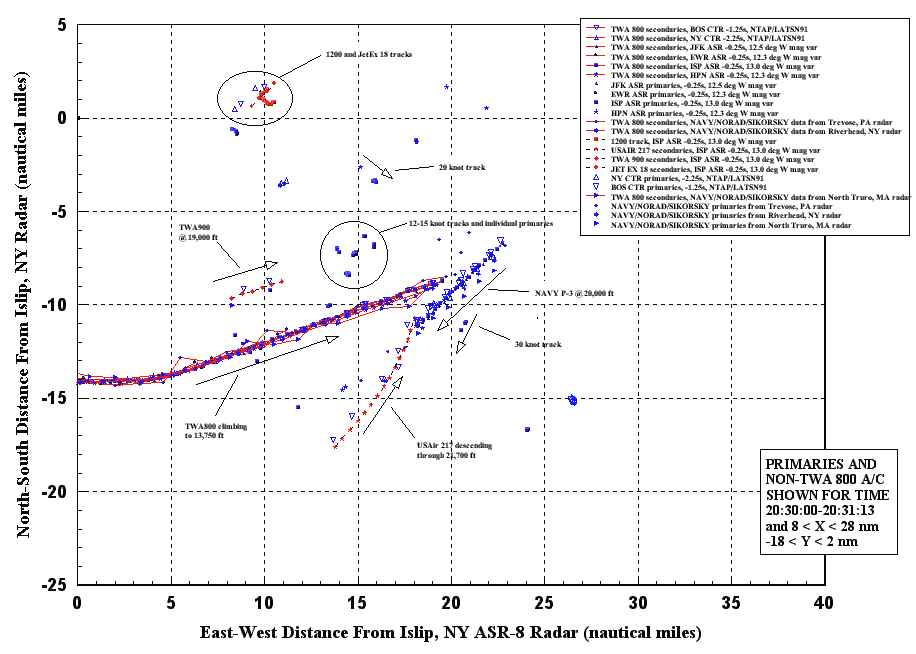
02Visual source
Map the possibilities
Which possibilities survive the pressure?
Give the accepted explanation and its strongest challengers the same hard questions: what fits, what fails, and what is still missing?Competing possibilities
The accepted account and its strongest alternatives.
Inclusion means a possibility is worth testing. It does not mean every possibility currently carries equal evidentiary weight.
Interpretation A - Internal fuel-tank explosion
A flammable fuel-air mixture in the center wing tank ignited, most likely because of an electrical fault involving fuel-quantity-system wiring. The resulting internal explosion initiated catastrophic structural failure.
Current treatment
Leading explanation. The recovered physical record strongly supports an internal explosion, while the initiating spark remains unresolved.
Interpretation B - External missile / external event
A missile or another external high-energy event initiated the destruction of the aircraft, potentially causing the center-wing-tank explosion secondarily.
Current treatment
Serious but currently secondary. Witness and process questions justify continued scrutiny, but affirmative missile evidence has not been established.
Possibility map
Stress-test every serious explanation.
Select a possibility to see what would need to be true, what supports it, what weakens it, what is missing, and how seriously the current record allows PARALLAX to treat it.
Primary questionDoes the available evidence better support an internal center-wing fuel-tank explosion, or an external missile / external initiating event, as the initiating cause of TWA Flight 800's destruction?
Interpretation A - Internal fuel-tank explosion
What would need to be true
A flammable fuel-air mixture in the center wing tank ignited, most likely because of an electrical fault involving fuel-quantity-system wiring. The resulting internal explosion initiated catastrophic structural failure.
What supports it
- Center-wing-tank flammability was physically plausible under relevant conditions.
- Full-scale and laboratory testing supported an internal tank explosion failure sequence.
- More than 95% of the aircraft was recovered without definitive missile-warhead signatures.
- No coherent incoming missile radar track was found.
What weakens it
- The exact ignition source was never physically identified with certainty.
- A subset of witness accounts remains difficult and deserves independent reconstruction.
What evidence is missing
- A recovered or independently reconstructed electrical path that identifies the ignition source.
- A modern reconstruction that reconciles the strongest witness sightlines with the breakup sequence.
How PARALLAX treats it now
Leading explanation. The recovered physical record strongly supports an internal explosion, while the initiating spark remains unresolved.
Discriminating evidenceOpen the categories that can move the assessment
These links lead to the underlying evidence reviews. Direction is kept separate from importance and is never converted into a score.
High impactEyewitness evidence
Mixed / disputed
Open evidence matrixHigh impactWreckage / warhead signatures
Strongly favors internal event
Open evidence matrixHigh impactCenter-wing-tank flammability
Strongly established
Open evidence matrixMedium impactRadar evidence
Moderately favors internal event
Open evidence matrixMedium impactExplosive residue
Ambiguous
Open evidence matrixMedium impactExact ignition source
Unresolved
Open evidence matrixThis map does not award points for novelty or authority. Compare serious possibilities, inspect what each one explains, and follow the evidence categories back to their detailed reviews.
Evidence matrix
Current direction by category.
Current direction shows what a category supports, challenges, or leaves unresolved. Evidence impact shows how important that category is to understanding the case, without turning uncertainty into a fake score.
How to read this
Current direction says what the evidence presently supports, challenges, or leaves unresolved. Evidence impact says how important that category is to understanding the case. Impact does not mean support for either side.
Evidence categoryCurrent directionEvidence impactKey limitation / note
Evidence categoryEyewitness evidence
Read review5 linked sources
Current directionMixed / disputed
Evidence impactHigh impactCentral to the case or capable of materially changing the assessment.
Key limitation / note
Mass record does not establish a missile; some individual accounts remain important.
Evidence categoryRadar evidence
Read review3 linked sources
Current directionModerately favors internal event
Evidence impactMedium impactMeaningfully informs the case but is not decisive alone.
Key limitation / note
No incoming missile track; non-detection is not decisive.
Evidence categoryWreckage / warhead signatures
Read review4 linked sources
Current directionStrongly favors internal event
Evidence impactHigh impactCentral to the case or capable of materially changing the assessment.
Key limitation / note
Large recovered sample lacked definitive missile-warhead damage.
Evidence categoryExplosive residue
Read review3 linked sources
Current directionAmbiguous
Evidence impactMedium impactMeaningfully informs the case but is not decisive alone.
Key limitation / note
Trace compounds are real but lack matching physical blast evidence.
Evidence categoryCenter-wing-tank flammability
Read review5 linked sources
Current directionStrongly established
Evidence impactHigh impactCentral to the case or capable of materially changing the assessment.
Key limitation / note
Testing supports a flammable tank atmosphere and internal explosion plausibility.
Evidence categoryExact ignition sourceLogged evidence
Current directionUnresolved
Evidence impactMedium impactMeaningfully informs the case but is not decisive alone.
Key limitation / note
The exact source of ignition energy was not determined with certainty.
Evidence categorySpike-tooth fracturesLogged evidence
Current directionWeakly discriminatory
Evidence impactLow impactAdds context but has little power to separate the interpretations.
Key limitation / note
Rapid strain may be real without identifying a cause.
Evidence category2013 technical challengeLogged evidence
Current directionRaises questions
Evidence impactMedium impactMeaningfully informs the case but is not decisive alone.
Key limitation / note
Legitimate dissent, but not currently enough to overturn the physical case.
Evidence categoryIAMAW party reportLogged evidence
Current directionFormal dissent / context
Evidence impactLimited impactRelevant, but too indirect or constrained to carry much of the case.
Key limitation / note
Strengthens the record of party-source dissent while also rejecting witness proof of a conclusively observed outside object.
Evidence categoryFOIA early-lead materialLogged evidence
Current directionContext / unresolved
Evidence impactLimited impactRelevant, but too indirect or constrained to carry much of the case.
Key limitation / note
Useful archival context for early leads; not proof that those leads were corroborated.
Evidence reviews
The repeatable review structure for future cases.
Each category separates the core question, established observations, source quality, competing interpretations, assessment, unresolved issues, and sources.
001-A
Eyewitnesses
Current directionMixed / disputed
Question tested
Do eyewitness accounts establish a separate rising or approaching object before the breakup?
Current read
The mass witness record does not establish a missile, but several individual accounts are specific enough that the missile hypothesis cannot be dismissed by saying all witnesses saw the damaged aircraft.
Established Observations
- FACTThe NTSB witness group worked from FBI material containing 736 witness accounts.
- FACT258 witnesses were classified as describing a streak of light, a broad category that did not automatically mean missile.
- DISPUTEDA subset of witnesses described vertical, near-vertical, low-horizon, or apparently separate luminous objects.
- FACTA 1996 FBI cable released via FOIA in 2026 recorded early investigative review of an unidentified radar object, a missile-consistent eyewitness lead, and Cairo faxes claiming credit.
- UNKNOWNThe strongest sightlines have not yet been independently reconstructed by PARALLAX.
Evidence Quality
Moderate. The number of accounts matters, but many underlying FBI interviews were agent summaries rather than verbatim transcripts reviewed by witnesses. A 2026 FOIA-released FBI cable is useful early-lead context, not a final causal finding.
Accepted / Conventional Reading
- The center wing tank exploded first.
- The forward fuselage separated.
- The remaining burning aircraft continued moving and breaking apart.
- From some ground viewing angles, the damaged aircraft appeared to rise or streak upward.
Challenge / Alternative Reading
- A narrower subset of witnesses may have seen a luminous object rising from low on the horizon or surface.
- Some accounts appear to distinguish an aircraft from a separate moving object.
- If accurately documented and geometrically consistent, those accounts would matter to the missile hypothesis.
PARALLAX Current Read
DISPUTED / UNRESOLVED
001-B
Radar
Current directionModerately favors internal-event explanation
Question tested
Does the radar record show an incoming missile, another aircraft, or only ambiguous returns?
Current read
The radar record provides no affirmative incoming missile track and therefore moderately favors the internal-event explanation, while later testing keeps missile non-detection from being conclusive.
Established Observations
- FACTInvestigators collected radar data from nine systems across five states.
- FACTThe NTSB reported no coherent radar track intersecting TWA Flight 800 and no sequence judged consistent with an incoming missile.
- SUPPORTED INFERENCESlow unidentified nearby targets, estimated around 12 to 30 knots, are weak candidates for an attacking missile.
- DISPUTEDAn apparent 400+ knot Islip radar sequence moving away from the accident location remains dependent on technical interpretation.
Evidence Quality
High for the existence of collected radar data; technical re-analysis of anomalous returns remains specialized.
Accepted / Conventional Reading
- No incoming missile track was found across the collected radar record.
- Unidentified slow returns were consistent with boats rather than aircraft or missiles.
- The high-speed apparent track was interpreted as anomalous radar propagation or reflection.
Challenge / Alternative Reading
- Radar can miss small missiles, so non-detection does not prove impossibility.
- Critics may argue that some anomalous returns represented real objects.
- The radar record needs technical expertise before every anomaly can be independently settled.
PARALLAX Current Read
MODERATELY FAVORS INTERNAL-EVENT EXPLANATION
001-C
Wreckage and Explosive Residue
Current directionStrongly favors internal-event explanation; residue ambiguous
Question tested
Does recovered wreckage show missile-warhead damage or explosive traces that identify an external initiating event?
Current read
More than 95% of the aircraft was recovered, and investigators did not identify characteristic missile-warhead damage. Trace explosive compounds are real evidence, but their meaning remains ambiguous without corresponding blast signatures.
Established Observations
- FACTMore than 95% of the aircraft was recovered, creating a large physical sample for damage analysis.
- FACTInvestigators reported finding no characteristic missile-warhead damage in the recovered wreckage.
- FACTTrace explosive compounds were detected on three wreckage samples: RDX, nitroglycerin, and RDX plus PETN.
- UNVERIFIED CLAIMClaims of additional explosive-positive samples remain not established by the material reviewed in version 0.1.
Evidence Quality
High for recovery scale and official damage analysis; moderate for unresolved residue-distribution claims requiring primary documentation.
Accepted / Conventional Reading
- A missile warhead would ordinarily be expected to create high-velocity fragmentation, pitting, petalling, hot-gas erosion, or related outside-to-inside damage.
- With more than 95% of the aircraft recovered, at least some characteristic warhead damage should likely have survived.
- Trace residue can be explained by documented contamination pathways, including earlier explosives-detection canine training.
Challenge / Alternative Reading
- Trace explosive residues were genuinely detected and should not be dismissed as nonexistent.
- Two ambiguous holes and additional-residue claims may warrant further primary-document review.
- A possible contamination pathway does not prove the exact source of every residue.
PARALLAX Current Read
STRONGLY FAVORS INTERNAL-EVENT EXPLANATION; EXPLOSIVE-RESIDUE EVIDENCE REMAINS REAL BUT AMBIGUOUS
001-D
Fuel Tank and Ignition Source
Current directionInternal explosion strongly supported; exact ignition unresolved
Question tested
Was a flammable center-wing-tank explosion physically plausible, and was the exact identified?
Current read
The conventional explanation is strongest in establishing tank flammability and a structurally plausible internal explosion. Its principal unresolved weakness is that the exact ignition mechanism was not identified with certainty.
Established Observations
- FACTInvestigators found that warm Jet A vapor could create a flammable center-wing-tank atmosphere under relevant conditions.
- FACTFull-scale testing demonstrated that internal combustion pressures could violently damage a Boeing 747 center wing tank.
- UNKNOWNThe NTSB explicitly stated that the source of ignition energy could not be determined with certainty.
- SUPPORTED INFERENCEThe NTSB favored a Fuel Quantity Indication System electrical-fault scenario, but did not recover the exact failed wire, short circuit, or spark location.
- DISPUTEDIAMAW disputed that the recovered wiring showed improper maintenance, malfunction, or reliable arcing evidence sufficient to identify the ignition path.
Evidence Quality
High for fuel-air flammability and full-scale testing; limited for the exact electrical path because critical recovered wiring was incomplete. The IAMAW is useful direct dissent on wiring and interpretation, but it does not by itself establish an external initiating event.
Accepted / Conventional Reading
- Heat below the center wing tank could warm fuel and vapor enough to create a flammable mixture.
- Laboratory and full-scale tests demonstrated that an internal fuel-air explosion could produce severe structural damage.
- Fuel-system wiring vulnerabilities made an FQIS electrical-fault ignition path plausible.
Challenge / Alternative Reading
- The exact ignition source was never physically identified end-to-end.
- Only a small amount of critical center-wing-tank wiring from Flight 800 was recovered.
- Boeing disputed whether recovered components showed clear electrical stress proving excess energy entered through those components.
PARALLAX Current Read
INTERNAL EXPLOSION STRONGLY SUPPORTED; EXACT IGNITION SOURCE UNRESOLVED
001-E
Technical Challenges
Current directionLegitimate dissent; does not currently overturn physical case
Question tested
Did the 2013 reconsideration petition raise technical questions strong enough to overturn the physical case?
Current read
The 2013 petition raised legitimate questions worthy of examination, but the material reviewed so far did not produce new physical evidence strong enough to overturn the wreckage, fuel-tank, or missile-damage findings.
Established Observations
- FACTIn 2013, the TWA 800 Project filed a formal petition asking the NTSB to reconsider its findings.
- FACTThe NTSB reviewed the petition, held a listening session in 2014, and denied reconsideration in a detailed response.
- DISPUTEDPetitioners argued that radar returns, spike-tooth fractures, witness geometry, and explosive residue claims weakened the official reconstruction.
- SUPPORTED INFERENCEThe petition is strongest as a set of technical challenges, not as independent proof of an external attack.
- FACTA 2026 FOIA-released FBI cable adds archival evidence that some missile and terrorism leads were active early in the investigation.
- FACTIAMAW submitted an investigation-party report challenging investigation process, witness reliability, tag-database validity, selected left-side damage observations, and parts of the wiring and fire/explosion interpretation while also acknowledging that the center wing tank exploded.
Evidence Quality
High for the existence of the petition, formal response, FOIA-released early lead material, and IAMAW ; technical claims require independent specialist review before stronger assessment.
Accepted / Conventional Reading
- Petitioners treated radar resolution as radar accuracy and connected separate primary returns as one continuous physical object.
- Spike-tooth fractures may reflect rapid strain without identifying an initiating detonation.
- Additional explosive-residue claims were not documented to the standard required for reconsideration.
Challenge / Alternative Reading
- Former investigators and technical critics raised specific objections deserving review rather than dismissal.
- A technical challenge followed by a technical rebuttal creates a useful evidence structure.
- Not sufficiently established does not mean proven false.
PARALLAX Current Read
LEGITIMATE TECHNICAL DISSENT; DOES NOT CURRENTLY OVERTURN THE PHYSICAL CASE
03Visual source
Name what remains
What still does not sit right?
Keep the stubborn gaps visible. Then state what the record can presently carry without pretending suspicion is proof or authority is closure.Open questions / What still does not sit right
The unanswered questions that matter.
- What precisely supplied the ignition energy inside the center wing tank?
- Can the strongest eyewitness sightlines be independently reconstructed today?
- Which of the strongest missile-like witnesses observed the aircraft and a separate object simultaneously?
- Were the strongest missile-like witnesses included in the CIA witness analysis?
- Were additional explosive-positive wreckage samples documented beyond the three publicly emphasized?
- What was the final disposition of the early Cairo-fax and missile-origin leads documented in the FOIA-released FBI cable?
- Can the IAMAW party report be matched to a complete docket-hosted copy and reconciled point-by-point with the NTSB final report and group factual reports?
- Does the unusual high-speed radar sequence have a fully satisfactory technical explanation?
- Do any surviving structural features require an external high-energy initiating event?
- Can a physically plausible missile-intercept geometry be reconciled with the strongest eyewitness accounts while also matching the absence of characteristic warhead damage?
What would change the picture
Evidence must be allowed to move the assessment.
- Stronger primary witness documentation or independent sightline reconstruction could alter the eyewitness assessment.
- Verified additional explosive-residue records with corresponding blast evidence would materially affect the physical case.
- Independent radar re-analysis could clarify whether anomalous returns have causal significance.
- Direct evidence of the internal ignition path would strengthen the conventional account.
Why this case matters
Why this conflict deserves scrutiny.
Human consequence
TWA Flight 800 matters first because 230 people died. Understanding the cause of an aviation disaster matters because accident investigation exists to explain the past and reduce recurrence.
Aviation safety
The investigation helped expose the danger of allowing potentially flammable vapor mixtures inside transport-aircraft fuel tanks while relying primarily on preventing ignition sources.
The accident contributed to later fuel-tank flammability-reduction requirements and additional attention to aircraft wiring safety.
Institutional coordination
Because investigators initially did not know whether Flight 800 had been destroyed by accident or criminal action, the NTSB and FBI worked the same disaster from different institutional perspectives.
The investigation influenced later procedures governing coordination between transportation-safety investigators and criminal investigators.
Why it matters to PARALLAX
TWA Flight 800 is a useful example of how the same true facts can be used to support radically different stories.
The purpose of PARALLAX is to show enough context to understand why the controversy exists and what the evidence actually does and does not establish.
What the evidence currently suggests
Where the record points - v0.1.6
PARALLAX does not require the reader to adopt a conclusion.
The current review finds that the recovered physical evidence more strongly supports an internal center-wing-tank explosion than a missile strike.
Several eyewitness, explosive-residue, radar-interpretation, and ignition-source questions remain legitimately disputed or unresolved.
The 2026 FOIA-released FBI cable improves the early-lead record, but does not currently change the physical-evidence assessment.
The IAMAW party report strengthens the record of investigation-party dissent, especially around wiring/arcing, FBI/NTSB process, database reliability, and selected wreckage observations, but does not currently displace the absence of confirmed warhead or missile-impact signatures.
Those unresolved questions justify continued inquiry, but they should not be treated as affirmative proof of an external attack without independent supporting evidence.
04Visual source
Inspect the record
Follow the evidence back to its sources.
Trace the sources, shared foundations, definitions, corrections, and revision history behind the public assessment.Source record
Inspect the material.
- Official recordntsb-investigation
NTSB accident investigation page - DCA96MA070
Official recordInstitutional record; weight depends on evidence, method, provenance, corroboration, and limits.- Limit
- Records what the institution published; it does not independently establish that the record is complete or its conclusions are correct.
Official investigation landing page for the TWA Flight 800 accident record.
- Official recordntsb-report
Aircraft Accident Report: In-flight Breakup Over the Atlantic Ocean
Official recordInstitutional record; weight depends on evidence, method, provenance, corroboration, and limits.- Limit
- Records what the institution published; it does not independently establish that the record is complete or its conclusions are correct.
Primary official accident report concluding that the center wing tank explosion initiated the accident sequence.
- Primary evidencentsb-docket
NTSB public docket - DCA96MA070
Primary evidenceDirect material, dataset, exhibit, transcript, or record; directness does not remove context checks.- Limit
- Directness does not by itself establish authenticity, completeness, or the correct interpretation outside the documented provenance.
Public docket collection containing supporting reports, studies, exhibits, and investigative material.
- Technical / scientific analysismissile-impact
TWA Flight 800 Missile Impact Analysis
Technical sourceScientific, engineering, forensic, or specialist analysis; weight follows method and reproducibility.- Limit
- Technical publication does not remove limits in method, data access, replication, or later criticism.
Technical analysis of expected missile impact and warhead damage signatures in recovered aircraft wreckage.
- Independent technical analysis2013-petition
2013 Petition for Reconsideration
Independent critiqueTechnical analysis outside the principal institution; judged by methods and source trail, not outsider status.- Provenance
- Filed by TWA 800 Project petitioners as a formal reconsideration request.
- Directness
- Direct source for the petitioners technical claims, not independent proof of those claims.
- Limit
- Interpretation disputed by the NTSB response and dependent on specialist review of radar, structural, witness, and residue evidence.
- Verification
- Formal filing verified; individual technical conclusions remain disputed.
Formal technical challenge asking the NTSB to reconsider findings related to radar, structural damage, witnesses, and explosive residue.
- Official recordntsb-response
NTSB Response to Petition for Reconsideration
Official recordInstitutional record; weight depends on evidence, method, provenance, corroboration, and limits.- Provenance
- Institutional response from the original accident-investigation agency.
- Directness
- Direct source for the agency rebuttal, not a substitute for inspecting the underlying evidence.
- Limit
- Official response may carry institutional incentives; PARALLAX weighs the reasoning and cited evidence rather than official status alone.
- Verification
- Formal response verified.
NTSB response denying reconsideration after reviewing the 2013 petition and related technical arguments.
- Official record25-year-retrospective
NTSB 25-year retrospective press release
Official recordInstitutional record; weight depends on evidence, method, provenance, corroboration, and limits.- Limit
- Records what the institution published; it does not independently establish that the record is complete or its conclusions are correct.
Retrospective NTSB release summarizing the accident investigation and later safety changes.
- Archival materialfbi-cairo-foia-1996
FOIA-released FBI cable noting early TWA 800 missile and Cairo fax leads
Archival recordHistorical or FOIA/source-file material; relevance depends on provenance, completeness, and context.- Provenance
- FBI cable released publicly in 2026 through Judicial Watch FOIA material.
- Directness
- Direct archival record of early investigative lead handling, not a final finding.
- Corroboration
- Consistent with the broader public record that missile, bomb, and mechanical explanations were all initially investigated.
- Limit
- Early lead document; later FBI/NTSB conclusions did not find evidence establishing a bomb or missile cause.
- Verification
- Document image publicly available; underlying leads require case-file context.
Archival FBI communication recording early investigative leads, including an unidentified radar object, a missile-consistent eyewitness account under review, and faxes from Cairo claiming credit. This documents early leads; it does not establish cause.
- Primary evidenceiamaw-party-report
IAMAW Air Transport District Lodge 142 analysis and recommendations regarding TWA Flight 800
Primary evidenceDirect material, dataset, exhibit, transcript, or record; directness does not remove context checks.- Provenance
- Scanned IAMAW party-coordinator report hosted by twa800.com; rendered copy identifies IAMAW Air Transport District Lodge 142 and R.T. Miller.
- Directness
- Direct source for IAMAW party findings and recommendations; not independent proof that its conclusions are correct.
- Method
- Party review based on participation in the investigation and group records; the public PDF is scanned, so text searchability and detailed citation granularity are limited.
- Corroboration
- Intersects with NTSB and petition disputes over wiring, ignition source, wreckage handling, FBI/NTSB coordination, and selected structural observations; conflicts with the NTSB final causal sequence.
- Limit
- Scanned copy hosted outside the NTSB docket; PARALLAX has not yet verified whether this exact scan is the complete final party submission in the NTSB archive.
- Verification
- Public scan visually inspected; primary docket copy still desirable.
Investigation-party report challenging parts of the wiring, fire/explosion, witness, wreckage-handling, and tag-database record while also acknowledging that the center wing tank exploded and that witness statements did not conclusively establish an outside object.
Source relationships
Where the argument shares a foundation.
This view identifies records reused across observations, evidence reviews, or other PARALLAX investigations. It prevents citation volume from being mistaken for independent confirmation.
Repeated citation is not independent corroboration.
A record is counted once even when several sections rely on it. This audit shows the sources carrying more than one part of the public argument.
Aircraft Accident Report: In-flight Breakup Over the Atlantic Ocean
Official record
- Review reuse
- 5 evidence reviews
- Observation reuse
- 14 established observations
- Cross-case reuse
- 0 other investigations
2013 Petition for Reconsideration
Independent technical analysis
- Review reuse
- 4 evidence reviews
- Observation reuse
- 7 established observations
- Cross-case reuse
- 0 other investigations
NTSB Response to Petition for Reconsideration
Official record
- Review reuse
- 4 evidence reviews
- Observation reuse
- 7 established observations
- Cross-case reuse
- 0 other investigations
FOIA-released FBI cable noting early TWA 800 missile and Cairo fax leads
Archival material
- Review reuse
- 2 evidence reviews
- Observation reuse
- 2 established observations
- Cross-case reuse
- 0 other investigations
IAMAW Air Transport District Lodge 142 analysis and recommendations regarding TWA Flight 800
Primary evidence
- Review reuse
- 2 evidence reviews
- Observation reuse
- 2 established observations
- Cross-case reuse
- 0 other investigations
Glossary
Plain-English terms for this case.
Definitions focus on words that materially affect how the evidence is understood.
Anomalous propagationanomalous radar propagation
A radar effect where atmospheric conditions bend or reflect radar energy in unusual ways, producing returns that may not match a real object path.
It matters because the NTSB used this explanation for a fast apparent Islip radar sequence near the accident time.
Related evidence
Center wing tankcenter-wing tank, CWT
A fuel tank located in the center section of the aircraft wing structure, near the fuselage.
This is the tank the NTSB concluded exploded and initiated the breakup sequence.
Related evidence
Chain of custody
The documented trail showing who collected, handled, stored, tested, and transferred a piece of evidence.
It matters for explosive-residue claims, witness records, and whether later source copies can be tied to primary records.
Related evidence
Deflagration
A rapid combustion event whose flame front moves slower than the speed of sound, unlike a high-explosive detonation.
The center-wing-tank scenario is generally treated as a fuel-air deflagration, not a missile-warhead detonation.
Related evidence
Explosive residue
Trace chemical material left by explosive compounds or by contact with explosive-containing material.
Residue is important in this case, but trace molecules alone do not prove that the aircraft was exposed to a detonation.
Related evidence
FQISFuel Quantity Indication System
Fuel Quantity Indication System, the sensors and wiring used to measure fuel quantity in the aircraft tanks.
The NTSB favored an FQIS-related electrical-fault path, but the exact failed wire or spark point was not identified with certainty.
Related evidence
High-velocity fragmentationhigh-velocity fragment penetration
Damage caused when fast-moving fragments penetrate, pit, or tear material at very high speed.
A detonating missile warhead would usually be expected to leave some recognizable high-velocity fragment damage.
Related evidence
Ignition source
The specific energy source that starts combustion, such as a spark, hot surface, or electrical fault.
The tank explosion is strongly supported, but the exact ignition source remains one of the central unresolved weaknesses.
Related evidence
Party report
A formal report or submission from an organization allowed to participate in an investigation because of relevant expertise or involvement.
IAMAW matters because it was an investigation party, so its dissenting report is stronger than ordinary commentary while still requiring comparison with the full record.
Related evidence
PETN
Pentaerythritol tetranitrate, a powerful explosive compound used in military and commercial explosive contexts.
PETN was part of the reported trace explosive-residue record and remains important but ambiguous.
Related evidence
Primary radar return
A radar reflection from an object, independent of whether the object is sending a transponder signal.
Primary returns matter because unidentified targets and possible tracks were central to radar disputes.
Related evidence
Radar track
A sequence of radar returns interpreted as the path of a moving object.
The case turns partly on whether particular returns form meaningful tracks or unrelated/anomalous returns.
Related evidence
RDX
A high explosive compound used in military and demolition applications.
RDX traces were reported on some wreckage samples, but the meaning of those traces remains disputed.
Related evidence
Secondary radar return
A radar-linked response from an aircraft transponder that helps identify and track cooperating aircraft.
Secondary radar is part of why aircraft tracks can be clearer than unidentified primary returns.
Related evidence
Structural breakup
The physical failure sequence in which major parts of an aircraft separate under aerodynamic, blast, fire, or mechanical loads.
The dispute is not whether breakup happened, but what initiated and shaped the sequence.
Witness geometry
The reconstruction of where a witness was looking, from what location, and how that sightline intersects the event area.
It matters because some of the strongest missile-like accounts depend on whether the sightline actually crossed the aircraft breakup area.
Related evidence
Challenge tools
PARALLAX can be challenged.
Challenges are evaluated by evidentiary quality, not ideological alignment.
Revision history
Important changes remain traceable.
Reframed the public case around the accepted account, reasons for doubt, and a possibility map.
September 1, 2026
- Added the story presented to the public and the strongest reasons it remains questioned.
- Added explicit standing and missing-evidence tests for both major possibilities.
- Moved the current PARALLAX read behind the conflict and evidence without changing the evidentiary conclusion.
Added IAMAW party-report source to the source-balance audit.
August 30, 2026
- Added the IAMAW Air Transport District Lodge 142 party report as primary party-submission evidence.
- Updated ignition and technical-challenge reviews to reflect IAMAW process, wiring, witness, database, and left-side damage critiques.
- Recorded that the source strengthens the dissenting source trail without changing the current physical-evidence assessment.
Audited source balance under the expanded sourcing principle.
August 30, 2026
- Added a FOIA-released 1996 FBI cable as archival early-lead context.
- Reclassified the 2013 petition as independent technical analysis and added source-limitation metadata.
- Recorded that the added archival context does not currently change the state-of-evidence assessment.
Added dossier, chronology, source-quality, and reading-orientation upgrades.
August 30, 2026
- Added a case-file stat strip to the investigation masthead.
- Reworked evidence reviews into clearer question, current-read, source-quality, interpretation, and assessment zones.
- Added source-quality labels and a reading-progress indicator to improve long-form navigation.
Upgraded the public investigation presentation without changing the evidentiary assessment.
August 30, 2026
- Added case chronology, image-led visual hierarchy, and a denser evidence-direction matrix.
- Improved archive-card and source-library presentation for faster scanning.
- Preserved the published state-of-evidence conclusion and unresolved-question ledger.
Added gallery and table-of-contents navigation to the public investigation page.
August 29, 2026
- Added sourced public-domain imagery for the case.
- Added jump links to major investigation sections and evidence reviews.
- Preserved the v0.1 state-of-evidence assessment without substantive evidentiary change.
Initial public state-of-evidence report structured under the PARALLAX method.
August 28, 2026
- Opened INV-001 as an active investigation.
- Published the first evidence map and five evidence reviews.
- Established the first public source library for the case.
- Recorded unresolved questions and challenge pathways.