Did North Vietnamese forces attack USS Maddox and USS Turner Joy on August 4, 1964, and how did intelligence processing and official statements shape the case presented to Congress and the public?
Gulf of Tonkin: The Second Attack Question
Did North Vietnamese forces attack USS Maddox and USS Turner Joy on August 4, 1964, and how did intelligence processing and official statements shape the case presented to Congress and the public?
Military HistoryIntelligenceCongressional AuthorityDeclassified Records
- Category
- Military History / Intelligence / Public Records
- Source record
- 22 sources
- Evidence reviews
- 06
- Current version
- v0.1.2
This investigation separates four claims that are often collapsed together: whether the ships reported an attack, whether attackers were actually present, how intelligence converted uncertainty into confirmation, and whether the public account materially misled Congress. Error, selective analysis, and deliberate fabrication carry different burdens of proof.
Authority does not receive automatic closure, and dissent does not receive automatic credibility. This case remains open to stronger records, technical correction, and good-faith challenge.
Case briefing
Enter the conflict before the conclusion.
The accepted account is documented as a claim to test, not a truth to inherit. Serious alternatives face the same standard.
The Johnson administration told Congress and the public that North Vietnamese forces had deliberately attacked U.S. destroyers twice in international waters. The second attack was presented as confirmed and became the immediate factual basis for retaliation and the .
The original action reports contain many apparent combat indicators and sincere crew belief. Later reconstruction adds missing intercepts, aircraft non-observation, unstable contacts, environmental limits, and contemporaneous command doubts that undermine the battle picture.
- The task-group commander warned in real time that many contacts and torpedo reports were doubtful.
- Supporting aircraft saw no attackers, wakes, impacts, or targets during the alleged second engagement.
- The fuller signals-intelligence record and later declassification undermine the attack narrative and expose selective processing, missing context, and overstated public certainty.
At a glance
What is firmly established
- USS Maddox was conducting a DESOTO signals-intelligence patrol off North Vietnam.
- U.S.-supported OPLAN 34A maritime raids were operating in the same theater under separate but loosely coordinated arrangements.
- Three North Vietnamese torpedo boats attacked Maddox on August 2 after the destroyer fired three warning shots.
- Maddox and Turner Joy reported and fired through what they believed was another attack on August 4.
- The August 4 action occurred in dark, stormy conditions with numerous ambiguous radar and sonar reports.
- Herrick sent a contemporaneous message saying many contacts and torpedo reports appeared doubtful and requested complete evaluation.
- Supporting aircraft did not visually confirm attacking boats or torpedo wakes.
- The fuller North Vietnamese SIGINT record shows salvage and coastal activity rather than attack command-and-control on August 4.
- Johnson and Defense Department statements presented the second attack as confirmed.
- The Gulf of Tonkin Resolution stated that U.S. ships had been deliberately and repeatedly attacked and granted broad military authority.
Still open
What remains disputed or unresolved
- What caused each individual radar, sonar, wake, light, and weapons report on August 4?
- Which commanders remained convinced after reviewing the full action record, and on what evidence?
- Which contradictory SIGINT products were available to each decision office before retaliation?
- Were post-incident SIGINT omissions and translation changes deliberate support for a preferred conclusion or severe non-deliberate analytic failure?
- What did President Johnson and individual senior officials privately believe at each decision point?
- How much fuller context or expressed uncertainty would have changed congressional voting?
- How should responsibility be divided among operational error, intelligence processing, policy urgency, and public communication?
Evidence snapshot
Where the major categories currently point.
Current direction and evidence impact are separate. Open any review for the complete observations, interpretations, source quality, and unresolved questions.
How to read this
Current direction says what the evidence presently supports, challenges, or leaves unresolved. Evidence impact says how important that category is to understanding the case. Impact does not mean support for either side.
Evidence categoryCurrent directionEvidence impactKey limitation / note
Evidence categoryAugust 2 engagement
Read review5 linked sources
Current directionAttack established
Evidence impactMedium impactMeaningfully informs the case but is not decisive alone.
Key limitation / note
Photographs, ship reports, damage, air support, and later records converge on a real first attack.
Evidence categoryAugust 4 visual and physical record
Read review6 linked sources
Current directionStrongly against second attack
Evidence impactHigh impactCentral to the case or capable of materially changing the assessment.
Key limitation / note
No aircraft confirmation, decisive debris, coherent damage, or stable target picture supports the reported multi-boat action.
Evidence categoryRadar, sonar, weather, and perception
Read review5 linked sources
Current directionFavors false alarm
Evidence impactHigh impactCentral to the case or capable of materially changing the assessment.
Key limitation / note
Difficult conditions, acknowledged false contacts, own-ship effects, and attack expectation explain the unstable battle picture.
Evidence categorySignals intelligence
Read review6 linked sources
Current directionStrongly against second attack
Evidence impactHigh impactCentral to the case or capable of materially changing the assessment.
Key limitation / note
The fuller intercept record shows salvage and coastal activity, not attack command-and-control.
Evidence categoryIntelligence handling
Read review6 linked sources
Current directionMixed: supports confirmation bias; intent disputed
Evidence impactMedium impactMeaningfully informs the case but is not decisive alone.
Key limitation / note
Selective summaries and translation problems are documented. Hanyok and Giles disagree about deliberate skewing.
Evidence categoryPublic and congressional narrative
Read review10 linked sources
Current directionStrongly supports material overstatement
Evidence impactHigh impactCentral to the case or capable of materially changing the assessment.
Key limitation / note
Categorical repeated-attack language exceeded the uncertainty and mission context available before the vote.
Evidence categoryCoordinated high-level fabrication
Read review10 linked sources
Current directionNot established
Evidence impactMedium impactMeaningfully informs the case but is not decisive alone.
Key limitation / note
Pre-existing policy planning and selective presentation matter, but the reviewed record does not prove a unified conspiracy to invent the incident.
Current read
Where the record points after review.
PARALLAX does not require the reader to adopt a conclusion.
The August 2 attack is established. The combined operational, visual, physical, and signals-intelligence record strongly supports that no North Vietnamese attack occurred on August 4, 1964.
The immediate false battle report is best explained by attack expectation, difficult conditions, ambiguous sensors, own-ship effects, human perception, and confirmation feedback. This does not require incompetence or bad faith from the crews.
The later intelligence record shows serious confirmation bias and selective presentation. Hanyok's source-grounded conclusion of deliberate skewing is important but disputed by Giles on intent and distribution. The no-attack finding is much firmer than any single motive explanation.
Congress and the public received a confirmed, repeated, substantially unprovoked attack narrative that the underlying record did not justify. The account was materially misleading in effect. The reviewed evidence does not establish that all principal officials knowingly participated in a coordinated fabrication.
The case remains open to authenticated North Vietnamese operational records, new physical or sensor evidence, complete intelligence-distribution logs, and contemporaneous records clarifying what decision-makers knew.
What would change it
The assessment remains revisable.
- Authenticated North Vietnamese operational records documenting an August 4 attack order, execution, or loss would materially weaken the no-attack assessment.
- Contemporaneous imagery or physical evidence securely tied to attacking boats that night would materially change the factual finding.
- A coherent contact reconstruction with independently confirmed targets that cannot be explained by weather or own-ship effects would strengthen H1.
- Reliable intercepts showing attack command-and-control rather than salvage or coastal tracking would reopen the SIGINT assessment.
- Complete distribution logs showing which contradictory products reached each decision office would refine the institutional finding.
- Contemporaneous senior-official notes establishing what was privately believed before the speech and vote would clarify intent without relying on hindsight.
- Unredacted translation records showing why messages were combined or altered would help resolve the Hanyok-Giles dispute.
01Visual source
Enter the conflict
What story were we given, and why is it questioned?
Begin with the account most people receive, then inspect why it remains contested before testing every serious possibility.The story we were given
The accepted account, stated without caricature.
The Johnson administration told Congress and the public that North Vietnamese forces had deliberately attacked U.S. destroyers twice in international waters. The second attack was presented as confirmed and became the immediate factual basis for retaliation and the .
Why people question it
The pressure points that keep this case open.
A contradiction is not proof of a preferred theory. It is a reason to keep asking better questions.
- 01
The task-group commander warned in real time that many contacts and torpedo reports were doubtful.
- 02
Supporting aircraft saw no attackers, wakes, impacts, or targets during the alleged second engagement.
- 03
The fuller signals-intelligence record and later declassification undermine the attack narrative and expose selective processing, missing context, and overstated public certainty.
At a glance
What is firmly established
- USS Maddox was conducting a DESOTO signals-intelligence patrol off North Vietnam.
- U.S.-supported OPLAN 34A maritime raids were operating in the same theater under separate but loosely coordinated arrangements.
- Three North Vietnamese torpedo boats attacked Maddox on August 2 after the destroyer fired three warning shots.
- Maddox and Turner Joy reported and fired through what they believed was another attack on August 4.
- The August 4 action occurred in dark, stormy conditions with numerous ambiguous radar and sonar reports.
- Herrick sent a contemporaneous message saying many contacts and torpedo reports appeared doubtful and requested complete evaluation.
- Supporting aircraft did not visually confirm attacking boats or torpedo wakes.
- The fuller North Vietnamese SIGINT record shows salvage and coastal activity rather than attack command-and-control on August 4.
- Johnson and Defense Department statements presented the second attack as confirmed.
- The Gulf of Tonkin Resolution stated that U.S. ships had been deliberately and repeatedly attacked and granted broad military authority.
Still open
What remains disputed or unresolved
- What caused each individual radar, sonar, wake, light, and weapons report on August 4?
- Which commanders remained convinced after reviewing the full action record, and on what evidence?
- Which contradictory SIGINT products were available to each decision office before retaliation?
- Were post-incident SIGINT omissions and translation changes deliberate support for a preferred conclusion or severe non-deliberate analytic failure?
- What did President Johnson and individual senior officials privately believe at each decision point?
- How much fuller context or expressed uncertainty would have changed congressional voting?
- How should responsibility be divided among operational error, intelligence processing, policy urgency, and public communication?
Scope
What this investigation is, and is not, asking.
The factual question is whether North Vietnamese forces attacked USS Maddox and USS Turner Joy on August 4, 1964. The institutional question is how an uncertain operational report became the public and congressional case for escalation.
The review includes the August 2 engagement, the alleged August 4 attack, radar and sonar, weather and human perception, communications and SIGINT, DESOTO and OPLAN 34A context, presidential and Defense Department statements, congressional testimony, the Gulf of Tonkin Resolution, and later declassification.
It does not judge the entire Vietnam War, settle every escalation decision, infer intent from error alone, or use the war later consequences as proof of what specific officials knew on August 4.
Timeline
Case chronology.
A compact record of the events, tests, publications, and review moments that define the current investigation.
Resolution and escalation options already under discussion
Administration records show work on congressional-resolution themes and pressure against North Vietnam before the August incidents.
Maddox conducts DESOTO patrol
USS Maddox collects signals intelligence off North Vietnam while U.S.-supported OPLAN 34A maritime raids operate in the same theater.
Documented attack on USS Maddox
After Maddox fires warning shots, three North Vietnamese boats launch torpedoes and machine-gun fire. Maddox and carrier aircraft engage them.
Ships report a second attack
Maddox and Turner Joy maneuver and fire during a dark, stormy night after reporting numerous apparent radar, sonar, wake, and light indications.
Herrick sends doubt message
Herrick says many contacts and torpedoes appear doubtful, cites weather and overeager sonar interpretation, and urges complete evaluation.
Retaliation and public address
Officials conclude an attack occurred, order strikes, and Johnson tells the nation that the initial attack was repeated.
Gulf of Tonkin Resolution passes and becomes law
Congress approves broad military authority based on a preamble stating that U.S. ships were deliberately and repeatedly attacked.
Senate hearings reopen the incident record
Hearings expose warning shots, the Herrick doubt message, mission-context disputes, and evidence that no August 4 attack occurred.
NSA releases the fuller SIGINT record
Hanyok no-attack reconstruction and the Giles-Hanyok exchange make both the factual correction and the intelligence-handling dispute inspectable.
Gallery
Visual context for the evidence.
These images are included as source-linked context, not as proof by themselves. Captions describe what the image can help inspect.
This image provides visual context. It does not establish cause, identity, date, or interpretation by itself.
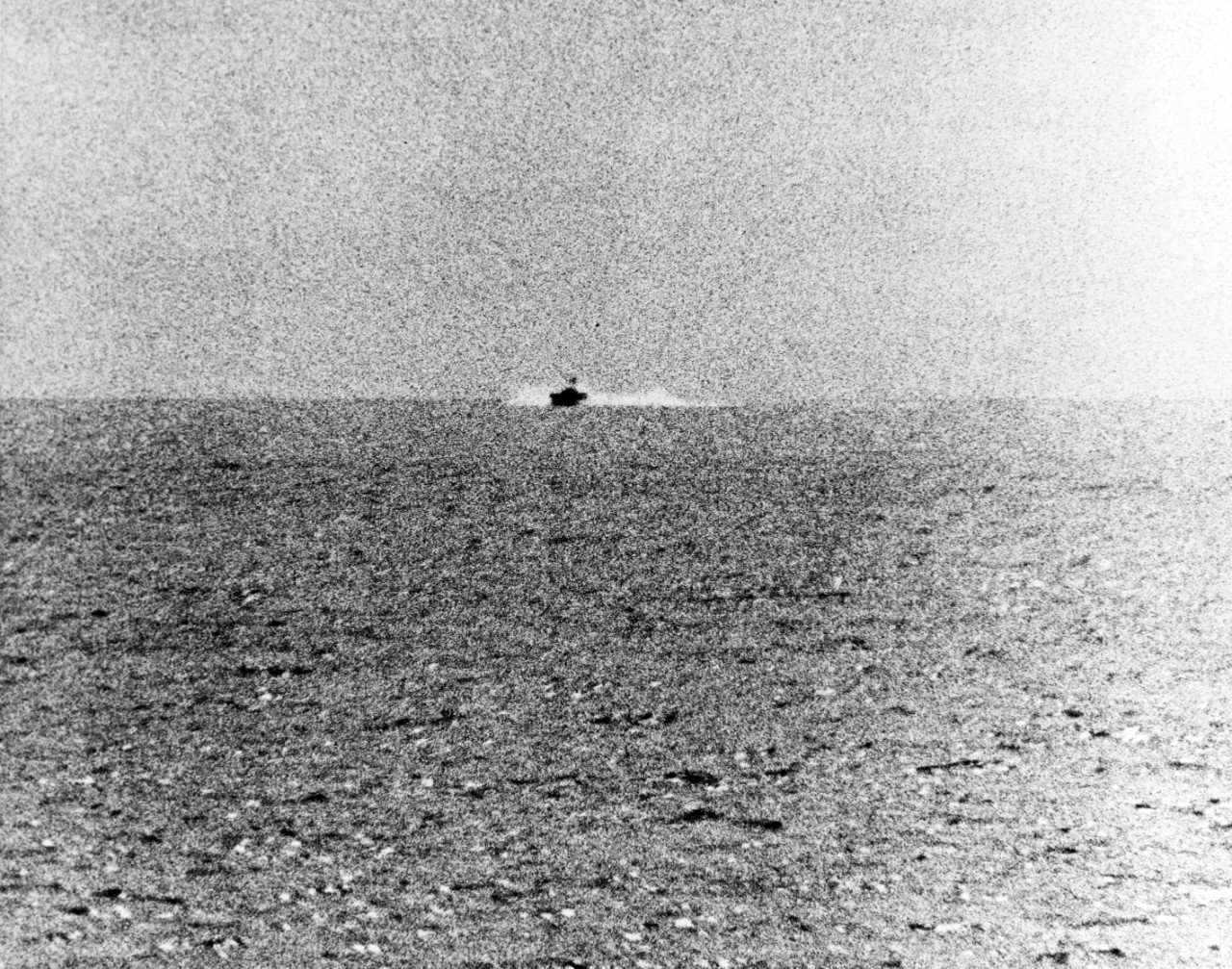
Official U.S. Navy photograph, NHHC catalog USN 711526. U.S. government work / official Navy photograph.USN 711526 Tonkin Gulf Incident, August 1964This image provides visual context. It does not establish cause, identity, date, or interpretation by itself.
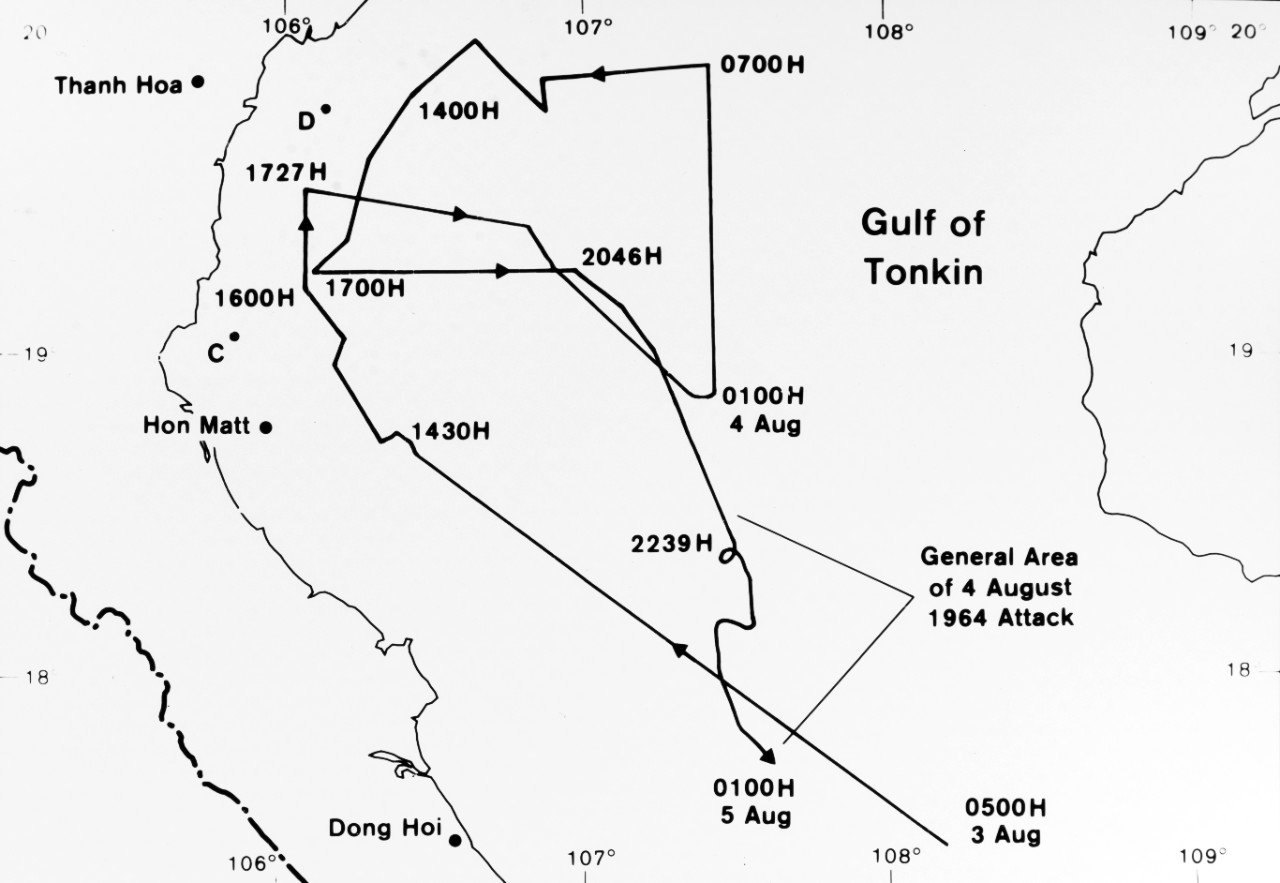
Naval History and Heritage Command photograph NH 96350. U.S. government work / NHHC historical chart.NH 96350 Tonkin Gulf Incident, August 1964This image provides visual context. It does not establish cause, identity, date, or interpretation by itself.
National Archives, Record Group 11. U.S. federal government record.Tonkin Gulf Resolution (1964)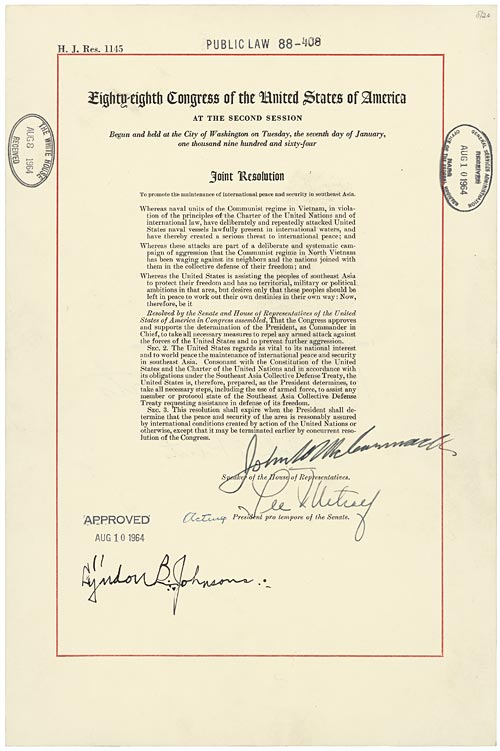
02Visual source
Map the possibilities
Which possibilities survive the pressure?
Give the accepted explanation and its strongest challengers the same hard questions: what fits, what fails, and what is still missing?Competing possibilities
The accepted account and its strongest alternatives.
Inclusion means a possibility is worth testing. It does not mean every possibility currently carries equal evidentiary weight.
Interpretation A - A second attack occurred
North Vietnamese boats attacked Maddox and Turner Joy on August 4, and confused details reflect difficult night combat rather than a nonexistent event.
Current treatment
Strongly challenged. The original attack account survives mainly as a record of what crews and officials believed or claimed, not as the best explanation of what occurred.
Interpretation B - Fog-of-war false alarm
Crews sincerely interpreted ambiguous sensors, weather, wakes, lights, and own-ship effects as hostile action under stress and a strong expectation of another attack.
Current treatment
Leading event-level explanation. It accounts for sincere crew action and the absence of attackers, while leaving the later escalation of certainty to a separate institutional analysis.
Interpretation C - Intelligence failure and confirmation bias
An early attack warning anchored later analysis. Supporting messages were elevated, contrary records were omitted, and translation or association errors created false corroboration.
Current treatment
Strongly supported as a process failure. Confirmation bias and selective intelligence handling are documented; a centrally ordered fabrication is not.
Interpretation D - Materially misleading public narrative
Officials presented a confirmed, repeated, substantially unprovoked attack while minimizing uncertainty and mission context material to Congress and the public.
Current treatment
Strongly supported in effect. The public narrative materially exceeded the evidence; the degree of deliberate deception remains person- and decision-specific.
Possibility map
Stress-test every serious explanation.
Select a possibility to see what would need to be true, what supports it, what weakens it, what is missing, and how seriously the current record allows PARALLAX to treat it.
Primary questionDid North Vietnamese forces attack USS Maddox and USS Turner Joy on August 4, 1964, and how did intelligence processing and official statements shape the case presented to Congress and the public?
Interpretation A - A second attack occurred
What would need to be true
North Vietnamese boats attacked Maddox and Turner Joy on August 4, and confused details reflect difficult night combat rather than a nonexistent event.
What supports it
- Two ships reported multiple apparent radar, sonar, wake, light, and weapons indications.
- Experienced crews and commanders acted as if under sustained torpedo attack.
- Some officers remained convinced after the event.
- False contacts are common in combat and do not automatically negate every contact.
What weakens it
- Supporting aircraft saw no attackers, wakes, impacts, or targets.
- No decisive physical debris, damage, or stable target track confirmed the reported engagement.
- Herrick contemporaneously doubted many contacts and requested complete evaluation.
- The fuller SIGINT record shows no attack preparation or execution.
What evidence is missing
- Authenticated North Vietnamese orders, operational logs, losses, or other direct records of an August 4 attack.
- A coherent physical or sensor reconstruction identifying actual attacking boats.
How PARALLAX treats it now
Strongly challenged. The original attack account survives mainly as a record of what crews and officials believed or claimed, not as the best explanation of what occurred.
Discriminating evidenceOpen the categories that can move the assessment
These links lead to the underlying evidence reviews. Direction is kept separate from importance and is never converted into a score.
High impactAugust 4 visual and physical record
Strongly against second attack
Open 004-BHigh impactRadar, sonar, weather, and perception
Favors false alarm
Open 004-CHigh impactSignals intelligence
Strongly against second attack
Open 004-DHigh impactPublic and congressional narrative
Strongly supports material overstatement
Open 004-EMedium impactAugust 2 engagement
Attack established
Open 004-AMedium impactIntelligence handling
Mixed: supports confirmation bias; intent disputed
Open 004-DThis map does not award points for novelty or authority. Compare serious possibilities, inspect what each one explains, and follow the evidence categories back to their detailed reviews.
Evidence matrix
Current direction by category.
Current direction shows what a category supports, challenges, or leaves unresolved. Evidence impact shows how important that category is to understanding the case, without turning uncertainty into a fake score.
How to read this
Current direction says what the evidence presently supports, challenges, or leaves unresolved. Evidence impact says how important that category is to understanding the case. Impact does not mean support for either side.
Evidence categoryCurrent directionEvidence impactKey limitation / note
Evidence categoryAugust 2 engagement
Read review5 linked sources
Current directionAttack established
Evidence impactMedium impactMeaningfully informs the case but is not decisive alone.
Key limitation / note
Photographs, ship reports, damage, air support, and later records converge on a real first attack.
Evidence categoryAugust 4 visual and physical record
Read review6 linked sources
Current directionStrongly against second attack
Evidence impactHigh impactCentral to the case or capable of materially changing the assessment.
Key limitation / note
No aircraft confirmation, decisive debris, coherent damage, or stable target picture supports the reported multi-boat action.
Evidence categoryRadar, sonar, weather, and perception
Read review5 linked sources
Current directionFavors false alarm
Evidence impactHigh impactCentral to the case or capable of materially changing the assessment.
Key limitation / note
Difficult conditions, acknowledged false contacts, own-ship effects, and attack expectation explain the unstable battle picture.
Evidence categorySignals intelligence
Read review6 linked sources
Current directionStrongly against second attack
Evidence impactHigh impactCentral to the case or capable of materially changing the assessment.
Key limitation / note
The fuller intercept record shows salvage and coastal activity, not attack command-and-control.
Evidence categoryIntelligence handling
Read review6 linked sources
Current directionMixed: supports confirmation bias; intent disputed
Evidence impactMedium impactMeaningfully informs the case but is not decisive alone.
Key limitation / note
Selective summaries and translation problems are documented. Hanyok and Giles disagree about deliberate skewing.
Evidence categoryPublic and congressional narrative
Read review10 linked sources
Current directionStrongly supports material overstatement
Evidence impactHigh impactCentral to the case or capable of materially changing the assessment.
Key limitation / note
Categorical repeated-attack language exceeded the uncertainty and mission context available before the vote.
Evidence categoryCoordinated high-level fabrication
Read review10 linked sources
Current directionNot established
Evidence impactMedium impactMeaningfully informs the case but is not decisive alone.
Key limitation / note
Pre-existing policy planning and selective presentation matter, but the reviewed record does not prove a unified conspiracy to invent the incident.
Evidence reviews
The repeatable review structure for future cases.
Each category separates the core question, established observations, source quality, competing interpretations, assessment, unresolved issues, and sources.
004-A
The August 2 Engagement
Current directionAttack established; context qualifies public framing
Question tested
Did the first engagement occur, and how should its sequence and operational context be described?
Current read
The daylight August 2 attack is directly documented. Maddox fired warning shots before North Vietnamese boats launched torpedoes and machine-gun fire. DESOTO and nearby activity matter to context, not to whether the attack occurred.
Established Observations
- FACTThree North Vietnamese torpedo boats approached USS Maddox in daylight on August 2, 1964.
- FACTMaddox fired three warning shots before sustained fire; the boats then launched torpedoes and fired machine guns.
- FACTCarrier aircraft engaged the boats. Maddox received minor damage and no personnel casualties.
- FACTMaddox was conducting a DESOTO intelligence patrol while U.S.-supported OPLAN 34A raids were occurring in the same theater.
- SUPPORTED INFERENCENorth Vietnamese commanders likely interpreted the U.S. destroyer inside a larger hostile operational context, even though DESOTO and OPLAN 34A had separate commands.
Evidence Quality
Strong. Contemporaneous ship reports, photographs, damage, air support, official documentary records, and later North Vietnamese evidence converge on a real engagement.
Accepted / Conventional Reading
- August 2 was a real torpedo-boat attack on a U.S. destroyer in international waters.
- The warning shots and mission context do not negate the subsequent attack.
Challenge / Alternative Reading
- The event was publicly described too cleanly as wholly unprovoked and unrelated to nearby hostile operations.
- North Vietnam had operational reasons to associate Maddox with U.S.-supported pressure along its coast.
PARALLAX Current Read
AUGUST 2 ATTACK ESTABLISHED; PUBLIC CONTEXT WAS INCOMPLETE
004-B
The August 4 Operational Record
Current directionStrongly favors no second attack
Question tested
Do the ship, aircraft, physical, and communications records establish a second North Vietnamese attack?
Current read
The ships experienced a real battle alarm and reported many apparent contacts, but the evidence does not converge on actual attackers. Aircraft saw none, no decisive physical trace was found, Herrick quickly expressed doubt, and the later reconstruction shows no attack activity.
Established Observations
- FACTMaddox and Turner Joy reported multiple apparent radar, sonar, wake, light, and torpedo indications and fired during a prolonged action.
- FACTThe night was dark, moonless, overcast, and affected by thunderstorms and difficult sea conditions.
- FACTCaptain Herrick said many contacts and torpedo reports appeared doubtful, cited weather and overeager sonar interpretation, reported no visual sightings from Maddox, and requested complete evaluation.
- FACTSupporting aircraft did not visually identify attacking boats, torpedo wakes, impacts, or other targets.
- FACTNo enemy wreckage or decisive physical evidence was recovered from the alleged engagement.
- SUPPORTED INFERENCEThe absence of convergent visual, physical, tracking, and communications evidence is strongly inconsistent with the large multi-boat engagement reported in real time.
Evidence Quality
Strong overall. Direct ship reports are rich but vulnerable to shared operational error; aircraft observation, contemporaneous doubt messages, full , and later official reassessment provide independent checks.
Accepted / Conventional Reading
- Experienced crews reported several forms of apparent evidence under combat conditions, and some commanders remained convinced that at least part of the attack was real.
- False contacts and confusion are common in battle and need not invalidate every observation.
Challenge / Alternative Reading
- The ships constructed a false battle picture from ambiguous signals, expectation, weather, own-ship effects, and shared feedback.
- A real attack of the reported scale should have produced independent visual, physical, and North Vietnamese communications evidence that is absent.
PARALLAX Current Read
THE AVAILABLE EVIDENCE STRONGLY FAVORS THAT NO NORTH VIETNAMESE ATTACK OCCURRED ON AUGUST 4
004-C
Radar, Sonar, Weather, And Perception
Current directionStrongly supports fog-of-war false alarm
Question tested
Can the reported contacts be explained without attacking boats?
Current read
Known environmental and human factors predict the observed pattern: many ambiguous signals, escalating alarm, unstable contacts, and no independent target confirmation.
Established Observations
- FACTThe ships maneuvered at high speed and changed course repeatedly during difficult night weather.
- FACTSonar reports included numerous apparent torpedoes, some later judged false.
- FACTHerrick identified weather effects and overeager sonar interpretation as possible explanations within hours.
- SUPPORTED INFERENCEThe recent August 2 attack and a new attack warning primed crews to interpret ambiguity as hostile action.
- UNKNOWNThe exact physical cause of every reported return, wake, light, and sound cannot now be reconstructed.
Evidence Quality
Strong for the documented conditions and operator doubts; moderate for reconstructing the exact cause of every transient contact decades later.
Accepted / Conventional Reading
- The number and variety of reports make a wholly false engagement difficult to accept.
- At least one genuine contact could be hidden among acknowledged false returns.
Challenge / Alternative Reading
- Expectation, storm effects, high-speed maneuvering, own-ship noise, wakes, and feedback among operators can create many correlated reports without an attacker.
- The failure of different evidence classes to converge is a signature of misperception rather than combat.
PARALLAX Current Read
SENSOR AMBIGUITY AND EXPECTATION STRONGLY SUPPORT THE FALSE-ALARM INTERPRETATION
004-D
Signals Intelligence
Current directionStrongly against attack; handling intent disputed
Question tested
Did independently confirm an August 4 attack, and how was the record handled?
Current read
The full record does not show attack preparation or execution. It shows salvage and coastal activity. Supporting messages were elevated while contrary material was omitted or obscured; whether that pattern was deliberately skewed remains contested.
Established Observations
- FACTAn early field interpretation warned that North Vietnamese naval forces might attack the DESOTO patrol.
- FACTLater translated messages were treated as post-action confirmation and became central to the attack case.
- FACTHanyok reconstructed a substantially larger record than the small set used in 1964 summaries.
- FACTThe fuller record shows salvage of boats damaged on August 2 and coastal tracking, not the command-and-control pattern of an August 4 attack.
- FACTHanyok identified contrary products omitted from summaries, translation changes, and unrelated messages joined into apparent confirmation.
- DISPUTEDHanyok concluded that the pattern was a conscious effort to support the Navy attack claim, while explicitly rejecting a top-to-bottom conspiracy or manufactured evidence.
- DISPUTEDGiles agreed that no attack occurred but disputed deliberate withholding and emphasized dissemination practice and analytic error.
Evidence Quality
Strong for the no-attack reconstruction because it uses a broad declassified record. Mixed on intent because Hanyok and Giles interpret the handling and distribution differently.
Accepted / Conventional Reading
- Early analysts made serious but understandable mistakes under time pressure and distributed what they believed mattered.
- Institutional dissemination limits, not deliberate suppression, explain much of the incomplete picture.
Challenge / Alternative Reading
- The omission pattern, translation changes, and message combination were too systematic to be accidental and served a preferred attack conclusion.
- The distortion occurred inside portions of intelligence handling without requiring direction from the White House or collusion at every level.
PARALLAX Current Read
SIGINT DOES NOT SUPPORT AN AUGUST 4 ATTACK; SEVERE CONFIRMATION BIAS IS ESTABLISHED MORE FIRMLY THAN DELIBERATE INTENT
004-E
Public Statements, Congress, And The Resolution
Current directionSupports material overstatement and omission
Question tested
Did officials communicate the uncertainty and operational context accurately enough for public and congressional judgment?
Current read
The public case described a confirmed, repeated, substantially unprovoked attack. The private record already contained important doubt, and the mission context was presented too categorically. The effect was even though uniform deceptive intent is not established.
Established Observations
- FACTJohnson told the nation that the initial attack had been repeated and that hostile vessels attacked with torpedoes.
- FACTDefense Department public material defended the second attack as fact while treating uncertainty as limited to details.
- FACTThe resolution stated that U.S. ships had been deliberately and repeatedly attacked and authorized all necessary measures.
- FACTOfficials had Herrick doubts and conflicting evidence before the retaliatory strike and public address.
- FACTOfficials presented the Navy patrol as routine and categorically separate from South Vietnamese attacks; later records show intelligence collection, U.S. support for OPLAN 34A, and loose coordination.
- FACTCongressional-resolution themes and broader pressure against North Vietnam were under discussion before the August incidents.
- SUPPORTED INFERENCEThe incidents provided a politically powerful occasion for a policy option already being developed.
- UNKNOWNThe congressional vote under a fuller presentation of uncertainty and mission context cannot be known.
Evidence Quality
Strong. The exact speech, public statements, resolution text, hearings, and internal chronology can be compared directly.
Accepted / Conventional Reading
- Officials reasonably relied on command and intelligence confirmation during a fast crisis and communicated the conclusion they believed.
- Operational details and covert-program context could not all be disclosed publicly in real time.
Challenge / Alternative Reading
- The administration converted disputed reports into categorical fact and omitted context material to whether the attacks were repeated and unprovoked.
- The resolution embedded the inaccurate repeated-attack claim while granting broad authority.
PARALLAX Current Read
CONGRESS AND THE PUBLIC RECEIVED A MATERIALLY OVERCONFIDENT AND CONTEXTUALLY INCOMPLETE ACCOUNT
Video Context
These clips are included to clarify how a claim is presented or explained. They are not substitutes for the source trail.
President Johnson report on the Gulf of Tonkin incident
The original televised address lets the reader inspect the certainty, repeated-attack framing, and announced response directly.
This is primary evidence of public presentation, not independent proof that the second attack occurred. The LBJ Library lists CBS rights restrictions for reuse beyond research viewing.
President Johnson Vietnam Address, August 4, 1964, MP498
004-F
Declassification And Later Reassessment
Current directionReverses the original August 4 assessment
Question tested
How did later releases change the evidentiary picture?
Current read
Hearings, , the Pentagon Papers, NSA releases, and later official histories exposed the operational doubts, fuller intelligence record, policy context, and gap between private uncertainty and public certainty.
Established Observations
- FACTThe 1968 Senate hearings exposed Herrick doubts, warning shots, mission-context disputes, and captured North Vietnamese testimony denying an August 4 attack.
- FACTThe Pentagon Papers and FRUS documented pre-incident policy planning, mixed attack evidence, and internal decision-making.
- FACTNSA releases made the larger SIGINT record and competing internal analyses available.
- FACTLater official Navy, Joint Chiefs, and Defense histories generally assess that no second attack occurred.
- FACTThe OSD history found no evidence that the administration manufactured the incident while concluding that no second attack occurred.
Evidence Quality
Strong for documentary reassessment because the later record adds primary messages and intercepts unavailable to the public in 1964. Retrospective institutional interpretation still requires source-specific scrutiny.
Accepted / Conventional Reading
- Later access corrected an honest crisis-time mistake and shows institutions revising their own record.
- The lack of proof of a coordinated fabrication should constrain claims about senior-level conspiracy.
Challenge / Alternative Reading
- Declassification shows that the public certainty was never justified by the full internal record.
- The long delay in releasing the decisive SIGINT record allowed the original narrative to shape policy and memory for decades.
PARALLAX Current Read
DECLASSIFICATION REVERSED THE AUGUST 4 FACTUAL ASSESSMENT AND EXPOSED THE GAP BETWEEN PRIVATE UNCERTAINTY AND PUBLIC CERTAINTY
03Visual source
Name what remains
What still does not sit right?
Keep the stubborn gaps visible. Then state what the record can presently carry without pretending suspicion is proof or authority is closure.Open questions / What still does not sit right
The unanswered questions that matter.
- Can every surviving August 4 ship message be synchronized using transmission, receipt, and local times?
- Which SIGINT products reached the White House, Defense Department, Joint Chiefs, NSA leadership, and field commands before the strike order?
- Are there unreleased or insufficiently cataloged radar plots, sonar logs, deck logs, or watch notes that change a specific contact?
- What did individual senior officials believe at each decision point, and which sources informed that belief?
- Which translation changes were procedural, analytic, or intentional?
- How did the 1964 dissemination system affect whether contrary intelligence reached non-NSA decision-makers?
- What uncertainty and operational context did members of Congress receive in nonpublic briefings?
- How should responsibility be apportioned among operational error, intelligence processing, policy urgency, and public communication?
What would change the picture
Evidence must be allowed to move the assessment.
- Authenticated North Vietnamese operational records documenting an August 4 attack order, execution, or loss would materially weaken the no-attack assessment.
- Contemporaneous imagery or physical evidence securely tied to attacking boats that night would materially change the factual finding.
- A coherent contact reconstruction with independently confirmed targets that cannot be explained by weather or own-ship effects would strengthen H1.
- Reliable intercepts showing attack command-and-control rather than salvage or coastal tracking would reopen the SIGINT assessment.
- Complete distribution logs showing which contradictory products reached each decision office would refine the institutional finding.
- Contemporaneous senior-official notes establishing what was privately believed before the speech and vote would clarify intent without relying on hindsight.
- Unredacted translation records showing why messages were combined or altered would help resolve the Hanyok-Giles dispute.
Why this case matters
Why this conflict deserves scrutiny.
Operational reports can be sincere and wrong
Confidence, training, and official status cannot replace converging evidence. People can act rationally on a false picture when conditions and expectations align.
Intelligence is a process
Intercepts require collection, translation, association, timing, and interpretation. Selection and framing can make an uncertain archive appear conclusive.
Public certainty has policy consequences
Reported, probable, and confirmed are not interchangeable when Congress is asked to grant broad military authority.
Correction is part of the record
Government archives preserve the original mistaken claims and much of the evidence that later corrected them. Revision improves the record; it does not make every source permanently worthless.
What the evidence currently suggests
Where the record points - v0.1.2
PARALLAX does not require the reader to adopt a conclusion.
The August 2 attack is established. The combined operational, visual, physical, and signals-intelligence record strongly supports that no North Vietnamese attack occurred on August 4, 1964.
The immediate false battle report is best explained by attack expectation, difficult conditions, ambiguous sensors, own-ship effects, human perception, and confirmation feedback. This does not require incompetence or bad faith from the crews.
The later intelligence record shows serious confirmation bias and selective presentation. Hanyok's source-grounded conclusion of deliberate skewing is important but disputed by Giles on intent and distribution. The no-attack finding is much firmer than any single motive explanation.
Congress and the public received a confirmed, repeated, substantially unprovoked attack narrative that the underlying record did not justify. The account was materially misleading in effect. The reviewed evidence does not establish that all principal officials knowingly participated in a coordinated fabrication.
The case remains open to authenticated North Vietnamese operational records, new physical or sensor evidence, complete intelligence-distribution logs, and contemporaneous records clarifying what decision-makers knew.
04Visual source
Inspect the record
Follow the evidence back to its sources.
Trace the sources, shared foundations, definitions, corrections, and revision history behind the public assessment.Source record
Inspect the material.
- Official recordtonkin-nsa-collection
Gulf of Tonkin Declassification and Transparency Collection
Official recordInstitutional record; weight depends on evidence, method, provenance, corroboration, and limits.- Provenance
- NSA FOIA and historical-release portal containing declassified agency records and authored institutional analyses.
- Directness
- Collection-level gateway to primary and technical materials used throughout INV-004.
- Limit
- The collection mixes direct records with retrospective analysis. NSA states that authors opinions do not necessarily represent an official agency position.
Official collection of released histories, chronologies, memoranda, translations, SIGINT reports, and internal responses concerning the August 1964 incidents.
- Technical / scientific analysistonkin-hanyok
Skunks, Bogies, Silent Hounds, and the Flying Fish: The Gulf of Tonkin Mystery, 2-4 August 1964
Technical sourceScientific, engineering, forensic, or specialist analysis; weight follows method and reproducibility.- Method
- Compares 122 relevant SIGINT products, watch-center notes, oral histories, translations, and military command records.
- Corroboration
- Its no-attack conclusion is consistent with later official Navy and Defense histories and with the operational record.
- Limit
- The author states that his views are not necessarily the official NSA position. His conclusion that the skewing was deliberate is disputed by Louis Giles.
Detailed reconstruction of the full signals-intelligence record. Concludes that no August 4 attack occurred and that supporting SIGINT was selectively presented.
- Technical / scientific analysistonkin-giles
Thoughts on Intelligence Related to the Gulf of Tonkin Mystery: The SIGINT Hounds Were Howling
Technical sourceScientific, engineering, forensic, or specialist analysis; weight follows method and reproducibility.- Directness
- Participant-adjacent institutional critique focused on SIGINT analysis and dissemination.
- Limit
- Short retrospective response by a former official from the institution whose performance is under review.
Former NSA official response agreeing that the August 4 attack did not occur while disputing Hanyok on deliberate withholding and skewing.
- Technical / scientific analysistonkin-hanyok-response
A Response to Mr. Giles
Technical sourceScientific, engineering, forensic, or specialist analysis; weight follows method and reproducibility.- Limit
- A rebuttal in an unresolved intent dispute; it does not identify a single directive ordering analysts to fabricate evidence.
Rebuttal identifying selective omission, translation changes, and message combination as the basis for Hanyok conclusion that skewing was deliberate.
- Primary evidencetonkin-nsa-calls
Transcript of Command and Intelligence Calls, 4-5 August 1964
Primary evidenceDirect material, dataset, exhibit, transcript, or record; directness does not remove context checks.- Provenance
- Declassified NSA memorandum and transcript.
- Limit
- A transcript of selected communications, not a complete record of every call or decision input.
Contemporaneous call transcript showing the evolving intelligence and command picture during the alleged second incident.
- Official recordtonkin-frus-volume
Foreign Relations of the United States, 1964-1968, Volume I, Vietnam, 1964
Official recordInstitutional record; weight depends on evidence, method, provenance, corroboration, and limits.- Method
- Curated primary-document edition prepared under the FRUS historical-documentation standard.
- Limit
- Selection is documentary rather than exhaustive, and some records contain redactions.
Official documentary edition covering policy planning, the August incidents, retaliatory decisions, and the Gulf of Tonkin Resolution.
- Primary evidencetonkin-frus-255
FRUS Document 255: August 2 Gulf of Tonkin Reporting
Primary evidenceDirect material, dataset, exhibit, transcript, or record; directness does not remove context checks.- Limit
- Compressed reporting created during or shortly after an active engagement.
Contemporaneous reporting on the approach and attack by North Vietnamese torpedo boats on August 2.
- Official recordtonkin-frus-276
FRUS Document 276: August 4 Decision Chronology
Official recordInstitutional record; weight depends on evidence, method, provenance, corroboration, and limits.- Directness
- Official editorial chronology quoting and citing contemporaneous messages and meeting records.
- Limit
- A later editorial reconstruction rather than one self-contained contemporaneous document.
Documents Herrick doubt message, internal confusion, efforts to marshal a convincing attack case, and the retaliatory-strike timeline.
- Primary evidencetonkin-frus-278
FRUS Document 278: National Security Council Meeting, August 4, 1964
Primary evidenceDirect material, dataset, exhibit, transcript, or record; directness does not remove context checks.- Limit
- Meeting summary rather than a verbatim transcript.
Contemporaneous summary of senior-level discussion, including the attack interpretation and draft resolution context.
- Primary evidencetonkin-frus-214
FRUS Document 214: Southeast Asia Resolution Planning, June 1964
Primary evidenceDirect material, dataset, exhibit, transcript, or record; directness does not remove context checks.- Limit
- Shows prior policy planning; it does not by itself prove that later incident reporting was fabricated.
Pre-incident planning record showing that congressional-resolution themes and escalation options were under discussion before August.
- Primary evidencetonkin-maddox-reports
USS Maddox Reports for the Tonkin Gulf Incidents, 2-4 August 1964
Primary evidenceDirect material, dataset, exhibit, transcript, or record; directness does not remove context checks.- Directness
- Firsthand operational reporting from the principal U.S. ship.
- Limit
- Action reports preserve crew and command interpretation; their directness does not remove fog-of-war error.
Ship action reports and related records for the daylight August 2 engagement and the alleged August 4 attack.
- Primary evidencetonkin-maddox-aug4
USS Maddox Report of Tonkin Gulf Action of 4 August 1964
Primary evidenceDirect material, dataset, exhibit, transcript, or record; directness does not remove context checks.- Limit
- Written inside the initial attack framework and acknowledges that numerous sonar indications were false.
Detailed Maddox action report describing darkness, thunderstorms, radar and sonar contacts, maneuver, and weapons fire.
- Primary evidencetonkin-turner-joy
USS Turner Joy Action Report for the Gulf of Tonkin, 4 August 1964
Primary evidenceDirect material, dataset, exhibit, transcript, or record; directness does not remove context checks.- Limit
- Operationally direct but not fully independent: both ships shared the same warning, environment, command picture, and feedback loop.
Turner Joy report describing radar, visual, wake, light, and weapons observations during the alleged attack.
- Archival materialtonkin-public-info
Publicly Released Information on the Tonkin Gulf Crisis
Archival recordHistorical or FOIA/source-file material; relevance depends on provenance, completeness, and context.- Directness
- Primary record of the official public case.
- Limit
- Useful for what officials said publicly, not as independent confirmation that the second attack occurred.
Contemporary Defense Department chronologies and public statements defending the first and second attack claims.
- Primary evidencetonkin-lbj-address
President Johnson Report on the Gulf of Tonkin Incident
Primary evidenceDirect material, dataset, exhibit, transcript, or record; directness does not remove context checks.- Provenance
- LBJ Library video MP498, donated by CBS.
- Limit
- Primary evidence of public framing, not independent evidence that an attack occurred. The Library notes CBS use and publication restrictions.
Original televised address stating that the initial attack had been repeated and announcing retaliatory action.
- Eyewitness / testimonytonkin-lbj-committee
Transcript of August 6, 1964 Executive Branch Testimony on the Southeast Asia Resolution
Witness recordFirsthand or witness-adjacent material; important even when mediation and memory limits remain.- Limit
- Official advocacy for the proposed resolution; later testimony and records qualified the categorical separation presented in 1964.
Contemporaneous testimony describing the Navy patrol as separate from and unaware of South Vietnamese attacks.
- Primary evidencetonkin-nara-resolution
Tonkin Gulf Resolution (1964)
Primary evidenceDirect material, dataset, exhibit, transcript, or record; directness does not remove context checks.- Limit
- The enacted text establishes what Congress authorized, not whether the factual premise was accurate.
Resolution image, transcript, vote context, and later historical note. The preamble states that U.S. ships were deliberately and repeatedly attacked.
- Primary evidencetonkin-govinfo-law
Public Law 88-408, 78 Stat. 384
Primary evidenceDirect material, dataset, exhibit, transcript, or record; directness does not remove context checks.- Limit
- Legal text records the authorization and stated premise; it is not a factual investigation of the naval incident.
Authoritative enacted text of the Gulf of Tonkin Resolution.
- Eyewitness / testimonytonkin-1968-hearings
Gulf of Tonkin: The 1964 Incidents, Senate Foreign Relations Committee Hearings
Witness recordFirsthand or witness-adjacent material; important even when mediation and memory limits remain.- Method
- Public congressional examination of officials and documentary exhibits nearly four years after the incidents.
- Limit
- Retrospective testimony occurred inside a major political dispute and should be checked against contemporaneous exhibits.
Hearings and exhibits covering warning shots, Herrick doubts, DESOTO and OPLAN 34A, captured North Vietnamese testimony, and the attack claim.
- Official recordtonkin-jcs-council
Council of War: A History of the Joint Chiefs of Staff
Official recordInstitutional record; weight depends on evidence, method, provenance, corroboration, and limits.- Limit
- Retrospective institutional synthesis rather than raw evidence.
Institutional history addressing the separate but loosely coordinated DESOTO and OPLAN 34A operations and the later no-attack assessment.
- Official recordtonkin-osd-history
History of the Office of the Secretary of Defense, Volume V: The McNamara Ascendancy, 1961-1965
Official recordInstitutional record; weight depends on evidence, method, provenance, corroboration, and limits.- Limit
- Retrospective institutional history. Its rejection of a manufactured incident does not resolve what every official knew at every point.
Later official history concluding that no second attack occurred while finding no evidence that the administration manufactured the incident.
- Archival materialtonkin-pentagon-papers
The Pentagon Papers
Archival recordHistorical or FOIA/source-file material; relevance depends on provenance, completeness, and context.- Limit
- Large retrospective study. Specific claims should be traced to underlying documents where possible.
Official archival collection of the Defense Department history of U.S. decision-making in Vietnam, including escalation context.
Source relationships
Where the argument shares a foundation.
This view identifies records reused across observations, evidence reviews, or other PARALLAX investigations. It prevents citation volume from being mistaken for independent confirmation.
Repeated citation is not independent corroboration.
A record is counted once even when several sections rely on it. This audit shows the sources carrying more than one part of the public argument.
Skunks, Bogies, Silent Hounds, and the Flying Fish: The Gulf of Tonkin Mystery, 2-4 August 1964
Technical / scientific analysis
- Review reuse
- 4 evidence reviews
- Observation reuse
- 10 established observations
- Cross-case reuse
- 0 other investigations
FRUS Document 276: August 4 Decision Chronology
Official record
- Review reuse
- 5 evidence reviews
- Observation reuse
- 6 established observations
- Cross-case reuse
- 0 other investigations
Gulf of Tonkin: The 1964 Incidents, Senate Foreign Relations Committee Hearings
Eyewitness / testimony
- Review reuse
- 4 evidence reviews
- Observation reuse
- 7 established observations
- Cross-case reuse
- 0 other investigations
USS Maddox Report of Tonkin Gulf Action of 4 August 1964
Primary evidence
- Review reuse
- 2 evidence reviews
- Observation reuse
- 7 established observations
- Cross-case reuse
- 0 other investigations
USS Turner Joy Action Report for the Gulf of Tonkin, 4 August 1964
Primary evidence
- Review reuse
- 2 evidence reviews
- Observation reuse
- 5 established observations
- Cross-case reuse
- 0 other investigations
Council of War: A History of the Joint Chiefs of Staff
Official record
- Review reuse
- 3 evidence reviews
- Observation reuse
- 4 established observations
- Cross-case reuse
- 0 other investigations
History of the Office of the Secretary of Defense, Volume V: The McNamara Ascendancy, 1961-1965
Official record
- Review reuse
- 3 evidence reviews
- Observation reuse
- 3 established observations
- Cross-case reuse
- 0 other investigations
A Response to Mr. Giles
Technical / scientific analysis
- Review reuse
- 2 evidence reviews
- Observation reuse
- 3 established observations
- Cross-case reuse
- 0 other investigations
Gulf of Tonkin Declassification and Transparency Collection
Official record
- Review reuse
- 2 evidence reviews
- Observation reuse
- 2 established observations
- Cross-case reuse
- 0 other investigations
Thoughts on Intelligence Related to the Gulf of Tonkin Mystery: The SIGINT Hounds Were Howling
Technical / scientific analysis
- Review reuse
- 2 evidence reviews
- Observation reuse
- 2 established observations
- Cross-case reuse
- 0 other investigations
Transcript of Command and Intelligence Calls, 4-5 August 1964
Primary evidence
- Review reuse
- 2 evidence reviews
- Observation reuse
- 2 established observations
- Cross-case reuse
- 0 other investigations
USS Maddox Reports for the Tonkin Gulf Incidents, 2-4 August 1964
Primary evidence
- Review reuse
- 1 evidence reviews
- Observation reuse
- 3 established observations
- Cross-case reuse
- 0 other investigations
Appears in004-A The August 2 Engagement
Glossary
Plain-English terms for this case.
Definitions focus on words that materially affect how the evidence is understood.
C3I
Command, control, communications, and intelligence: the message and direction pattern expected when military units plan and execute an operation.
The reconstructed North Vietnamese record lacks the expected C3I pattern for an August 4 attack.
Related evidence
COMINT
Communications intelligence, a subset of SIGINT focused on intercepted communications.
Related evidence
confirmation bias
The tendency to favor information that supports an existing expectation and discount conflicting information.
An attack warning and the August 2 engagement shaped how later ambiguous signals were interpreted.
DESOTO patrolDeSoto patrol
A U.S. Navy signals-intelligence patrol conducted by destroyers near foreign coastlines.
Maddox was collecting intelligence off North Vietnam during the August incidents.
fog of war
The uncertainty, delay, ambiguity, and error that affect perception and decisions during military operations.
FRUS
Foreign Relations of the United States, the State Department official documentary history of U.S. foreign policy.
Gulf of Tonkin Resolution
Public Law 88-408, enacted in August 1964, authorizing the President to take broad military measures in Southeast Asia.
Related evidence
materially misleading
Incomplete, overstated, or inaccurate in a way that could matter to a reasonable decision-maker. It describes effect and does not by itself prove intent.
Related evidence
OPLAN 34A34A
A covert program of U.S.-supported South Vietnamese operations against North Vietnam, including maritime coastal raids.
It was distinct from DESOTO command, but both operated in the same theater with loose coordination.
radar contact
A detected radar return interpreted as an object or target; a contact is not automatically an identified vessel.
SIGINT
Signals intelligence: information derived from intercepted communications or electronic signals.
SIGINT was initially presented as attack confirmation, but the fuller record points to salvage and coastal activity.
Related evidence
sonar contact
An acoustic detection interpreted as an underwater object, wake, or torpedo. Environmental and own-ship effects can create false contacts.
Challenge tools
PARALLAX can be challenged.
Challenges are evaluated by evidentiary quality, not ideological alignment.
Revision history
Important changes remain traceable.
Updated the NH 96350 gallery credit to the working Navy catalog URL.
September 3, 2026
- Replaced an obsolete Naval History and Heritage Command image path with its current canonical record.
- Made no change to the evidence assessment or case conclusion.
Reframed the case around the public war narrative and the possibilities beneath it.
September 1, 2026
- Added the story presented to Congress and the strongest reasons it failed evidentiary review.
- Added possibility-specific missing evidence and current treatment.
- Preserved the no-second-attack assessment and the distinction between error, selective handling, and coordinated fabrication.
Initial state-of-evidence report for the Gulf of Tonkin second attack question.
August 30, 2026
- Opened INV-004 under the PARALLAX Investigation Protocol.
- Separated the August 4 factual question from the intelligence and public-presentation questions.
- Added six evidence reviews, four non-exclusive interpretations, and explicit strongest-case and weakness sections.
- Added source-provenance and limitation metadata, glossary terms, a case timeline, and change criteria.
- Added official Navy and National Archives gallery material and the original LBJ address as primary public-record media.
- Published the current no-second-attack assessment while distinguishing material public overstatement from an unestablished high-level conspiracy.